
 CelebYachts reportThe Fleet
The geography of the Support and explorer cohort
AIS tracks separate the sixteen registered hulls into three distinct operational profiles, disproving the idea that the classification implies a shared…
By On the record · Sep 2, 2026 · Data from CelebYachts1
A vessel’s position is the boat’s, not the owner’s. Ownership is as reported, not certified.
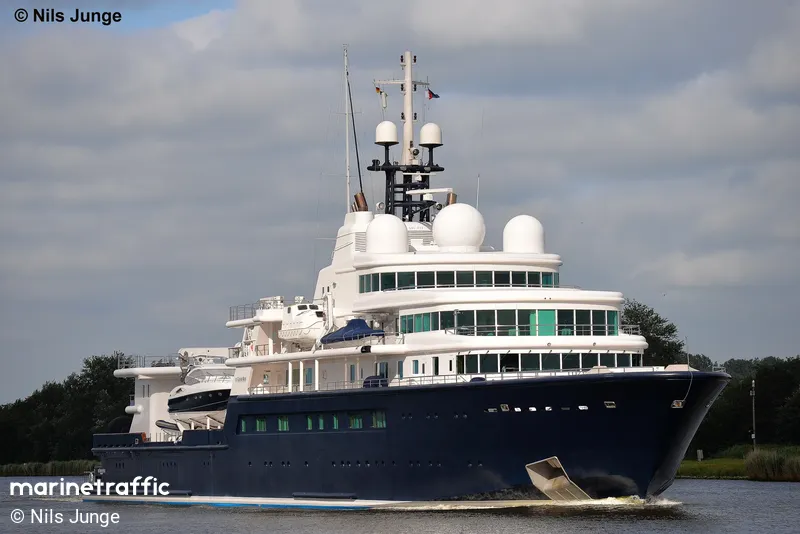
The registry groups a hundred-and-eight-metre Caribbean cruiser, a forty-six-metre Singaporean tender, and a seventy-seven-metre Arctic runner under one heading. The broadcast data does not show a unified fleet. It shows three separate patterns of movement, separated by latitude and purpose.
The cohort contains sixteen tracked hulls. Their lengths range from 45.6 metres to 108.3 metres. Their owners span four continents. The register places them under a single administrative label, but the AIS archive divides them into three non-overlapping categories. Eight vessels have logged passages exceeding 300 nautical miles. Seven vessels have remained within 50 nautical miles of a single port. One vessel operates in the Indian Ocean. The classification describes hull geometry and intended market, not navigation. The financial origins of the owners' wealth are not published in the register. The data records only the current titleholders and their positions.
The high-latitude runners
La Datcha and Sherpa are the only two vessels in the cohort operating outside temperate waters. La Datcha, a 76.98-metre yacht owned by Oleg Tinkov, spent the first week of August navigating the Greenland Sea. The broadcast records show four separate legs originating from or terminating at Longyearbyen. Passage 301 covered 69.1 nautical miles outward on 1 August. Passage 377 added 118.5 nautical miles on 2 August, reaching a point 79 nautical miles off the coast. Passage 449 brought the vessel back 112.6 nautical miles on 3 August. Passage 513 completed the circuit with a final 21.7 nautical miles on 4 August. The total distance logged around Svalbard was 321.9 nautical miles. The timestamps indicate continuous operation across four consecutive days. The intervals between broadcasts are consistently spaced at twenty-four hours, indicating a scheduled patrol rhythm rather than opportunistic cruising. The vessel returned to the same anchorage, suggesting a survey or supply run rather than a through-passage.

Sherpa, a 71.2-metre vessel owned by Jim Ratcliffe, operated on a similar schedule but on the opposite side of the Atlantic. The archives record four passages off the East Coast of Canada between 30 July and 2 August. Passage 145 started and ended at Corner Brook over 23.1 nautical miles. Passage 316 repeated the pattern at Saint-Anthony, covering 106.3 nautical miles on 2 August. Passage 381 logged 372.4 nautical miles later that same evening, indicating a long offshore leg. Passage 517 recorded a final 26.2 nautical miles on 4 August. Sherpa covered 528 nautical miles in total. The distances match the operational profile of a research or expedition vessel conducting transects rather than a leisure craft making a seasonal transit. Both La Datcha and Sherpa demonstrate that the explorer designation correlates with high-latitude endurance, but their tracks diverge completely after leaving the Mediterranean basin.
The inter-basin network
The middle cluster consists of vessels that treat the Mediterranean as a connected system of basins rather than a single destination. Cloudbreak, a 72.25-metre yacht owned by Aleksandr Svetakov, executed the longest single movement in the cohort. Passage 104 carried the vessel 578.3 nautical miles from Dubrovnik to Paros on 29 July, passing 38 nautical miles off Kos before reaching Rhodes on passage 241, which added 96.8 nautical miles on 31 July. The total displacement for Cloudbreak was 675.1 nautical miles. Cloudbreak's route traverses three distinct maritime boundaries. The initial leg departs the northern Adriatic at Dubrovnik, cuts across the Ionian Sea past Kos, and enters the Aegean via Rhodes before terminating at Paros. The 578.3-nautical-mile segment represents a direct eastward transit across open water. The subsequent 96.8-nautical-mile hop confirms the vessel maintained speed through the Dodecanese archipelago. Intrepid, a 67.15-metre vessel owned by Eric Smidt, covered 300.4 nautical miles from La Maddalena to Béziers on 29 July, crossing the Ligurian and Provençal basins in a single recorded leg. These passages cover distances that typically require forty-eight to seventy-two hours of continuous engine operation at service speed.
The remaining vessels in this cluster operate on shorter, repetitive routes. Wayfinder, a 68.2-metre yacht owned by Bill Gates, made three hops along the French Riviera between 28 July and 5 August. Passage 37 ran 30.3 nautical miles from Saint-Tropez to Antibes. Passage 274 covered 29.4 nautical miles from Nice to Saint-Tropez on 1 August. Passage 556 added 32.7 nautical miles from Saint-Tropez to Cagnes-sur-Mer on 5 August. Wayfinder logged 92.4 nautical miles in total, staying entirely within the Ligurean Sea. Anawa, a 62.0-metre vessel owned by Jorge Paulo Lemann, restricted its movements to the Strait of Sicily. Four passages between 30 July and 4 August moved the yacht 99.6 nautical miles between Catania and Siracusa. Gene Chaser, a 55.5-metre yacht owned by Jonathan Rothberg, ran 61.0 nautical miles from 39 nautical miles off Mostar to Split on 1 August. These tracks show vessels utilising established winterisation or summering routes, moving between protected anchorages rather than attempting open-water crossings.
The static anchors
The final group comprises seven hulls that have shown negligible displacement in the current tracking window. Le Grand Bleu, a 108.3-metre yacht owned by Eugene Shvidler, holds position in the Caribbean Sea. Olivia O, an 88.5-metre vessel owned by Eyal Ofer, sits in the Tyrrhenian Sea. Game Changer, a 69.2-metre yacht owned by Karen Lo, is recorded in the Rotterdam Area. Sputnik, a 60.0-metre vessel owned by Oleg Deripaska, remains in the East Mediterranean. Charley, a 46.0-metre yacht owned by Goh Cheng Liang, is positioned in the Singapore Area. None of these vessels appear in the passages table. Their absence from the movement log indicates either prolonged anchoring, engine shutdowns that disable AIS transmission, or operations confined to harbour limits. The static group occupies widely separated coordinates. Le Grand Bleu is positioned in the Caribbean Sea, far from the European tracking grid. Olivia O rests in the Tyrrhenian Sea, north of Corsica. Game Changer is recorded in the Rotterdam Area, a major shipping lane in the North Sea. Sputnik remains in the East Mediterranean, likely near Cyprus or Lebanon. Charley is stationed in the Singapore Area, placing it in the Indian Ocean sector. The geographical spread of these six vessels, combined with the single vessel in West Africa, demonstrates that the cohort spans every major ocean basin except the Pacific.
Jonathan Rothberg owns two vessels in the cohort, Gene Chaser and Gene Machine. Gene Chaser logged 61.0 nautical miles in the Adriatic. Gene Machine is recorded in the Ligurean Sea, sharing the same Area as Wayfinder but maintaining independent operations. Anthony Hsieh similarly owns two hulls, Bad Company Support and Bad Company Support 175. The larger vessel, measuring 53.2 metres, is located in West Africa. The smaller vessel, at 45.6 metres, is anchored in the Aegean Sea. The 31.8 nautical miles logged by Bad Company Support were Split into two separate passages on 30 July and 3 August, both centred on Paros. The temporal and spatial separation between these privately held pairs confirms that the Support and explorer classification does not dictate joint deployment. Each hull answers to its own schedule.
The registry lists sixteen hulls. The AIS data confirms that only ten have moved more than 100 nautical miles in the past month. Six have remained stationary or made negligible coastal hops. The register classifies the hulls by design parameters rather than usage. The broadcast archive records the distances directly. It separates them by latitude and intent. The grouping exists on paper. The navigation happens elsewhere.
Reporting and data: CelebYachts, republished by On the record.
Sources
The numbers on this page point here. Each one links to the record it came from.
- 1