
 CelebYachts reportYards & Design
The geometry of a state vessel
The unpublished interiors of Katara force a reading of her hull lines instead. A 124-metre length and nearly 8,000 gross tons dictate a layout built for security and displacement, not comfort.
By On the record · Oct 26, 2026 · Data from CelebYachts1
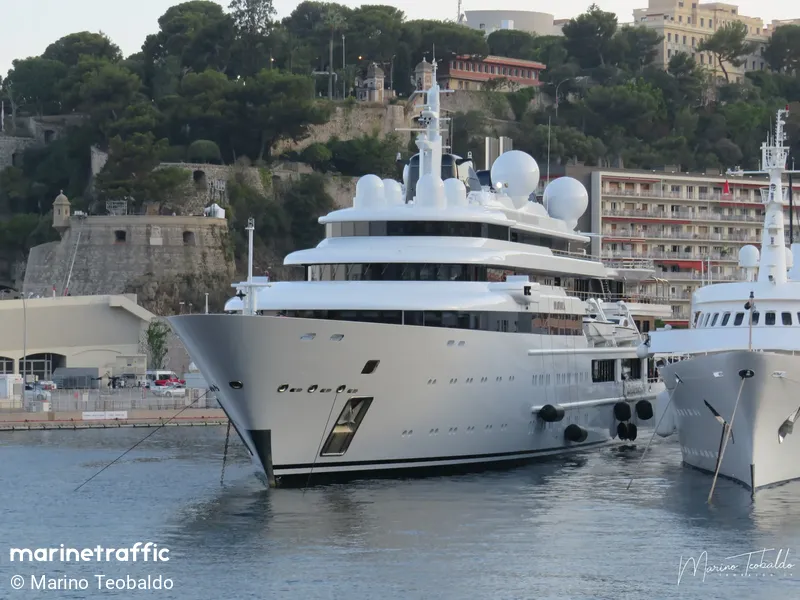
A vessel’s position is the boat’s, not the owner’s. Ownership is as reported, not certified.
The interior designer and the owner’s brief for Katara have never been published. That silence leaves only the registered dimensions to work with. A 124.35-metre hull with a 19.45-metre beam and 7,922 gross tons carries a volumetric envelope that explains the arrangement of decks, machinery, and guest spaces better than any brochure could.
The gross tonnage figure of 7,922 tells you immediately that Katara is not designed for speed.
Gross tonnage measures the total enclosed volume of a ship, not its weight, and a ratio of roughly 64 cubic metres per metre of length places her well above the density typical of performance-oriented motor yachts.
A slender hull sacrifices internal space to cut through water; Katara’s 19.45-metre beam preserves it.
That width creates a stable platform for heavy machinery and thick bulkheads, but it also increases wetted surface area, which raises resistance at higher speeds.
The result is a vessel optimised for steady, long-range cruising rather than open-water sprinting.
The volume problem
Lürssen built the hull at their Bremen yard in 2010.
The shipyard operates a dual commercial and naval production line, and that background shows in the structural logic of a 7,000-tonne displacement yacht.
Naval construction demands strict watertight subdivision and reinforced deck plating to survive combat damage or heavy sea states.
Those same requirements translate directly into the interior architecture of a state vessel.
Corridors run wider to accommodate emergency egress protocols.
Bulkheads are thicker, reducing the flexibility of floor plans and locking in fixed layouts early in the design phase.
The yard’s experience with warship construction means the internal skeleton prioritises compartmentalisation over open-plan living.
Without access to the floor plans or material specifications, the only reliable way to map the accommodation is through the constraints imposed by the registered dimensions.
A beam of 19.45 metres allows for side-by-side master suites or a central grand salon flanked by guest cabins, but the 7,922 gross tonnage ceiling means those spaces cannot be stacked indefinitely.
Every additional deck adds to the windage and requires taller pillars or longer unsupported spans, both of which complicate the naval architecture.
The most efficient use of that volume places the largest guest accommodations on the main and upper decks, with crew quarters pushed lower to keep the centre of gravity down.
AIS data confirms the slow-cruising profile suggested by the tonnage.
During a passage from Barcelona to Palma de Mallorca in August 2026, Katara covered 130 nautical miles at an average speed of 12.0 knots, topping out at 15.0 knots.
A shorter loop within the harbour at Barcelona recorded an average of 12.3 knots over 17 nautical miles.
Her longest tracked movement, from Palma to Ibiza, averaged just 8.0 knots over 62 nautical miles.
These figures are consistent with a heavily loaded displacement hull moving through crowded Mediterranean waters or operating under diplomatic security protocols that require constant escort or controlled pacing.
Her last recorded position placed her in the Balearic Sea at 41.38° N, 2.19° E.
The weight of the machinery
The engine room occupies a substantial portion of the aft section, dictated by the need to house propulsion systems capable of moving nearly 8,000 tonnes of volume efficiently.
Fuel tanks sit alongside or beneath the machinery spaces, adding to the deadweight that limits payload capacity.
This leaves less tonnage margin for superstructure expansion, reinforcing the decision to maximise the beam rather than add height.
The tender garage and aviation facilities must therefore be integrated into the existing footprint rather than appended to it.
A helicopter deck positioned forward or midships balances the heavy aft machinery, while a stern garage keeps the swimming platform clear for diplomatic guests who prefer discrete embarkation.

The diplomatic brief
The ownership record lists the Emir of Qatar as the current holder, but the delivery date complicates the narrative of the original brief.
Katara was completed in 2010, three years before Tamim bin Hamad Al Thani assumed the throne in August 2013.
The initial commissioning authority was therefore the previous ruling generation or the Qatari state apparatus itself.
A state-owned yacht carries different operational requirements than a privately funded leisure craft.
Secure communications arrays take precedence over entertainment venues.
Armoured glazing and blast-resistant materials replace decorative finishes.
The bridge sits higher and further forward to give the captain and security staff unobstructed views of approaching traffic, while the guest areas are shielded behind multiple layers of bulkheads.
The flag state and home port further constrain the design choices.
Flagged under Qatar with Doha as the home port, Katara falls under maritime regulations that may differ from standard international superyacht codes.
Gulf Coast operations demand heat dissipation systems robust enough to handle ambient temperatures exceeding 45 degrees Celsius, which affects the sizing of ventilation shafts and the placement of air conditioning units.
These mechanical requirements carve into the available interior volume, often pushing plant rooms into spaces that would otherwise serve as guest cabins or lounges.
The naval pedigree of the builder ensures those plant rooms are acoustically isolated and vibration-dampened, preserving the quietude required for official meetings or rest periods during long transits.
The visual language of the exterior follows similar logic.
Lürssen’s design philosophy for state vessels favours clean lines and minimal protrusions to reduce radar cross-section and wind resistance.
Sun decks are typically recessed or covered to provide shade without adding structural complexity.
Railings are kept low to maintain sightlines for security personnel.
The absence of visible luxury markers on the superstructure does not indicate a lack of budget; it reflects a deliberate choice to prioritise function over display.
Diplomatic vessels operate best when they blend into commercial shipping lanes or anchor quietly in designated marinas without drawing unnecessary attention.
The registration places Katara in the category of Middle East royalty and heads of state, a classification that groups her with other sovereign assets rather than commercial charter yachts.
This distinction matters because it determines the insurance frameworks, the maintenance schedules, and the crew hierarchy.
A state yacht carries a larger complement of security officers and technical specialists relative to service staff.
The galley is sized for formal state dinners as well as daily crew meals, requiring separate storage and preparation zones to maintain security protocols.
AIS tracking shows Katara operating consistently within European waters during the summer months, a pattern typical for sovereign assets seeking cooler climates and established diplomatic infrastructure.
The Balearic Islands offer secure anchorage points and proximity to major European capitals, facilitating quick departures for official engagements.
The recorded speeds remain deliberately moderate, avoiding the wake and noise associated with high-performance runs.
This operational tempo suggests a vessel designed for endurance and discretion rather than spectacle.
The hull number and IMO identifier tie her to a specific construction contract at the Lürssen yard, a record that can be audited against naval export databases and commercial registry filings.
The consistency between the registered tonnage, the beam measurements, and the observed transit speeds forms a coherent picture of a ship built for a single purpose: transporting dignitaries safely, quietly, and without compromise.
The interior details remain locked behind closed doors, but the mathematics of the hull tell the rest of the story.
Volume, beam, and displacement do not lie.
They dictate exactly how much space is left for the people who live inside.
Reporting and data: CelebYachts, republished by On the record.
Sources
The numbers on this page point here. Each one links to the record it came from.
- 1CelebYachtsCelebYachts: The geometry of a state vessel