
 CelebYachts reportData
The longest hulls afloat
The title belongs to a vessel that is not yet delivered and measures differently depending on who counts her. Until her final length overall is certified…
By On the record · Jul 10, 2026 · Data from CelebYachts1
A vessel’s position is the boat’s, not the owner’s. Ownership is as reported, not certified.
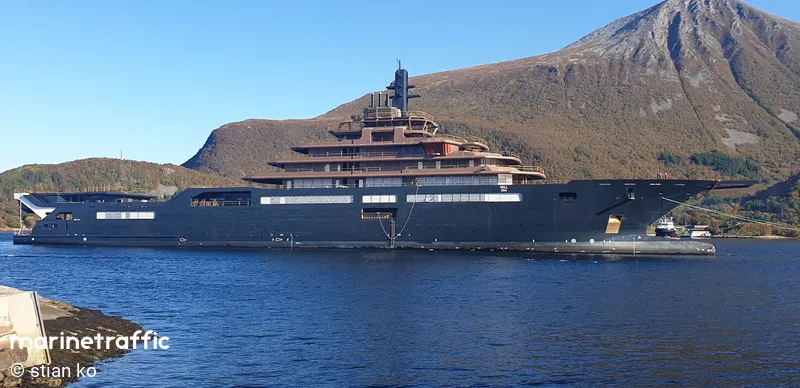
Open-source reports place REV Ocean at 195 metres, while the register lists her at 182 metres. This gap defines the problem of measuring size. The longest-hulls table captures a single axis of scale while obscuring volume, mission profiles, and the physical limits of shipyard sheds.
The register places REV Ocean at the top of the longest-hulls table at 182.0 metres. Open-source reporting places her at 195.0 metres. The difference stems from how a vessel grows during construction and how different registries apply measurement standards. Until her final length overall is certified by a classification society, the title of longest private luxury yacht belongs to Azzam, a 180.61-metre Lürssen launched in 2013. Azzam still holds the record after twelve years because shipyard sheds do not expand to match billionaire budgets. They dictate the maximum beam and length that can be assembled under cover. Any hull longer than 180 metres requires either a yard expansion or a decision to build outdoors, which increases weather delays and corrosion risk. The register captures what has been built, not what has been promised.
Shipyard capacity dictates length
Lürssen has dominated the upper end of the register for a decade. Azzam set the benchmark in 2013. Blue followed in 2022 at 160.0 metres. Opera arrived in 2023 at 146.35 metres. A+ measured 147.25 metres in 2012. All four share a common denominator: they fit within the same production envelope. The yard's Kiel and Bremen-Vegesack facilities have a fixed footprint. Extending them would require acquiring adjacent land, reconfiguring crane runs, and halting other projects. The result is a ceiling on length that persists regardless of demand. When a client requests a hull exceeding 180 metres, the yard either declines the order or shifts the project to a partner facility.
REV Ocean bypassed this constraint entirely. She was never intended as a conventional superyacht. Norwegian businessman Kjell Inge Røkke commissioned her through his REV Ocean initiative, drawing on profits from his industrial holdings. The design began as a 140-metre luxury vessel before Espen Øino expanded the hull to accommodate scientific equipment. Contracts were signed in 2017 with VARD shipyards. The hull was built in Tulcea, Romania, and launched in August 2019. A 12-metre midsection was later inserted near Trondheim, pushing her past 190 metres. Final outfitting is scheduled for Vlissingen-Oost in the Netherlands, with delivery expected in late 2026. The delay demonstrates how adding length mid-build disrupts propulsion alignment and interior sequencing. The vessel now carries a gross tonnage of 16,854, placing her second only to Fulk Al Salamah in volume among the longest hulls.
Mission profiles inflate tonnage
Three hulls in the top ten exceed 155 metres but do not compete in the private charter market. Fulk Al Salamah measures 164.0 metres and weighs 20,361 gross tonnes. She was built by Mariotti in Genoa in 2016 for the Sultanate of Oman. Her length derives from a dual mandate: presidential transport and coast guard operations. A vessel serving both roles requires extensive hangar space, medical facilities, and command centres, which inflates tonnage without increasing guest accommodation. Eclipse follows at 162.5 metres, built by Blohm+Voss in 2010. She carries 13,564 gross tonnes and an estimated value of 700 million dollars. Dubai, also 160.0 metres, shares a builder with Eclipse but was completed earlier, in 2006, with Platinum Yachts handling the conversion. Both Blohm+Voss hulls demonstrate how German engineering prioritises structural rigidity over sheer volume.
Al Saïd, a 155.0-metre Lürssen delivered in 2008, reaches 15,850 gross tonnes. Her weight comes from reinforced decks and heavy machinery layouts typical of gulf state vessels. None of these ships chase the lowest possible length-to-tonnage ratio. They accept greater displacement to house mission-critical systems. The register lists them alongside private yachts because length overall is an easily measured datum, even when the internal arrangements diverge completely. El Mahrousa / El Horriya measures 145.72 metres. She was built by Samuda Brothers in London in 1865. Her age separates her from the modern cohort, yet her length keeps her in the conversation. The next oldest, Prince Abdulaziz, dates to 1984 and measures 147.01 metres.
Volume scales independently of length
Length alone does not determine a Yacht's scale. Gross tonnage measures enclosed volume, not external dimensions. Fulk Al Salamah proves this most clearly. She is shorter than REV Ocean by eighteen metres, yet she carries 3,507 more gross tonnes. Dilbar, at 156.0 metres, holds 15,917 gross tonnes. Al Saïd, half a metre shorter, holds 15,850. The gap between length and volume reveals how modern yards optimise interior space. A wider beam and higher freeboard increase tonnage without extending the waterline. Sailing Yacht A, listed in the heaviest cohort at 142.81 metres, reaches 12,558 gross tonnes through a broad hull form designed to support her mast.
The register's longest-hulls table therefore captures a single axis of size. It ranks vessels by how far their bows stretch from sterns, not by how much steel they displace or how many square metres of deck they offer. Owners who care about volume look to the gross tonnage rankings instead. Dilbar leads that list at 750 million dollars and 15,917 GT. Eclipse and Scheherazade follow at 700 million dollars each. Solaris and Crescent sit at 600 million dollars. The overlap between the two tables is small. Only Azzam, Blue, and Fulk Al Salamah appear in both the longest and most valuable cohorts. That intersection highlights a market reality: extreme length costs more to build per metre than extreme volume, but it does not automatically translate to higher resale value.
Classification surveys will shift the table
The longest-hulls table contains 215 entries. The step down from the leader to the twelfth place is steep. The majority of the top twenty were constructed after 2000. The data shows a clear acceleration in hull growth following the financial crisis, as wealth concentrated among fewer buyers who preferred larger platforms. The record will shift when REV Ocean's final specifications are published. If her 195-metre measurement stands, she will take the top position. If the register retains 182 metres, Azzam remains the longest certified private yacht. The margin between them is narrow enough that a single classification survey could alter the ranking. Until then, the table reflects current construction capacity, not ultimate ambition.
Reporting and data: CelebYachts, republished by On the record.
Sources
The numbers on this page point here. Each one links to the record it came from.
- 1CelebYachtsCelebYachts: The longest hulls afloat