
 CelebYachts reportYards & Design
The hundred-and-eleven-metre constraint
Dreamboat’s proportions are determined by Oceanco’s Alblasserdam dry dock and her gross tonnage, not by a bespoke naval architect.
By On the record · Aug 14, 2026 · Data from CelebYachts1
A vessel’s position is the boat’s, not the owner’s. Ownership is as reported, not certified.
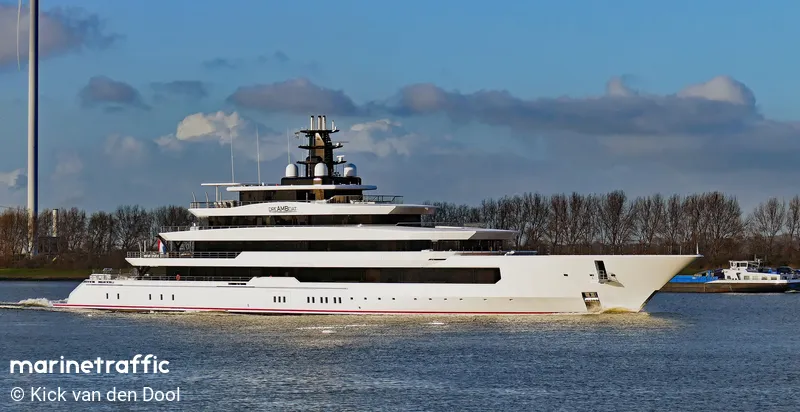
The 110.9-metre motor yacht built for Arthur Blank carries 4,525 tons of registered volume into a 17-metre beam. That ratio reveals a vessel shaped by shipyard capacity and classification rules, not by an interior designer’s brief.
Oceanco operates from Alblasserdam, approximately twenty kilometres from Rotterdam. The yard occupies eight point two hectares and maintains direct access to the North Sea via inland waterways. In 2010 the company demolished old slips to construct a covered dry dock capable of handling vessels up to one hundred and forty metres. Dreamboat, delivered in 2025, measures one hundred and ten point nine metres overall. She sits comfortably inside that envelope, which means her maximum length was never a question of market demand but of structural ceiling. The yard can simultaneously build five yachts in the eighty-metre category and delivers approximately two per year. Dreamboat is one of those deliveries, completed after Gabe Newell acquired the builder in August 2025. The timeline suggests she was already under construction when ownership changed hands. A hull of this length does not appear on a schedule without a slipway reserved years earlier. The yard’s history shows a deliberate pivot from the Y Generation of eighty-metre hulls toward larger volumes. Project Bravo, launched in 2018, marked the start of that shift. Dreamboat represents the next phase, utilising the same infrastructure to carry greater displacement without requiring new civil works. The acquisition of maritime systems integrator Alewijnse in August 2025, followed by the purchase of a business complex in Zwijndrecht that adds thirteen thousand four hundred square metres to existing facilities, indicates a yard scaling its supply chain to match the physical capacity of its sheds. Dreamboat was built inside that expanding footprint.
The shed, not the drawing
The interior has not been published. Floor plans, material selections, and commissioned artwork remain undisclosed. What the register does confirm is a gross tonnage of four thousand five hundred twenty-five against a beam of seventeen metres. That ratio demands a specific internal geometry. Naval architects working to a fixed length and a high tonnage target must stack decks vertically rather than spread them horizontally. The beam fixes the width of the main salon and the dining areas; the remaining volume goes to machinery, fuel tanks, stabilisers, and the engineering spaces required by Lloyd’s Register and SOLAS conventions. Escape routes, watertight subdivision, and the placement of the engine room each take a fixed share of the displacement. The helicopter deck and tender garage occupy further square metres that cannot be converted into guest cabins. A hull of that tonnage cannot use the smaller dock, which leaves two possible layouts: a traditional three-deck arrangement above the waterline, or a compressed four-deck profile with a lower lounge. The AIS data shows her operating in the Ionian Sea, moving between Siracusa and Catania at average speeds of 12.8 knots and maximum speeds of 14.7 knots. These figures are consistent with a full-displacement hull optimised for range rather than sprinting. The machinery required to push four thousand five hundred tons of steel through the water at fifteen knots dictates a long engine room aft, which in turn pushes the helideck forward or midships. Every spatial decision follows from that starting point. The four thousand five hundred twenty-five tons of volume must accommodate everything from ballast to ventilation shafts, leaving a defined remainder for habitable space. That remainder is constrained by the seventeen-metre beam and the classification rules governing passenger safety.
Volume and constraint
Arthur Blank co-founded The Home Depot in the nineteen eighties. The retail chain’s flotation and subsequent growth generated the capital that now funds Dreamboat. He serves as chairman of AMB Group LLC, which owns four professional sports franchises in Atlanta, including the NFL’s Falcons and MLS’s United FC. His net worth stands at eleven billion four hundred million dollars. The vessel carries his initials in its name, dreAMBoat, a naming convention that appears in public records alongside an estimated value of three hundred million dollars. The register lists her flag as the Cayman Islands and her home port as George Town. Ownership structures for yachts of this scale typically route through offshore holding companies, but the specific corporate steps remain unpublished. The money that bought the hull came from a single commercial venture, and that origin constrains nothing about the boat’s engineering. It simply places her in a tier where custom yards compete for contracts that exceed half a billion dollars. Oceanco’s extended production facility in Alblasserdam can absorb such orders because the yard already supplies the infrastructure for one hundred and forty-metre builds. Dreamboat does not require a new crane, a reinforced jetty, or a widened lock. She fits the existing book. The owner’s portfolio extends to professional golf and soccer, but those assets do not intersect with the vessel’s specification. The capital is liquid, the purchase is recorded, and the hull is delivered. The estimated value of three hundred million dollars aligns with current market rates for newly delivered custom hulls in this length band, though the actual transaction price has never been confirmed.
The capital that fills the hold
The last recorded position places Dreamboat at 37.84° N, 15.29° E, in the Ionian Sea. The track covers a series of short passages between Sicily and Malta during July and August 2026. One voyage ran from Messina to Lipari, covering 29.4 nautical miles. Another looped between Siracusa and Catania, logging 48.7 nautical miles at an average speed of 12.8 knots. A third passage returned from Catania to Siracusa, covering 32.0 nautical miles. A fourth trip stayed within Catania’s harbour limits, covering 13.4 nautical miles. A fifth run between Siracusa and Catania reached a maximum speed of 16.7 knots. Two additional legs connected Valletta to Marsalforn and Siracusa to itself, covering 17.9 nautical miles and 15.3 nautical miles respectively. The distances are short, the speeds moderate, and the coverage complete. This pattern matches summer positioning rather than trans-oceanic transit. The vessel remains within radio range of Italian and Maltese coast stations, which explains the uninterrupted AIS broadcast. The low average speeds suggest either sea trials, crew familiarisation, or a deliberate choice to conserve fuel while anchored or drifting near the coast. The maximum speed recorded across the tracked period was 16.7 knots, achieved on a single run from Siracusa to Catania. That figure confirms the propulsion system can deliver power beyond the typical cruising envelope, but the operational data shows no sustained high-speed runs. The hull form, optimised for displacement efficiency, does not reward repeated sprinting. The AIS record ends with the vessel stationary or moving very slowly off the Sicilian coast, where she remains as of the latest broadcast.
Movement and tracking
The timestamps reveal a deliberate pacing. The passage from Valletta to Marsalforn began at 05:31 and concluded at 07:28, lasting one hour and fifty-seven minutes. The return leg from Siracusa to itself started at 00:39 and ended at 02:23, covering 15.3 nautical miles in under two hours. The longest tracked segment, the 48.7 nautical mile run between Siracusa and Catania, took four hours and twenty-eight minutes. These durations translate to steady cruising speeds well below the vessel’s maximum capability. The AIS broadcasts were continuous throughout each leg, indicating active transmission rather than intermittent pinging. The vessel did not cross open ocean during this period; she remained within coastal waters where signal loss is uncommon. The pattern suggests a phased acceptance cruise or a post-delivery familiarisation programme rather than immediate commercial deployment. The propulsion system operated within a narrow band of efficiency, avoiding the high-RPM regimes that would accelerate wear on a new hull. The data ends on 5 August, when the vessel departed Messina and logged 29.4 nautical miles before the feed cut. She has not appeared on the AIS grid since that departure, leaving her final anchorage unconfirmed.
Reporting and data: CelebYachts, republished by On the record.
Sources
The numbers on this page point here. Each one links to the record it came from.
- 1