
 CelebYachts reportYards & Design
The hundred-and-forty-two-metre constraint
Dragonfly and Nord share a length because Lürssen’s sheds favour that span, not because they share a platform. Their differing beams, powertrains, and design…
By On the record · Jul 11, 2026 · Data from CelebYachts1
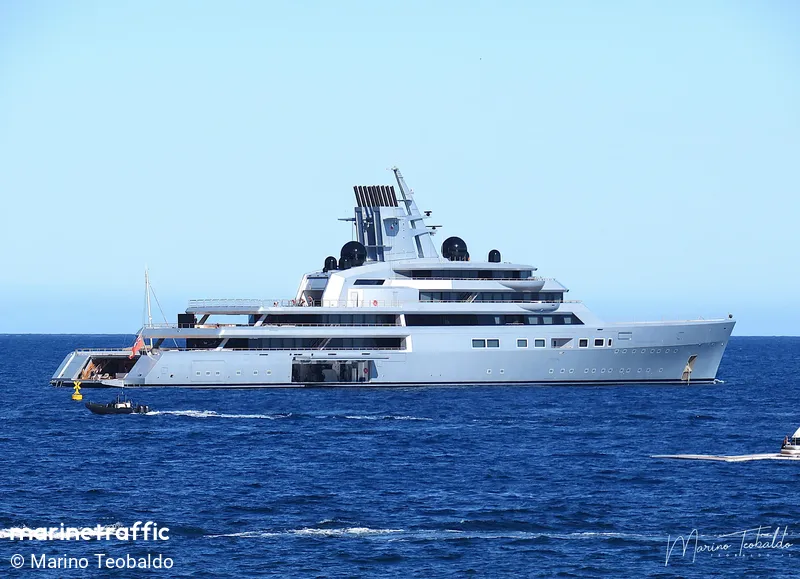
A vessel’s position is the boat’s, not the owner’s. Ownership is as reported, not certified.
Two Lürssen vessels measure within half a metre of each other. The coincidence in length reflects shipyard capacity and client demand for maximum range, not a shared architectural lineage. Dragonfly and Nord are parallel responses to identical industrial limits.
Two vessels built by Lürssen measure within half a metre of each other. Dragonfly runs 142.15 metres (466 feet). Nord measures 141.63 metres (465 feet). They were launched three years apart and carry very different owners. The coincidence in length does not indicate a shared platform, a sisterhood of hulls, or a common architectural lineage. It indicates a shipyard that favours a specific span for its slipways and clients who insist on maximum range at that span. The evidence points to parallel engineering rather than copied design. Dragonfly and Nord are independent answers to the same industrial constraint.
The shed, not the drawing
Lürssen’s Bremen-Vegesack facility dictates the envelope. A vessel of 142 metres requires a dry dock and a building hall that can accommodate the keel, launch, and fit-out without excessive crane repositioning. The yard has repeatedly returned to this length because it matches the physical limits of its primary construction halls. When a client requests a yacht near that limit, the builder starts from the shed walls inward. Dragonfly and Nord share that starting line.
The internal geometry diverges immediately. Dragonfly carries a beam of 20.42 metres (67 feet) and encloses 9,408 gross tonnes. Nord sits wider at 22.48 metres (74 feet) and displaces 10,154 gross tonnes. Register figures place Nord’s beam at 22.48 metres, though contemporary reports cite 19.50 metres; the variation reflects measurement standards rather than structural alteration. The extra two metres of beam on Nord creates a distinct stability profile and allows a broader spread of amenities across the main levels. Dragonfly’s narrower beam concentrates volume vertically, resulting in five decks and 2,000 square metres of living space packed into a tighter footprint. The difference in beam also dictates where the helicopter pads can be placed. Dragonfly positions two helipads aft, clear of the bridge wings. Nord places one on the bow and another on the top deck, integrated into the main mast with a covered hangar. The spatial trade-offs are visible in the steel.
Divergent engineering
The propulsion layouts confirm separate naval architecture. Dragonfly was designed with a diesel-electric hybrid system from the outset. Each of her two MAN engines produces 7,300 kilowatts, driving electric azimuth pods. This configuration supports a top speed of 24 knots while managing hotel loads at anchor. The electrical consumption at dock reaches approximately 16,800 kilowatt-hours daily, powering HVAC systems, stabilizers, water management, and entertainment infrastructure including spas and pools. The hybrid arrangement reflects a modern efficiency mandate, accommodating the high baseline draw of luxury amenities without resorting to constant generator run-time.
Nord follows a more conventional mechanical routing. Her specifications list zero-speed stabilizers and a steel hull with an aluminium superstructure and teak-laid decks. She carries a movie theatre, a spa room, a sauna, and underwater lighting, alongside a tender garage and beach club. The absence of a published hybrid system on Nord suggests a focus on raw mechanical reliability over electrified hotel load management. Both yachts carry twelve guest cabins and require substantial crew quarters, but Dragonfly specifies a crew of fifty-three, while Nord’s complement is handled through standard Lürssen accommodation blocks. The exterior and interior design teams further separate the projects. Dragonfly’s exteriors were drawn by German Frers, with interiors by Nauta Design. Nord received a unified hand from Nuvolari & Lenard for both hull lines and cabin layouts. Different designers produce different stress distributions, deck heights, and window placements. The hulls do not share moulds.
The owners who ordered them
Ownership history explains the timeline gap and the specification shifts. Nord began life as Project OPUS under the supervision of Moran Yacht & Ship in Fort Lauderdale. She was commissioned by Alexei Mordashov, chairman of Severstal, Russia’s largest steel and mining company. Mordashov’s capital originates from metallurgy and mining. Nord’s design prioritises endurance and structural redundancy, traits that match a buyer accustomed to moving bulk commodities across continents. The vessel was initially flagged in Germany in 2020 before shifting to the Cayman Islands and later Russia.
Dragonfly entered construction in 2019 as Project Alibaba for Leonid Mikhelson. The keel was laid in 2020, and she launched in December 2023. Ownership transferred to Sergey Brin during the fitting-out phase. Brin, who co-founded Google and remains a controlling shareholder at Alphabet Inc., brings a technology-driven approach to maritime assets. The transfer occurred after the hull was already taking shape, which explains why Dragonfly retains a familiar Lürssen silhouette but adopts a completely different powertrain and interior philosophy. Brin’s acquisition did not alter the external lines significantly, but it accelerated the integration of advanced hybrid systems and digital management protocols. The cost of the project settled around $450 million, while Nord’s valuation sits near $500 million. The price differential reflects the timing of the orders, the inflation in marine-grade materials, and the complexity of the onboard systems.
Where they sit now
The operational lives of the two yachts have been shaped by geopolitical friction. Nord faced immediate restrictions following Russia’s 2022 invasion of Ukraine. Western authorities targeted the vessel for seizure. Mordashov avoided capture by ordering a high-speed transit away from the Seychelles, where she typically wintered. The yacht ran at full speed for 6,701 nautical miles, disabling mandatory location transponders to evade tracking. She arrived in Vladivostok on April 11, 2022, having crossed the Japan Sea and made stops in South Korea and the Maldives. Transponders remained off until June 12, 2023, when the vessel reappeared in the Indian Ocean near Indonesia. She continued through the Strait of Hormuz after maintenance in Dubai and reached Benoa Port in Bali by July 2026. Her current position places her in the Java Sea, flagged under Russia.
AIS data tracks the divergence in real time. Dragonfly has operated without similar disruption. Delivered on December 3, 2024, she registered in the Cayman Islands and moved directly into commercial service. Her last recorded position sits in the West Mediterranean, maintaining regular AIS broadcasts. The contrast in movement patterns underscores the difference between a vessel built for unrestricted global cruising and one forced into regional isolation. Both remain within the 142-metre bracket, but their trajectories have separated completely.
Reporting and data: CelebYachts, republished by On the record.
Sources
The numbers on this page point here. Each one links to the record it came from.
- 1