
 CelebYachts reportInvestigations
The hundred-and-nine-metre constraint
Identical length does not mean shared design. Two Oceanco hulls prove that shipyard infrastructure dictates dimensions while gross tonnage reveals…
By On the record · Sep 21, 2026 · Data from CelebYachts1
A vessel’s position is the boat’s, not the owner’s. Ownership is as reported, not certified.
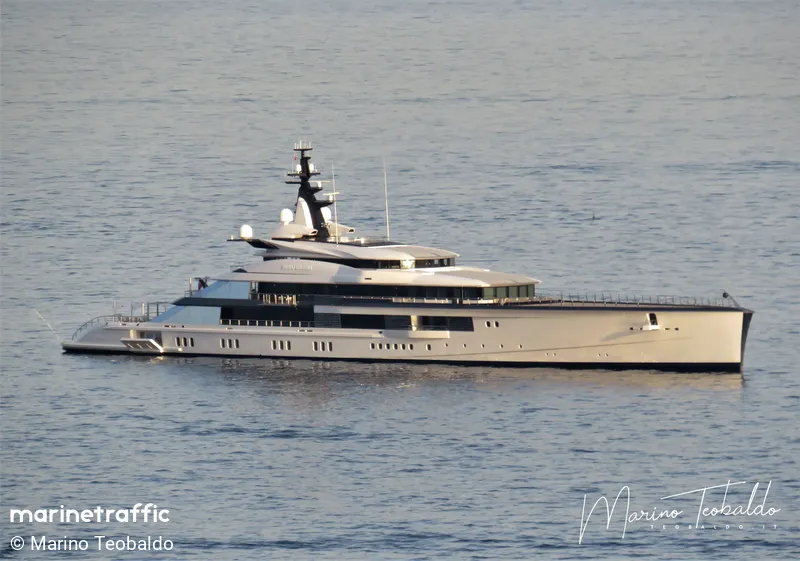
BRAVO EUGENIA and Seven Seas measure exactly 109.0 metres and share a 16.0-metre beam, but they are not sisterships. The matching dimensions reflect Oceanco’s Alblasserdam slipway limits and inland transit rules. A tonnage gap of more than 1000 units proves each vessel was engineered as a separate volume problem.
Two Oceanco vessels share an exact length of 109.0 metres and a beam of 16.0 metres, yet they are not sisterships. BRAVO EUGENIA (Y718) and Seven Seas (Y720) represent a convergence on paper that dissolves under structural scrutiny. The identical external dimensions are the product of a single shipyard’s slipway geometry and the practical constraints of Dutch inland waterways, not a shared design platform. Where the length matches, the gross tonnage diverges by more than a thousand units, proving that each hull was solved as an independent volume problem. The yard repeated a footprint to reduce production risk, not because the two owners requested the same architecture.
The footprint of Alblasserdam
Oceanco operates from an extended production facility in Alblasserdam, roughly twenty kilometres from Rotterdam. The yard traces its custom megayacht strategy to 2002, when Theodore Angelopoulos took control and shifted focus to the 80-metre-plus niche. That decision established a building rhythm that continues today. In 2008 the company acquired adjacent land, and two years later began demolishing old buildings to construct a covered dry dock capable of handling vessels up to 140 metres in length. That ceiling defines the upper bound of the yard’s ambition, but the lower bound is dictated by the river network.
A hull of 109.0 metres sits comfortably within the draught and clearance limits of the Rhine–Meuse delta, allowing a completed vessel to navigate directly to the North Sea without requiring bridge removal permits or tow barges. The yard’s logistics favour this bracket. BRAVO EUGENIA received her technical launch at Zwijndrecht on 14 February 2017 before moving to Alblasserdam for outfitting. She entered service in December 2018. Four years later, Seven Seas rolled out as Y720. Both projects occupied the same physical envelope on the slipway. The yard’s ability to run five large builds simultaneously means that repeating a proven mould line reduces engineering risk. A 109-metre hull requires a specific arrangement of longitudinal girders and transverse bulkheads that fits neatly into the existing crane spans and assembly jigs.
The thousand-tonne gap
External measurements tell only half the story. BRAVO EUGENIA carries a registered gross tonnage of 3418. Seven Seas registers at 4444. Gross tonnage measures enclosed volume, not displacement, and a difference of 1026 units between two vessels of identical length and beam indicates a fundamentally different internal architecture. The extra space in Seven Seas could stem from additional deck levels, higher freeboard, wider cabin volumes, or a more complex superstructure profile. Without published floor plans, the exact distribution remains opaque, but the numerical spread rules out a simple scaling of interiors.
Classification records confirm the divergence. Lloyd’s Register certified BRAVO EUGENIA, and the classification process would have scrutinised stability calculations, subdivision compartments, and machinery space ventilation against the 3418 GT figure. Seven Seas, entering service in 2022, arrived under updated SOLAS amendments and likely faced stricter fire safety and evacuation modelling. The heavier registration suggests a denser fit-out or a larger auxiliary plant. Both vessels carry Cayman Islands flags and George Town home ports, but the tonnage gap places them in different categories of operational demand. One is optimised for a specific range of amenities; the other absorbs more volume into its steel shell.
Capital and configuration
The owners who commissioned these hulls brought different priorities to the drawing board. Jerry Jones purchased the Dallas Cowboys in 1989 and has operated the franchise as a private holding ever since. His yacht reflects a functional mandate. BRAVO EUGENIA features two helicopter pads, a spa, a steam room, a sauna, a gymnasium, a beach club, and a plunge pool. The inclusion of dual aviation decks points to a requirement for rapid personnel transfer and offshore operations, consistent with a sports owner who utilised the vessel for his 2020 NFL draft broadcast. The estimated value of 225 million dollars aligns with a working platform that prioritises utility alongside comfort.
Steven Spielberg, the highest-grossing film director in cinema history, acquired Seven Seas four years later. The vessel’s higher tonnage and 250 million dollar estimate suggest a layout geared toward expansive guest accommodation and entertainment spaces rather than tactical mobility. The absence of documented aviation facilities in the available records shifts the focus entirely to interior volume. Both men paid for custom builds, but the resulting steel responds to different calendars and different crew requirements. The identical length does not imply identical lifestyles.
Tracking the hulls
AIS broadcasts place both vessels in the western Mediterranean during late summer. BRAVO EUGENIA logged a position at 37.59° N, 0.99° W, operating off the Spanish coast. Seven Seas appeared further east at 39.75° N, 2.61° E, drifting through the Balearic Sea. The tracks show neither yacht engaged in high-speed transit; both moved at speeds consistent with cruising or station-keeping. The data confirms active employment rather than storage.
The yard’s delivery rhythm supports this pattern. Oceanco produces approximately two superyachts per year across its eight-hectare site. The four-year interval between Y718 and Y720 allowed the engineering team to refine propulsion and thermal management between builds. BRAVO EUGENIA runs on twin MTU 2,920HP diesel engines equipped with a heat and energy recovery system and an integrated battery setup, pushing her to a maximum speed of 17.5 knots. Seven Seas shares the same builder and era of marine engineering, though her exact powerplant configuration has not been published. The tonnage increase would normally demand more shaft horsepower, yet the lack of confirmed performance figures leaves her top speed unverified.
Both hulls remain tracked. The AIS pings continue to update, showing vessels that are actively maintained rather than mothballed. The coincidence of their lengths is a byproduct of shipyard logistics and client tolerance for a proven dimension. The divergence in tonnage, flag registry, and operational role proves that Oceanco did not stamp out a duplicate. It solved two separate problems inside the same rectangular boundary.
Reporting and data: CelebYachts, republished by On the record.
Sources
The numbers on this page point here. Each one links to the record it came from.
- 1