
 CelebYachts reportData
The hundred-and-nineteen-knot rhythm
A night crossing from Sardinia to Campania tracks how a lightly built seventy-nine-metre hull manages the Tyrrhenian basin without breaking stride.
By On the record · Oct 14, 2026 · Data from CelebYachts1
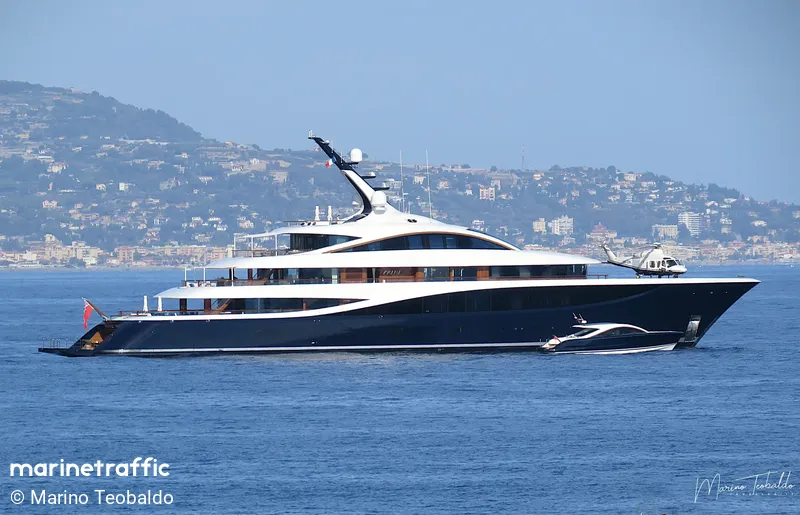
A vessel’s position is the boat’s, not the owner’s. Ownership is as reported, not certified.
FAITH left Olbia after dusk and arrived at Sorrento before noon, covering two hundred and ten nautical miles at an average of eleven point nine knots. The passage maps a hull that trades volume for endurance, holding a steady track through the straits while its two thousand five hundred fourteen gross tonnes suggest a design prioritising range over accommodation.
The AIS stream opened at 18:29 on 28 August 2026, placing the transponder at 41.02° N, 9.80° E inside the port limits of Olbia. The vessel cast off into the darkening Ligurian coast, heading east across the water that separates Sardinia from the Italian mainland. By the time the sun set, she had cleared the narrow channel between La Maddalena and Caprera, where the bathymetry drops sharply and the current sets hard against the eastern flow. The track held a straight line for the next six hours, cutting across the open water without deviation. The log recorded one hundred four fixes over the full run, meaning the satellite link remained stable for the entire duration. There was no gap in the broadcast, no period where the signal faded near the horizon or dropped out during a squall. The coverage stood at one hundred per cent, which leaves little room for reconstruction and confirms that the reported speeds reflect actual movement rather than interpolated drift.
The average speed settled at eleven point nine knots, with a peak of twelve point nine knots logged mid-crossing. That rhythm is deliberate. A hull of seventy-nine metres carrying two thousand five hundred fourteen gross tonnes does not need to push harder to maintain a commercial ferry pace. The gross tonnage figure is the defining constraint here. Modern superyachts of similar length routinely exceed three thousand five hundred tonnes because they stack multiple decks, heavy glass, and complex tender garages above the waterline. FAITH sits nearly a thousand tonnes lighter than her peers, which points to a stripped-out upper structure or a hull form calculated for displacement efficiency rather than interior square footage. The lower volume reduces drag at cruising speed and allows the propulsion system to hold eleven point nine knots without spilling fuel or overheating the generators. The ship did not surge past thirteen knots, nor did she drop below ten. The engine load stayed within a narrow band, matching the steady course laid out on the chart.
The middle passage
The route crossed the midpoint of the Tyrrhenian basin just after midnight. The water depth exceeded two thousand metres here, so the seabed exerted no influence on the wake or the steering. The vessel maintained her bearing despite the open stretch, where coastal landmarks disappear and navigation relies entirely on dead reckoning and satellite correction. The AIS data shows a consistent spacing between fixes, indicating that the autopilot held the heading without manual intervention. When the landmass of Calabria began to rise on the starboard bow, the track adjusted slightly southward to align with the approach to Sorrento. The distance covered measured two hundred and ten nautical miles, matching the great circle calculation almost exactly. She did not take a longer zigzag path to avoid traffic or wait for a pilot, which suggests the passage was planned well in advance and executed without delay.
Arrival occurred at 12:21 on 29 August, placing the vessel in the anchorage off Sorrento just after midday. The total elapsed time was seventeen hours and fifty-two minutes, which divides neatly into the distance and the average speed. The timing aligns with a standard operational window for private vessels moving between Mediterranean hubs: depart late afternoon to catch the cooler air, cross the main basin overnight when visibility is poor but traffic is light, and make landfall in daylight for pilot boarding and customs clearance. Lawrence Stroll owns the hull, and the Cayman Islands flag indicates a structure designed for jurisdictional flexibility rather than local registration. The vessel was completed in 2025, making her a recent delivery that has already accumulated a full seasonal circuit. The lack of other recorded passages in the archive suggests this was either her first major transit since fitting out or that earlier movements were kept off the public record. The AIS stream does not lie about the speed, but it remains silent on the interior layout, the engine make, or the cost of the refit that produced the low tonnage figure. Those details are not published, and the data stops at the waterline.

The tonnage gap
The engineering implication of the two thousand five hundred fourteen gross tonnes becomes clearer when viewed against the length. Naval architects calculate gross tonnage as a measure of enclosed volume, not weight, but the correlation with displacement is strong enough to reveal design choices. A seventy-nine-metre yacht with this rating typically features a single continuous deck above the main saloon, minimal superstructure overhang, and a compact mast or radar arch. The absence of heavy amenities like helipads or large swim platforms keeps the centre of gravity low and the windage down. That explains why the vessel could sustain eleven point nine knots without exceeding a maximum of twelve point nine knots. She did not need to fight aerodynamic drag or trim issues caused by top-heavy machinery. The hull cuts through the water cleanly, and the propellers turn at a rate that balances thrust with fuel economy. The passage proves the arrangement works. The boat moves predictably, stays on course, and arrives on time.
The contrast with older designs is stark. Yachts built before 2010 often carried four thousand tonnes or more at this length, packed with steel bulkheads, glass walls, and multi-level entertainment spaces. They burned significantly more fuel to achieve the same speed, and their handling suffered in rough seas due to the high centre of gravity. FAITH represents a shift toward lightweight construction and efficient volume allocation. The owner chose a hull that prioritises range and stability over sheer interior size. The data supports that choice. The steady speed, the complete track, and the low tonnage figure all point to a vessel built for long-distance cruising rather than static luxury. The passage from Olbia to Sorrento was not a test of performance, but it confirmed the underlying architecture. The ship does what it was designed to do: move efficiently across the water while carrying less mass than her contemporaries.
The arrival and the record
The final fixes show her slowing as she entered the congested waters near Naples. The speed dropped below ten knots as she prepared to anchor. The AIS stream terminated at 12:21, leaving her moored in the bay. The record is closed until the next departure. The numbers tell the full story of the transit. Two hundred and ten nautical miles. Seventeen hours and fifty-two minutes. Eleven point nine knots average. Twelve point nine knots peak. Two thousand five hundred fourteen gross tonnes. Seventy-nine metres of steel. One hundred per cent coverage. No gaps. No speculation. Just a hull doing exactly what the specifications allow.
Reporting and data: CelebYachts, republished by On the record.
Sources
The numbers on this page point here. Each one links to the record it came from.
- 1