
 CelebYachts reportYards & Design
Why Al Raya and Radiant share a 110m length
Two Lürssen yachts measure the same. Their beams differ by nearly three metres. The yard uses its shed size to set the limit, not a shared design.
By On the record · Sep 24, 2026 · Data from CelebYachts1
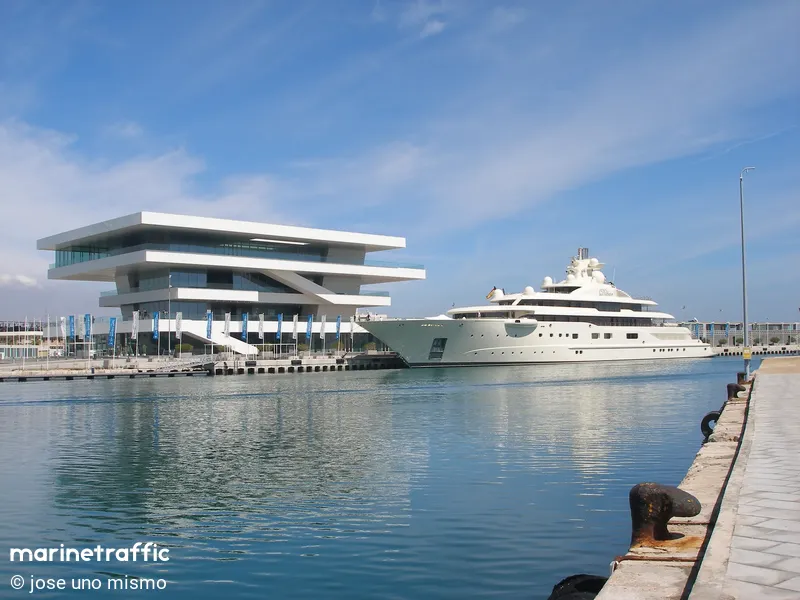
A vessel’s position is the boat’s, not the owner’s. Ownership is as reported, not certified.
Al Raya and Radiant arrived at the register as identical twins on paper. Their beams diverge by nearly three metres. Their construction dates span two years. The identical lengths result from Lürssen’s slipway dimensions rather than a shared hull design.
Al Raya and Radiant sit in our register as mirror images. Both measure exactly 110.0 metres from bow to stern. Both carry the Cayman Islands flag. Both were built by Lürssen in Germany. A casual glance suggests they are sisterships.
The numbers tell a different story. Al Raya has a beam of 16.0 metres. Radiant is wider, at 18.85 metres. That is a difference of nearly three metres. It is enough space for a large swimming pool or extra guest cabins.
Their owners are also distinct. Al Raya belongs to King Hamad bin Isa Al Khalifa of Bahrain. Radiant is owned by Abdulla Al Futtaim, an Emirati billionaire. One was delivered in 2008. The other followed two years later in 2010.
Who owns Al Raya and Radiant?
Al Raya carries the name of a former yacht owned by Alisher Usmanov. Usmanov renamed his previous Dilbar to Al Raya in 2018 before selling it. The current Al Raya is held by the Bahrain royal family. She is registered under King Hamad bin Isa Al Khalifa. Her estimated value sits at $250 million.
Radiant serves a different purpose. She is homeported in George Town. Her owner is Abdulla Al Futtaim. He leads the Al-Futtaim Group. His net worth reached $4.9 billion in July 2025. Radiant is valued at $320 million. She is the more expensive vessel.
The two women do not share a platform. They do not share a naval architect. They do not share a design team. The only common thread is the builder and the length constraint. Lürssen builds custom vessels. Each project starts with a client's wish list.
Clients often ask for specific lengths. They want to hit a milestone number. 110 metres is a psychological barrier for many buyers. It signals serious scale without crossing into larger clubs. Lürssen sees this pattern repeat across decades.
Why do they share the same length?
The answer lies in the shipyard itself. Lürssen operates massive facilities in Germany. Its main yards are in Lemwerder and Rendsburg. These sites have fixed slipways and dry docks. The physical space limits how long a hull can be.
A 110-metre slipway creates a natural ceiling. Building a longer yacht requires a new dock or a major expansion. That costs hundreds of millions. It takes years to plan. Most clients do not want to wait that long.
So the yard offers what fits. If a client wants 110 metres, Lürssen delivers 110 metres. The length is dictated by the shed, not the drawing. The beam, however, remains flexible. It depends on stability needs and interior layout.
This explains the divergence in width. Al Raya is narrower. Radiant is broader. Both fit the same slipway. Both meet the 110-metre target. But their internal volumes differ. Al Raya holds 5,148 gross tons. Radiant holds 5,082 gross tons.
Gross tonnage measures internal volume. It is a calculation of enclosed space. A wider beam usually allows more usable Area on each deck. Radiant’s extra width gives her more room per tonne of displacement.
Lürssen has built many yachts at this scale. Dilbar measured 156 metres. Azzam stretched to 180 metres. Each required specific infrastructure. The 110-metre class is workhorse territory. It balances range, crew comfort, and client prestige.
Does length prove they are sisters?
No. Length alone proves nothing about design kinship. Two houses can stand next to each other and look identical from the street. Their foundations may differ entirely. Their floor plans may serve opposite purposes.
In yachting, convergence is common. When a yard perfects a mould line, clients copy it. They want the same profile. They want the same silhouette. But the engineering inside changes with every order.
Al Raya and Radiant show this clearly. They share a builder. They share a length. They do not share a soul. One serves a King. The other serves a businessman. Their journeys reflect their owners' lives.
AIS data shows their movements. Al Raya recently appeared in the Ligurian Sea. Radiant was spotted near Piraeus Area. They travel different routes. They visit different ports. They belong to different worlds.
What does the yard gain from this?
Efficiency. Standardising the length simplifies production. The yard knows how to cut steel for 110 metres. It knows how to install engines for that draft. It reduces risk for both builder and buyer.
It also maximises asset use. A slipway sitting empty loses money. Filling it with another 110-metre project keeps cash flowing. Lürssen is the largest yacht builder in the world. Volume matters to its bottom line.
Peter Lürssen has overseen this strategy for years. The company acquired Blohm+Voss in 2016. It expanded its reach. It now builds naval ships too. Naval Vessels Lürssen (NVL) handles defence contracts.
The dual focus stabilises revenue. Yacht orders fluctuate. Defence contracts provide steady work. This mix allows Lürssen to maintain its massive workforce. It supports the yards in Bremen, Hamburg, and Wolgast.
For Al Raya and Radiant, the outcome is simple. They are products of a system. The system favours repetition. It rewards predictability. It does not promise uniqueness.
Readers often assume identical specs mean identical origins. This is a mistake. The register lists facts. It does not explain motives. Only the shipyard knows why two hulls chose the same number.
The answer is financial. And practical. The shed sets the limit. The client sets the style. The beam fills the gap. Everything else is detail.
Reporting and data: CelebYachts, republished by On the record.
Sources
The numbers on this page point here. Each one links to the record it came from.
- 1