
 CelebYachts reportYards & Design
The hundred-and-ten-metre constraint at Oceanco
Convergence on paper between Kaos and Leviathan reflects shipyard economics and shed dimensions, not a shared design platform.
By On the record · Aug 21, 2026 · Data from CelebYachts1
A vessel’s position is the boat’s, not the owner’s. Ownership is as reported, not certified.
Two Oceanco-built motor yachts measure 110.1 metres and 110.0 metres. The similarity is a function of the Alblasserdam facility’s covered dry dock and the yard’s production rhythm, not sisterhood. The steel and aluminium that separate them tell a different story about how custom yards scale.
The shed, not the drawing
Oceanco operates from Alblasserdam in the Netherlands, a site that spans 8.2 hectares and sits roughly 20 kilometres from Rotterdam. The yard expanded significantly in 2010 by demolishing old slips and constructing a covered dry dock capable of handling vessels up to 140 metres. That infrastructure dictates the physical envelope available to naval architects. When a client requests a yacht just over 110 metres, the yard does not need to alter its primary construction lines or reorder long-lead structural components. The 110-metre mark has become a recurring dimension at the facility because it fits comfortably within the shed while maximising the usable floor space.
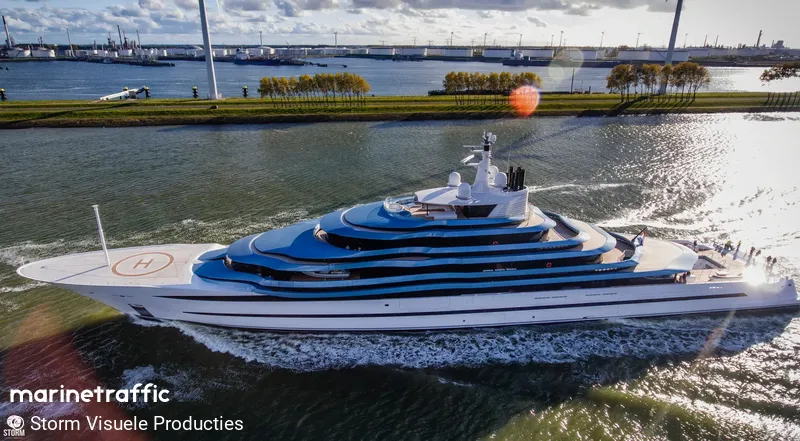
Kaos measures 110.1 metres overall with a beam of 16.4 metres and a gross tonnage of 4,523. She was launched in 2017 under the name Jubilee and renamed Kaos in 2018. Her estimated value stands at $300 million. Leviathan measures 110.0 metres with a slightly narrower beam of 16.0 metres and a gross tonnage of 4,970. She was launched in 2025. The two hulls share a length to the nearest metre, but the tonnage differential of 447 units reveals divergent internal priorities. Gross tonnage measures enclosed volume, not displacement. The extra volume on Leviathan accounts for heavy scientific equipment, a submarine garage, a dedicated dive centre, a laboratory, a hospital ward, and a three-dimensional print shop. Kaos carries none of those installations in her published specifications. The length convergence is therefore a structural coincidence rather than a design kinship.
The weight of the steel
The naval architecture for Leviathan was handled jointly by Lateral Naval Architects and Oceanco, with exterior styling by the yard itself and interiors by Mark Berryman Designs. The naval architect responsible for Kaos remains undisclosed. Without access to the original lofting plans or the structural arrangement drawings, it is impossible to verify whether the two vessels share framing spacing, bulkhead positions, or machinery foundations. What is visible on paper is a deliberate choice by Oceanco to repeat a proven external envelope. Custom yards do not rebuild their primary jigs for every new commission. Reusing the mould lines and structural templates for a second 110-metre project reduces engineering hours and keeps the supply chain stable.
Ownership and the yard
The owners of these two vessels come from entirely different capital bases, which shaped the operational requirements inside the steel. Nancy Walton Laurie inherited wealth from the Walmart distribution network. Her commission prioritises conventional superyacht amenities, reflected in the vessel’s classification and market valuation. Gabe Newell co-founded Valve, the software company behind Steam and Half-Life. His background in technology and marine exploration through his Inkfleet organisation dictated a radically different interior programme. Leviathan was conceived as part of a broader fleet strategy that includes the support vessel Draak. Newell participated directly in the development process, resulting in a communal mess hall that seats guests and crew together, eleven cabins for twenty-two guests, and a complete absence of teak decking in favour of durable, low-maintenance surfaces.
About 2,000 people were involved in building Leviathan. The construction timeline stretched across eight years after Kaos entered service, during which Oceanco underwent a change in corporate ownership. Mohammed Al Barwani, who had acquired the yard in 2010, sold it to Newell in August 2025. The acquisition coincided with the final stages of Leviathan’s fitting out. Following the purchase, Oceanco acquired Dutch maritime systems integrator Alewijnse and purchased a business complex in Zwijndrecht, adding 13,400 square metres to its existing footprint. This expansion consolidates engineering and integration work under one roof, reducing the need to subcontract critical systems. Newell’s control of the yard allowed him to integrate specific industrial systems into the hull before launch.
Leviathan’s specification sheet lists a wastewater treatment system and a waste-heat recovery system alongside the scientific laboratories. These additions increase the gross tonnage without adding guest accommodation. The vessel handles a crew of 33, a number that matches the operational demands of maintaining a hospital, a dive centre, and a submarine garage. Kaos carries no published crew complement or technical breakdown, which is typical for vessels owned by private individuals who prefer opaque registration structures. The difference in estimated values—$300 million for Kaos versus $500 million for Leviathan—reflects the cost of the scientific payload, the advanced propulsion plant, and the inflation in shipyard labour rates over the eight-year gap between deliveries.
Standardisation at Alblasserdam
The physical constraints of the Alblasserdam yard extend beyond the dry dock. Oceanco maintains direct access to the North Sea via inland waterways, which simplifies the movement of oversized components. The yard can simultaneously build five yachts in the 80-metre-plus category, delivering approximately two per year. This output rate requires standardisation. When a yard runs parallel projects, it batches procurement for engines, generators, and hull plating. Ordering steel plate in uniform widths for two adjacent slipways lowers costs and shortens lead times. The 0.1-metre difference in length between Kaos and Leviathan falls well within the tolerance of modular construction. It is more efficient to keep the frames identical and adjust the aft deck layout than to shift the entire longitudinal grid.
Leviathan carries a diesel-electric propulsion setup featuring two ABB DO980P Azipods and a 5.5 megawatt-hour battery bank. This configuration supports a cruising speed of 13 knots and a maximum speed of 17.6 knots, with a range of 6,500 nautical miles. The battery system enables prolonged silent operation, a requirement aligned with marine research objectives rather than leisure cruising. Open records do not contain the lofting plans required to confirm structural kinship. The recurrence of the 110-metre figure is a rational response to shed capacity, supply chain efficiency, and client expectations for a vessel large enough to carry tenders and toys without sacrificing sea-keeping ability.
Reporting and data: CelebYachts, republished by On the record.
Sources
The numbers on this page point here. Each one links to the record it came from.
- 1