
 CelebYachts reportYards & Design
The hundred-and-thirty-six-metre constraint
Identical beams and near-identical lengths across Crescent and Flying Fox reveal Lürssen’s shed geometry overriding client preference, not a shared design…
By On the record · Jul 12, 2026 · Data from CelebYachts1
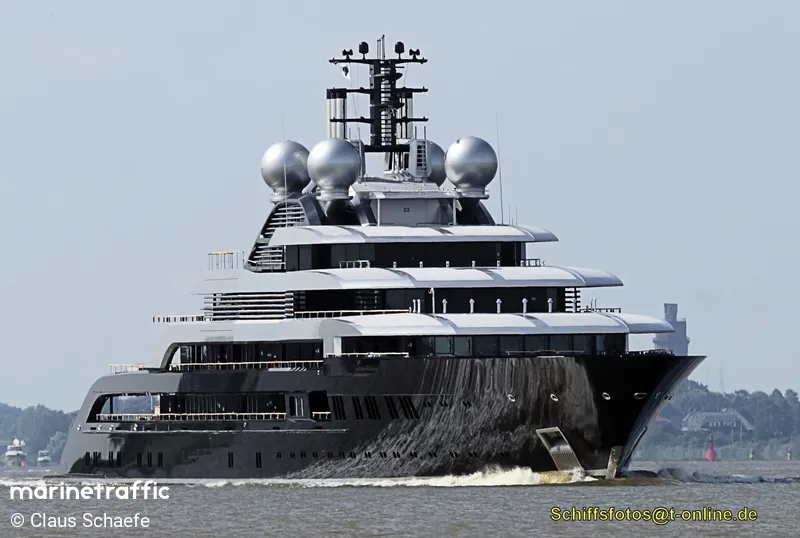
A vessel’s position is the boat’s, not the owner’s. Ownership is as reported, not certified.
Two Lürssen-built motor yachts measure within four tenths of a metre and share a twenty-one-metre beam. The evidence points to shipyard infrastructure determining hull form, leaving exterior designers Espen Øino and interior studios working within fixed parameters rather than developing sister platforms.
The register holds two Lürssen motor yachts, Crescent and Flying Fox, that differ by less than half a metre in overall length and share an identical twenty-one-metre beam. Crescent measures 135.61 metres and was launched in 2018. Flying Fox measures 136.0 metres and entered service in 2019. Their gross tonnages sit at 9,034 and 9,022 respectively. The matching dimensions indicate a single builder repeating a hull envelope that fits its primary construction shed, rather than a shared design platform.
The shed, not the drawing
When a yard operates at this scale, the limiting factor is rarely the client wish list. It is the gantry crane radius, the dry dock wall spacing, and the assembly hall length. Lürssen maintains facilities in Lemwerder, Berne, Bremen-Fähr-Lobbendorf, and Bremen-Vegesack. The yard acquired Blohm+Voss in 2016 and absorbed its project lines before downsizing the Hamburg site in September 2021. During that consolidation period, standardising the maximum beam across new builds reduces engineering overhead. A twenty-one-metre beam fixes the longitudinal bulkhead placement and dictates the width of all transverse decks. The four-tenths difference in length between the two hulls falls within the tolerance of final outfitting and tender garage configuration, not structural redesign.
On 14 September 2018, a fire broke out in the floating dock at Fähr-Lobbendorf, burning the then-under construction structure of the yacht Sassi. The damage exceeded 610 million euros. The incident forced the yard to prioritise existing orders and streamline workflows. Crescent launched later that year near Rendsburg, fitting into the production schedule after the yard recalibrated its capacity. Reusing a proven hull form allowed the engineering team to bypass full hydrostatic model testing for the second vessel. The parallel hull shape ensures that stability calculations remain largely transferable between Crescent and Flying Fox, saving months of simulation time.
The exterior lines of Crescent were drawn by Espen Øino, while Zuretti Design handled the interior. Flying Fox lacks published designer attribution in the available records, which reinforces the separation between the two projects. If they originated from a single platform study, the exterior styling would typically retain sisterly proportions in the bow flare and stern profile. Instead, the identical beam acts as a rigid constraint. Naval architects working within a fixed beam must adjust vertical volume. Deck heights, machinery placement, and fuel tank capacity shift to accommodate the tonnage target. Crescent displaces her 9,034 tonnes through a draught of 5.20 metres.
The weight of the beam
Propulsion choices further illustrate the yard approach to standardisation. Crescent runs on twin 7,512 hp MTU 20V 1163 M84 diesel engines driving twin propellers. This arrangement yields a top speed of 15 knots and a cruising range of 7,000 nautical miles at 11 knots. The powerplant selection aligns with Lürssen established supply chain for vessels in the ninety-thousand-tonne bracket. Matching engine mounts, shaft alignments, and exhaust routing across multiple hulls allows the yard to pre-fabricate machinery spaces. Flying Fox shares the same beam and comparable displacement, meaning her auxiliary systems likely follow the same dimensional logic. The register does not publish her engine specifications, but the tonnage parity makes divergent propulsion layouts unnecessary.
Amenities distribution follows the beam constraint. Crescent carries zero-speed stabilisers, a swimming pool, a movie theatre, a beach club, and a spa room. She also features two helicopter landing pads, one on the bow and another on the top deck covered by a hangar integrated into the main mast. The twenty-one-metre beam sets the maximum width for the beach club and tender garage. Anything wider would require a broader hull, triggering a complete reclassification of the structural grid. The hangar placement on the top deck demonstrates how vertical stacking compensates for horizontal limits. Aviation operations dictate deck reinforcement and rotor wash clearance, but the footprint remains bounded by the beam.
Owners and obligations
The owners of these two hulls operate under entirely different regulatory pressures. Crescent is registered to the Caymanese company Black Dragon Minerals LLS. She is reported as property of Igor Sechin, the chief executive officer of Rosneft. Sechin is a government official considered a close ally of Vladimir Putin. In March 2022, Spanish authorities detained Crescent as property of Rosneft following sanctions connected to the Russian invasion of Ukraine. The vessel carries an estimated value of 600 million dollars. Her last recorded position placed her in the Balearic Sea at 41.1° N, 1.23° E.
Flying Fox is owned by a Member of the Royal Family of Abu Dhabi. She carries an estimated value of 400 million dollars. Like Crescent, she flags in the Cayman Islands with George Town as her home port. Her last observed position sat at 37.79° N, 23.8° E in the Aegean Sea. The Cayman Islands registration provides a uniform legal wrapper for both vessels, but it does not neutralise jurisdictional risk. Sechin detention demonstrates how political status overrides corporate holding structures. The identical beam and length on paper do not translate to identical operational freedom. One vessel faces active seizure proceedings; the other moves through the Mediterranean without public restriction.
The question of whether Crescent and Flying Fox share a platform cannot be answered from the register alone. The sources confirm identical beams, near-identical lengths, and overlapping tonnage bands. They do not confirm shared drawings or common procurement contracts. What the data does confirm is that Lürssen production methodology favours dimensional repetition. When a yard builds multiple vessels above one hundred and thirty metres, it locks in the beam early. The exterior architect receives a fixed canvas. The interior designer works within a predetermined volume. The resulting yachts look distinct on the water, but their steel skeletons obey the same geometric rules.
The available records contain multiple vessels from the same builder. Only two share this exact beam-length combination. The absence of a third vessel carrying a twenty-one-metre beam at this length suggests the pairing is incidental rather than planned. Lürssen adjusts its output to client budgets and delivery schedules. The yard does not force clients into a standardised line. It offers a proven envelope that minimises construction risk. Crescent and Flying Fox occupy that envelope. Their similarities are mechanical, not genealogical.
Reporting and data: CelebYachts, republished by On the record.
Sources
The numbers on this page point here. Each one links to the record it came from.
- 1