
 CelebYachts reportYards & Design
Why Crescent and Flying Fox are so similar
Two Lürssen yachts built in 2018 and 2019 share identical beams. Their matching dimensions reflect shipyard limits, not a shared design.
By On the record · Aug 28, 2026 · Data from CelebYachts1
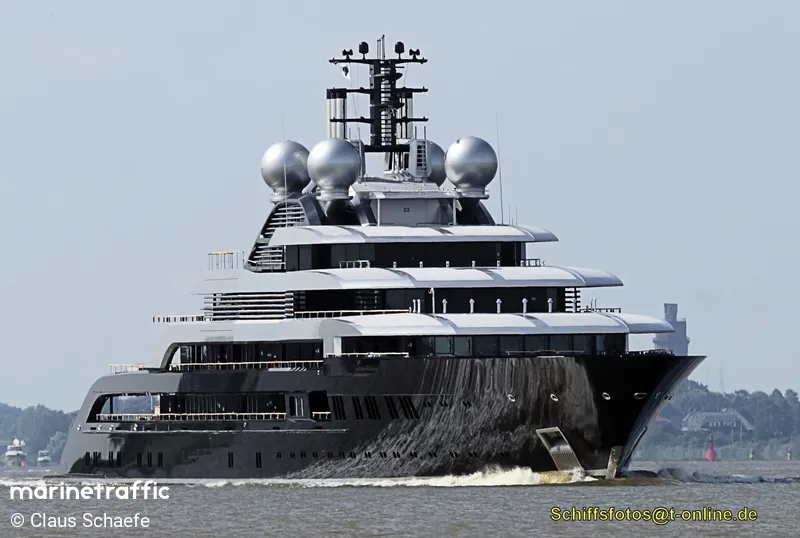
A vessel’s position is the boat’s, not the owner’s. Ownership is as reported, not certified.
Crescent and Flying Fox measure 135.61 metres and 136 metres respectively. They share a 21-metre beam and similar tonnage. The owner of Crescent is Igor Sechin. The owner of Flying Fox is a Member of the Abu Dhabi royal Family. Their similarity reflects Lürssen’s building limits, not a common platform.
Crescent and Flying Fox are two large yachts from the German yard Lürssen. They were delivered in consecutive years, 2018 and 2019. Their sizes on paper are almost identical. Crescent measures 135.61 metres long. Flying Fox measures 136 metres long. Both yachts have a beam of exactly 21 metres. Their gross tonnages are also very close at 9,034 and 9,022.
What do the numbers tell us about their build?
The register shows these figures clearly. The length difference is only thirty-nine centimetres. This is less than the width of a car. The beam is identical. The gross tonnage, which measures internal volume, differs by just twelve units. This level of precision suggests a common constraint. It does not prove they share a hull mould or a sister-ship design. A yard that builds at this scale has standard shed sizes. Clients often ask for specific volumes. The yard delivers to those physical limits.
Crescent was launched in 2018. Her exterior design comes from Espen Øino. Zuretti Design handled the interior. She is flagged in the Cayman Islands. Her home port is George Town. Flying Fox followed in 2019. She shares the Cayman flag and home port. Her builder is also Lürssen. The yard is based in Bremen-Vegesack. It has facilities in Rendsburg and Lemwerder. These sites handle large custom builds. The convergence in size points to the yard’s capabilities.
Both yachts use steel hulls. Their superstructures are aluminium. Crescent has teak decks. She has a draught of 5.20 metres. Flying Fox has similar construction methods. Twin helicopter landing pads sit on both vessels. One pad is on the bow of each yacht. Crescent has a second pad on the top deck. This pad can be covered by a hangar in the main mast. Flying Fox also has two helipads. The amenities include swimming pools and gyms. Both have beach clubs connected to platforms.
Who owns these yachts and what happened to them?
Crescent is owned by Igor Sechin. He is the CEO of Rosneft. Sechin is a Russian government official. He is considered a close ally of Vladimir Putin. The yacht is held by a Caymanese company called Black Dragon Minerals LLS. In March 2022, Spain detained Crescent. The detention followed sanctions against Sechin. These sanctions relate to the 2022 Russian invasion of Ukraine. The Spanish authorities froze the asset. She has remained immobilised since then.
Flying Fox has a different owner. She belongs to a Member of the Royal Family of Abu Dhabi. No specific name is provided in the public record. Her estimated value is 400 million dollars. Crescent is valued at 600 million dollars. Flying Fox was last tracked in the Aegean Sea. This was off the coast of Greece. The tracking data places her there in late August 2025. She appears to be active and moving.
How did Lürssen produce such similar results?
Lürssen is the largest yacht builder in the world. It has built notable vessels like Azzam and Dilbar. The yard acquired Blohm+Voss in 2016. This expanded its capacity. Lürssen builds naval ships as well. Its military division is called Naval Vessels Lürssen. The yard was bought by Rheinmetall in 2025. This deal included four northern German yards. The focus remains on high-end custom work.
The yard has faced challenges. A fire broke out in September 2018. It damaged the floating dock at Fähr-Lobbendorf. The structure under construction was Sassi. The damage cost over 610 million euros. Around 900 emergency services responded. This was the largest deployment in Bremen’s post-war history. Such incidents test a yard’s resilience. Lürssen continued to deliver complex projects.
The similarity between Crescent and Flying Fox is structural. Lürssen uses standardised approaches for large hulls. The sheds dictate the maximum beam. The cranes limit the length. Clients choose features within those bounds. The designers adapt the layout. Espen Øino designed Crescent. Other architects work on other Lürssen projects. The physical output converges. The inputs differ. The result looks alike on paper.
Does this mean they are sisterships?
No source confirms they are sisterships. They share a builder and a timeframe. They do not share a single platform. The term sistership implies a shared mould. Lürssen builds custom yachts. Each order is unique. The dimensional match is a coincidence of scale. It reflects the yard’s engineering standards. It does not indicate a common origin.
The propulsion systems are similar but distinct. Crescent uses twin MTU engines. Each produces 7,512 horsepower. The model is the 20V 1163 M84. These drive two propellers. Her top speed is 15 knots. Her range is 7,000 nautical miles at 11 knots. Flying Fox has comparable performance. The details are not fully public. The class is Lloyd’s Register for Crescent. Flying Fox likely follows similar standards.
The owners’ backgrounds explain the demand. Sechin’s wealth comes from energy. The Abu Dhabi owner represents state interests. Both require secure, capable vessels. Lürssen meets that need. The yard delivers reliability. The dimensions are a byproduct of that reliability. They reflect manufacturing reality.
What is the significance of this pairing?
The pair highlights Lürssen’s market position. It dominates the upper end of the market. Competitors struggle to match its scale. The yard sets the standard. Other builders follow. The convergence of size is inevitable. It is economics. Clients want the best. The best comes in fixed sizes. The yard delivers those sizes. The result is a fleet of lookalikes.
Crescent’s detention adds a political layer. Sanctions target oligarchs. The yacht is an asset. It cannot move. Flying Fox sails freely. She visits the Aegean. The contrast is stark. One is frozen. One is free. Both are products of the same yard. The same constraints apply to both. The outcome depends on politics. The steel is the same.
The registry data confirms the similarity. The IMO numbers differ. The MMSI codes differ. The flags are the same. The builders are the same. The lengths are nearly equal. The beams are equal. The tonnages are equal. The year of build differs by one. The pattern is clear. It is a pattern of production. It is not a pattern of kinship.
Readers often search for connections. They assume similarity means relation. That assumption is wrong. Yacht design is bespoke. Every curve is chosen. Every material is selected. The yard guides the choice. The yard enforces the limit. The limit creates the shape. The shape repeats. The repetition shows efficiency. It is not identity.
Lürssen’s history supports this view. It started in 1875. It built rowboats first. It moved to motorboats. It now builds warships and yachts. The scale has grown. The methods have refined. The output is consistent. The consistency is the story. The numbers tell it. The names hide it. The truth is in the steel.
Reporting and data: CelebYachts, republished by On the record.
Sources
The numbers on this page point here. Each one links to the record it came from.
- 1