
 CelebYachts reportYards & Design
The hundred-and-two-metre volume
A 16-metre beam and 3,840 tons of enclosed space define Destiny’s architecture, prioritising interior volume and liveaboard stability over hydrodynamic…
By On the record · Aug 24, 2026 · Data from CelebYachts1
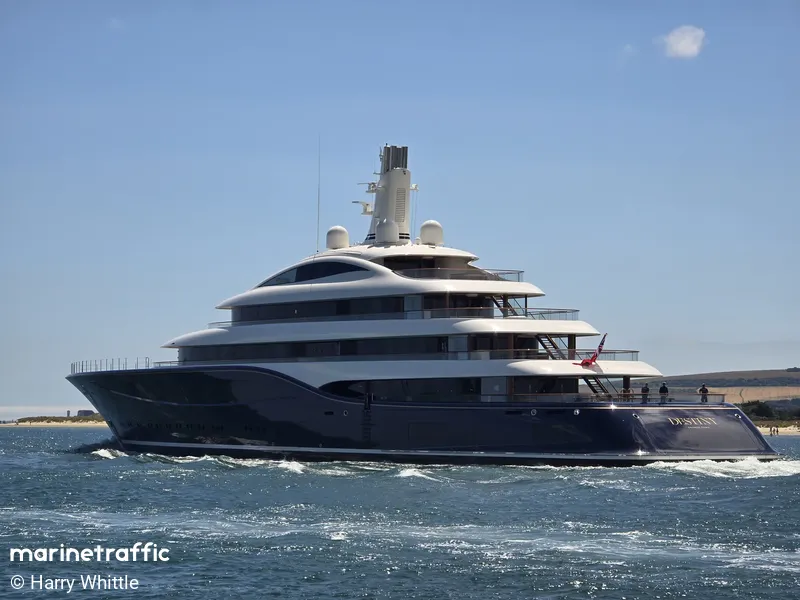
A vessel’s position is the boat’s, not the owner’s. Ownership is as reported, not certified.
Steve Schwarzman’s new 102-metre yacht carries a beam-to-length ratio that forces a specific structural compromise. The dimensions of the hull reveal a vessel built for expansive public decks and heavy displacement, not for crossing oceans at speed.
The hull form of Destiny begins with a single, defining dimension: a beam of 16.0 metres on a 102.0-metre length overall. That ratio of 0.157 places her well outside the slender profiles favoured by designers chasing high-speed runs. A beam that wide relative to the length forces the naval architect to accept a broader waterline and a fuller entry. The trade-off is immediate. Wetted surface area increases, which raises resistance through the water and demands more shaft horsepower to maintain cruising speeds. In exchange, the yacht gains initial stability and interior square footage that a narrower hull simply cannot accommodate. Cabins run deeper. Public rooms stretch wider. The 16.0-metre beam acts as a structural mandate that shapes every deck above it. A vessel of this proportion requires reinforced longitudinal framing to manage the bending moments across such a wide platform, particularly when loaded with fuel, water, and provisions for extended passages. The sheer breadth of the main deck sets the template for the entire superstructure, limiting the feasibility of tapering upper decks without compromising the volume targets set by the owner.
The width penalty
The gross tonnage of 3,840 confirms the spatial priorities established by that beam. Gross tonnage measures enclosed volume, not weight, and a figure of 3,840 for a hull of this length indicates a multi-deck arrangement with substantial public accommodation. Volume of this magnitude requires careful subdivision to meet international safety standards, dictating the placement of watertight bulkheads and the routing of machinery spaces. The tonnage also implies a significant superstructure. Every additional deck adds height to the centre of gravity, which the wide beam helps counteract, but it also increases windage. The resulting silhouette will be blocky rather than tapered, optimised for floor space rather than aerodynamic cleanliness. The 3,840 GT reflects a design brief focused on liveaboard comfort rather than high-speed transit. It suggests a layout where guest suites likely span the full width of the hull or occupy dedicated side decks, maximising natural light and exterior access at the expense of a sleeker, more aggressive profile. Classification societies will scrutinise the stability calculations for this volume, requiring precise weight distribution data to certify the vessel for operation in various sea States.
The volume allocation
Builder details and estimated value remain unrecorded in the current data, but home port is also null. Ownership sits with Steve Schwarzman, who ordered the hull for delivery in 2026. The absence of a named yard does not obscure the engineering reality: a 102-metre steel or aluminium hull carrying nearly four thousand tons of gross volume requires a facility capable of handling heavy plate work and extensive outfitting. The Cayman Islands flag provides the regulatory framework for the vessel. Registration there aligns with standard commercial superyacht practice, offering a familiar jurisdiction for charter operations and class society inspections. The decision to fly the Cayman flag often correlates with a business model that anticipates frequent chartering, as the registry is recognised globally for its compliance with international maritime conventions and its streamlined administrative processes for large commercial vessels.
The Cayman registry
The combination of a 102.0-metre length and a 16.0-metre beam dictates a specific powertrain configuration. The increased beam raises the displacement significantly, even before accounting for the 3,840 GT of interior volume. Higher displacement means the engines must overcome greater hydrodynamic drag at any given speed. Naval architects typically respond to this by installing higher-output diesel-electric or gas turbine packages, often arranged in twin-engine configurations to balance thrust with manoeuvrability. The wide beam also improves turning radius control, allowing the yacht to pivot effectively despite its mass. However, the fuel capacity required to sustain range with this hull form will consume a notable portion of the deadweight allowance. The design will likely prioritise efficient cruising speeds over maximum sprint capabilities, as the energy cost of pushing a 16-metre beam through the water rises exponentially beyond certain thresholds. This trade-off is baked into the steel from the keel up.
The power requirement
Operating a vessel of this scale introduces specific compliance obligations. The Cayman Islands registration subjects Destiny to rigorous inspection regimes, particularly regarding fire safety and emergency evacuation routes mandated by the Safety of Life at Sea convention. The 3,840 GT threshold triggers additional requirements for life-saving appliances and crew training standards. These regulations directly influence the interior layout, as escape routes and muster stations must be integrated into the public spaces without encroaching on the volume targets. The wide beam aids compliance by providing ample deck space for lifeboat deployment and clear evacuation corridors. The 2026 delivery date ensures the vessel will be built to the latest environmental directives, including ballast water management systems and exhaust cleaning technologies. The regulatory landscape does not merely constrain the design; it actively shapes the functional hierarchy of the decks, placing safety infrastructure alongside the luxury amenities.
The regulatory environment
Tracking data places Destiny in the Aegean Sea at 37.25° N, 23.17° E. AIS broadcasts show the vessel holding station in those coordinates, consistent with a hull undergoing sea trials or fitting out at a nearby marina before final handover. The lack of recorded movements confirms she has not yet entered active service. The dimensions of the hull define her operational capabilities. A 16.0-metre beam and 3,840 GT lock her into a category of wide-body, high-volume luxury yachts, built to carry passengers across long distances in spacious, stable quarters rather than to outrun smaller, faster craft. The 2026 delivery window allows the shipyard sufficient time to complete the complex welding sequences and interior installations required for a vessel of this tonnage, ensuring that the promised volume translates into a structurally sound and seaworthy platform.
Reporting and data: CelebYachts, republished by On the record.
Sources
The numbers on this page point here. Each one links to the record it came from.
- 1