
 CelebYachts reportYards & Design
How Tango and ZEN show Feadship's growth
Two yachts from the same Dutch cooperative reveal how new shipyard sheds and changing buyer wealth expanded superyacht sizes over ten years.
By On the record · Sep 25, 2026 · Data from CelebYachts1
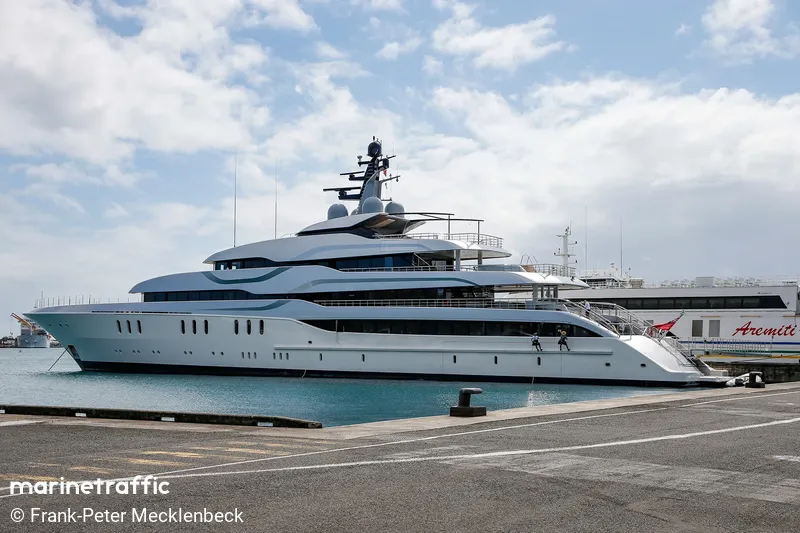
A vessel’s position is the boat’s, not the owner’s. Ownership is as reported, not certified.
Tango and ZEN were both ordered through De Voogt Naval Architects. Their dimensions show a structural shift at the Feadship yards. The extra size came from a new dry dock in Amsterdam and a new class of buyer, not just more luxury.
Tango and ZEN share a design office. They also share a builder. Both vessels carry the Feadship designation. Yet they look very different on paper. The gap between them tells a story about industrial change.
The older yacht is Tango. She measures seventy-seven point seven metres. Her owner is Viktor Vekselberg. He paid for her around twelve hundred million dollars. The register lists her value at that figure.
The newer vessel is ZEN. She runs eighty-eight point three eight metres. Her owner is Jack Ma. His fortune comes from Alibaba Group. He built his wealth in China. His yacht reflects that scale.
Why did Feadship build two ships so differently?
Feadship is a cooperative venture. It joins two Dutch shipyards. These are Royal Van Lent Shipyard and Koninklijke De Vries Scheepsbouw. They share one design centre. That centre is De Voogt Naval Architects.
De Voogt designed both Tango and ZEN. This explains their similar style. But the builders faced different physical limits. Tango was finished in twenty eleven. ZEN arrived in twenty twenty one.
The time between them matters. Feadship changed its capacity during those years. Royal Van Lent opened a new dock in early twenty nineteen. It sits in Amsterdam's Westpoort area. This dock handles superyachts up to one hundred sixty metres.
Tango predates this expansion. She fits into the older slips. Those slips handle vessels up to one hundred metres. Tango stays well within that limit. ZEN arrives after the new dock opens. She uses the larger space.
The new dock allows bigger steel volumes. Gross tonnage measures inside volume. Tango holds two thousand eighty-three tons. ZEN holds two thousand five hundred sixty-two tons. That is nearly four hundred tons more.
Beam width also increased. Tango is twelve point two metres wide. ZEN is thirteen metres wide. The extra width supports the extra length. It gives more room for decks and cabins. The structure grew with the market.
The Amsterdam dock enables the larger ZEN. The older slips still handled Tango well. The cooperative structure allowed flexibility. Different yards could take different orders.
Feadship has roots going back to eighteen forty nine. The Akerboom family bought a small yard then. They joined with the Van Lent family in nineteen twenty seven. The cooperative formed in nineteen forty nine.
Henri de Voogt founded the export association. He wanted to sell to American clients. The first launch was at the New York Boat Show in nineteen fifty one. Steel was a new technology there.
The company stopped building wood yachts by the mid-fifties. Mergers reduced the number of yards. By nineteen sixty six only three yards remained. The group grew steady through the sixties.
Royal Van Lent got a royal charter in twenty zero one. De Vries received hers in twenty zero six. LVMH acquired Royal Van Lent in twenty zero eight. Ownership changed, but the cooperative model stayed.
Who owns these yachts and where do they go?
Viktor Vekselberg owns Tango. He is a Russian-Israeli businessman. He leads the Renova Group conglomerate. Forbes estimates his net worth at nine point three billion dollars. He ranks as the two hundred sixty-second richest person.
Vekselberg was born in Ukraine. He holds Russian, Israeli and Cypriot citizenship. Tango flies the flag of the Cook Islands. Her home port is George Town. She was last seen in the Balearic Sea.
Jack Ma owns ZEN. He is a Chinese philanthropist. He co-founded Alibaba Group and Yunfeng Capital. His net worth is approximately twenty seven point five billion dollars. He is among the richest men in China.
Ma's wealth comes from e-commerce. This differs from Vekselberg's industrial background. ZEN flies the flag of the Cayman Islands. Her home port is also George Town. She was last tracked in the Gulf of Alaska.
The buyers reflect global economic shifts. Vekselberg represents the old Russian oligarch class. His wealth comes from metals and mining. Ma represents the new Asian tech elite. His wealth comes from digital platforms.
Both men demanded large yachts. But the constraints differed. Vekselberg needed a vessel for European waters. The Balearic Sea is his usual haunt. Ma needs range for Pacific crossings. The Gulf of Alaska shows that reach.
Feadship adapted to both markets. The Amsterdam dock enabled the larger ZEN. The older slips still handled Tango well. The cooperative structure allowed flexibility. Different yards could take different orders.
De Vries operates yards in Aalsmeer and Makkum. The Makkum yard opened in twenty zero five. It has deep water access. It builds yachts over one hundred twenty metres long. Its shed is one hundred seventy metres wide.
Royal Van Lent manages Kaag and Amsterdam. Kaag has two dry docks. It handles vessels up to one hundred metres. Amsterdam handles the larger ones. This division of labour helps the cooperative.
The design centre sits in Hoofddorp. De Voogt Naval Architects works there. They create the plans for both hulls. The shared engineering ensures quality. It also ensures consistency across the fleet.
Feadship launched at the New York Boat Show in nineteen fifty one. It showcased steel construction. This was new for North America. Orders flowed for steel and aluminum. The company moved away from wood quickly.
Henry Ford and Malcolm Forbes bought Feadships. They were early American clients. Don Kenniston managed the US office from nineteen seventy seven to twenty zero eight. Ted McCumber runs it now.
The nuclear energy maritime organization joined Feadship in September twenty twenty five. This shows future ambitions. The cooperative looks beyond traditional fuels. Tango and ZEN use conventional power.
Tango and ZEN mark a decade of growth. They show how infrastructure enables scale. They show how buyer profiles evolve. The same designer produced two very different boats. The difference lies in the steel and the money.
Reporting and data: CelebYachts, republished by On the record.
Sources
The numbers on this page point here. Each one links to the record it came from.
- 1