
 CelebYachts reportYards & Design
How Maryah became a yacht from a Soviet research ship
Maryah was built as a Soviet research vessel. The conversion kept the original hull shape. This design choice limits her speed and range today.
By On the record · Jul 13, 2026 · Data from CelebYachts1
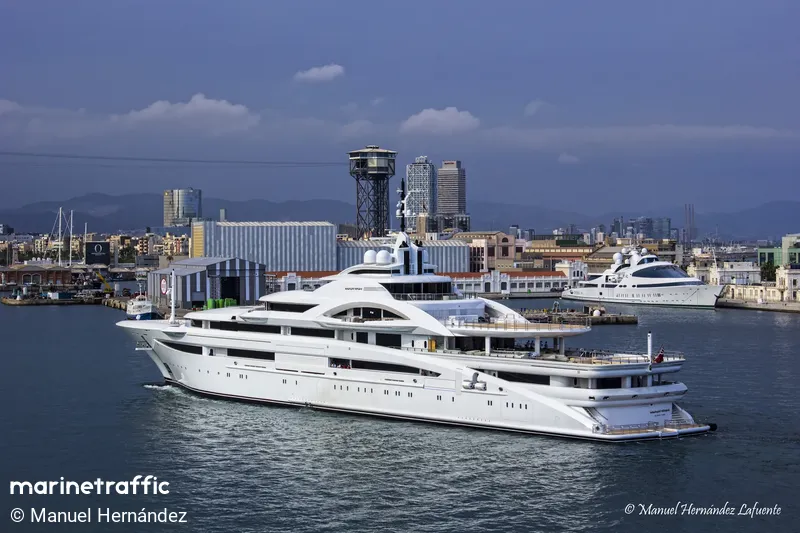
A vessel’s position is the boat’s, not the owner’s. Ownership is as reported, not certified.
Maryah, owned by Sheikh Tahnoon bin Zayed Al Nahyan, began life as a Soviet research ship in 1990. She was rebuilt into a luxury yacht between 2007 and 2015 at Elefsis Shipyards in Greece. Her dimensions show the engineering cost of this change. The steel remembers its past work.
Maryah is a 125-metre motor yacht. She carries a Cayman Islands flag. Her owner is Sheikh Tahnoon bin Zayed Al Nahyan of Abu Dhabi. He holds her through a private structure. The value is estimated at $250 million.
She did not start as a superyacht. She launched in 1990 as a Soviet research ship. Her original name was Dalmorgeologiya. She was later renamed Fortune. The Polish Szczecin Shipyard built her frame.
The Greek Elefsis Shipyards changed her purpose. They worked on her from 2007 to 2015. H2 Yacht Design planned the retrofit. Naos S.r.l. handled the naval architecture. Genesis Yachtline finished the interior in Florida.
What does the old hull look like now?
Her length is 125.0 metres. Her beam is 17.0 metres. This gives a length-to-beam ratio of about 7.4 to 1. Modern superyachts often run higher. A ratio near 8 or 9 is common for speed.
A wider beam adds stability. It also creates more drag. The wide body slows her down. It uses more fuel to move. The shape suits slow, steady work. It does not suit fast cruising.
Her gross tonnage is 7,023. This measures her internal volume. The number is modest for her length. The thick walls of a research ship take up space. They leave less room for cabins.
The hull form dictates her performance. She cannot match the speed of new builds. Her displacement geometry remains unchanged. The steel keeps its original lines. No amount of luxury fitting changes physics.
The conversion added comfort features. Luxury interiors replaced lab equipment. But the skeleton stayed the same. The engine placement follows the old layout. The machinery sits where it always did.
The steel remembers its original purpose. The hull shape limits what the engines can achieve.
How long did the rebuild take?
Work started in 2007. H2 Yacht Design joined in 2009. They called the project Project Czar. The name Czar was used then. The plan took years to finish.
Announcements came in September 2014. The new name Maryah was revealed. Sea trials began in Greece that October. She moved slowly during tests. The engines were checked carefully.
She appeared in Tivat in March 2015. Porto Montenegro saw her hull. She completed her maiden voyage in Livorno, Italy. That happened in April 2015. The build was finally done.
She was spotted in May 2015. The French Riviera hosted her. The conversion was complete. The ship had become a yacht. The transition took eight years.
Elefsis Shipyards handled the heavy work. They are a Greek company. Founded in 1968, they build bulk carriers too. They know how to handle large steel vessels. This job used their repair skills.
Where has she been since 2015?
She returned to Porto Montenegro in 2019. The location suited her size. She stayed there for some time. Then she moved again. Her movements are sporadic.
In 2023, she went to Gibraltar. She needed another retrofit. The refit was done by NCA Refit. This work finished in 2024. Maintenance keeps an old hull safe.
AIS data shows her recent path. She sailed from Damietta, Egypt. She reached Barcelona, Spain in late September 2026. The trip covered 1,538 nautical miles. It took five days to cross.
Her average speed was 13.2 knots. Max speed hit 16.1 knots. These figures confirm the hull limits. A sleek yacht would go faster. The wide beam holds her back.
Before that, she moved near Safaga. She traveled to Suez, Egypt. The distance was 230 nautical miles. Average speed dropped to 10.7 knots. Short trips suit her profile.
She stays in the Red Sea often. Coordinates show 27.67° N, 33.89° E. This area fits her operational range. She does not make long ocean runs. Regional hops are her norm.
Who owns Maryah and why?
Sheikh Tahnoon bin Zayed Al Nahyan owns her. He is from Abu Dhabi, UAE. He serves as a national security advisor. His status explains the vessel's nature.
Royalty often prefer unique ships. A converted hull offers privacy. The research past hides her origins. Guests may not see the lab tables. The history is obscured by luxury.
The cost of conversion was high. Estimates place her value at $250 million. This includes the original hull price. It covers the decade of work. It pays for the unique design.
Ownership is reported, not certified. Records list him as the holder. The Cayman Islands flag provides secrecy. George Town is her home port. This setup protects his identity.
The yacht reflects his taste. He chose a working hull. He accepted the speed limits. He gained a one-of-a-kind ship. The trade-off is clear.
Does the conversion add value?
New yachts cost billions. Maryah cost less to build. The base hull was cheap. The conversion added significant expense. The total is still lower than new.
But the savings have limits. Every part had to be fitted. Old frames met new designs. The join points require care. Engineering costs rise with age.
Maintenance is harder for old hulls. Parts are no longer made. Specialists must fabricate custom pieces. Elefsis knows the steel well. They can fix what breaks.
The value lies in exclusivity. No other ship looks like this. The Soviet origin is a story. Buyers pay for the narrative. The history adds charm.
Speed is the main penalty. She cannot outrun newer boats. Fuel bills are higher per mile. Range is shorter on full tanks. These are the hidden costs.
Yet she remains seaworthy. The 2024 refit ensured this. NCA Refit updated her systems. The hull integrity is sound. She sails safely in global waters.
The conversion succeeded on its terms. It created a luxury vessel. It kept the robust Soviet frame. The result is a unique yacht. She sails on, slow and steady.
Reporting and data: CelebYachts, republished by On the record.
Sources
The numbers on this page point here. Each one links to the record it came from.
- 1