
 CelebYachts reportProfiles
The industrial logic behind Fincantieri’s two yachts
The yard’s superyacht output is dictated by heavy-industry infrastructure and state backing, rather than a commercial pursuit of luxury margins.
By On the record · Aug 24, 2026 · Data from CelebYachts1
A vessel’s position is the boat’s, not the owner’s. Ownership is as reported, not certified.
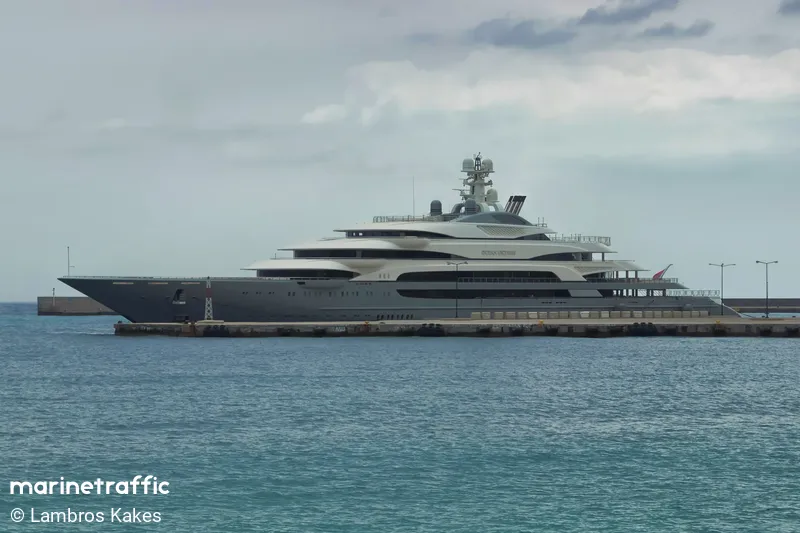
Fincantieri built only two of the world’s largest motor yachts, yet those vessels anchor its register. Their existence proves that the yard’s capacity comes from warship sheds and cruise-liner economics, leaving superyacht construction as a structural byproduct rather than a commercial strategy.
Fincantieri’s record on this site contains just two hulls, Ocean Victory and Serene, measuring 140 m and 133.9 m respectively.
They were delivered in 2014 and 2011.
The yard does not build a steady stream of large yachts because its production model is anchored in public contracts and heavy commercial shipping.
The facilities that allow it to assemble these two vessels are the same ones engineered for littoral combat ships and cruise liners.
The constraint is physical: covered building sheds built for naval programmes that happen to clear enough space for a 140 m hull.
The result is a sporadic yacht output that appears whenever a slipway becomes free from a larger state order.
The corporate architecture
Fincantieri was founded in December 1959 as a financial holding company to consolidate Italian state shipyards, including Cantieri Riuniti dell’Adriatico and Ansaldo.
It did not become an operating entity until 1984, when it incorporated subsidiaries like Italcantieri and reorganised into merchant, naval, repair and engine divisions.
That transition locked the group into a cycle of long-term government procurement.
Ownership remained with the Italian state through IRI until 2002, when liquidation passed control to Fintecna and eventually Cassa Depositi e Prestiti.
Today CDP Equity holds 64.21 per cent.
The state backing stabilises the balance sheet against cyclical downturns in private leisure craft, allowing the yard to prioritise multi-year naval and cruise contracts.
A yacht order arrives only when the primary pipeline clears.
Expansion and regulatory friction
In January 2009 Fincantieri acquired the US Manitowoc Marine Group, absorbing Marinette Marine and topside repair facilities in Ohio and Wisconsin.
The purchase doubled its American footprint and secured U.S. Navy and Coast Guard work.
Twelve months later it bought STX OSV Holdings Ltd for €900 million, renaming the subsidiary Vard and entering offshore support vessel construction.
These acquisitions targeted commercial and defence markets, not the superyacht sector.
The group’s European dominance grew alongside these purchases, yet the integration of French assets stalled when the European Commission opened an antitrust investigation into cruise market concentration.
In September 2017 Prime Minister Paolo Gentiloni and President Emmanuel Macron signed an agreement for Fincantieri to take a majority stake in STX France, but the transaction collapsed in January 2021 after regulatory delays and political opposition.
The failed buyout demonstrates how regulatory scrutiny and state interests govern the yard’s growth more than private yacht demand.
The cruise shadow
The Mega Yachts division illustrates the operational reality of this model.
Established in 2005, it focused on large luxury vessels but produced only two entries for this register before shifting focus back to cruise and naval programmes.
Serene, measuring 133.9 m, was delivered in 2011 and won the Superyacht Design Award.
Ocean Victory followed in 2014 at 140 m.
Neither vessel triggered a new wave of yacht commissions.
Instead, the yard directed its capital toward cruise ship construction, where it held over 25 per cent of the global market share from 1995 onward.
The delivery of Crown Princess in 1990 marked its formal entry into passenger vessels, followed by Carnival Destiny in 1996.
More recently, Monfalcone launched Star Princess in September 2024, a 345 m liquefied natural gas-powered liner, while Ancona prepares Viking Libra for hydrogen propulsion by late 2026.
The sheer tonnage of these commercial projects consumes the same building berths that could theoretically host additional yachts.
The listing process began on 16 June 2014 and ended on 27 June 2014.
To celebrate the event, a ship’s bow was installed at Palazzo Mezzanotte in Milan, appearing to emerge from the building itself.
The debut took place on 3 July 2014.
Marghera entered the cruise sector with Costa Classica in 1991, Sestri Ponente followed in 2003 with Costa Fortuna, and Ancona added Silver Spirit in 2009.
Defence and infrastructure crowding
Defence contracts further crowd the schedule.
In 2019 Fincantieri created Naviris, an equal joint venture with Naval Group based in Genoa, to modernise Horizon-class frigates and develop the European Patrol Corvette.
The Italian Navy ordered the fourth new-generation submarine in June 2024 for €500 million.
In January 2025 the yard acquired Whitehead Alenia Sistemi Subacquei from Leonardo, taking over torpedo and sonar manufacturing.
A February 2025 contract with Norwegian Cruise Line valued at €9 billion for four maxi cruise ships extends production commitments through 2036.
These orders occupy the workforce of 24,000 employees across 18 shipyards.
The two yachts on the register are therefore not products of a dedicated luxury line but residual capacity released from heavier programmes.
Infrastructure divisions also absorb capital.
Fincantieri Infrastructure S.p.A., established in 2017, reconstructed the Viadotto Genova San Giorgio between 2019 and 2020.
The division expanded in 2021 with the acquisition of Inland and the creation of Fincantieri Infrastructure Opere Marittime for port and quay construction.
Such projects require steel fabrication capacity and engineering talent that compete with yacht interior fit-outs.
The yard’s strategic pivot toward alternative energy and underwater systems reinforces this pattern.
In March 2023 it led the creation of the National Underwater Dimension Hub in La Spezia.
February 2024 saw the acquisition of Remazel for offshore and underwater operations.
By 2025 the Minerva project began developing mini nuclear reactors for military submarines, and the Navis Sapiens initiative integrated artificial intelligence into fleet data processing.
Each initiative demands shipyard floor space and skilled labour that would otherwise support discrete luxury builds.
Geographic distribution and capacity
The geographic distribution of its yards dictates where a hull can be assembled.
Trieste serves as headquarters and houses historic facilities inherited from CRDA and Ansaldo.
Muggiano specialises in naval vessels, having launched the Destriero in 1992, an aluminium fast craft that crossed the Atlantic at 53.09 knots.
Monfalcone handles large commercial and cruise vessels, as demonstrated by the recent LNG liners.
Ancona hosts the hydrogen-capable Viking Libra.
Livorno and Muggiano were sold by OTO to Ansaldo in 1949, closing off earlier options for large-scale civilian assembly.
The remaining sites in Riva Trigoso, Palermo, Ancona, Marghera and Sestri Ponente form a network optimised for volume production rather than bespoke craftsmanship.
A 140 m yacht requires a berth capable of handling heavy block assembly and crane capacity calibrated for cruise decks.
The yard possesses such infrastructure, but deploying it for a single private hull interrupts the sequencing of state and commercial orders.
Ownership and visibility
Ownership transparency remains partial.
The corporate chain passes through CDP Equity and the Italian Ministry of Economy and Finance, with shares traded on the Borsa Italiana as part of the FTSE Italia Mid Cap Index since June 2014.
Listing fees and dividend obligations pressure management to prioritise high-volume contracts over low-turnover luxury projects.
The yard’s public filings do not break out profit margins by segment, leaving the financial return on Serene and Ocean Victory unverified.
What is visible is the allocation of physical resources.
Covered sheds at Muggiano and Monfalcone measure sufficient span to house the two registered hulls.
When those sheds clear from submarine keel-laying or cruise module stacking, a yacht contract can proceed.
Until then, the slipways remain occupied by vessels that generate predictable government revenue or carry thousands of paying passengers.
The register’s two entries reflect a broader industrial truth.
Fincantieri does not chase the superyacht market.
It builds what its state-backed infrastructure, naval partnerships and cruise contracts allow.
The 140 m Ocean Victory and the 133.9 m Serene exist because heavy industry occasionally yields space.
Their dimensions match the maximum clearance of existing shipbuilding halls.
Their delivery dates align with lulls in naval procurement cycles.
Any future addition to the registry will depend not on shifts in luxury demand but on the release of a slipway from a larger programme.
Reporting and data: CelebYachts, republished by On the record.
Sources
The numbers on this page point here. Each one links to the record it came from.
- 1