
 CelebYachts reportInvestigations
The institutional life of the oldest hulls
Longevity in the register is not a product of preservation budgets but of wartime seizures, state service, and commercial conversions that delayed scrapping…
By On the record · Aug 10, 2026 · Data from CelebYachts1
A vessel’s position is the boat’s, not the owner’s. Ownership is as reported, not certified.
The twelve oldest vessels still tracked by AIS do not share a single owner or builder. They survived because they were removed from the private leisure market and absorbed into navies, training fleets, or state administrations, where operational necessity overrode the economic pressure to scrap.
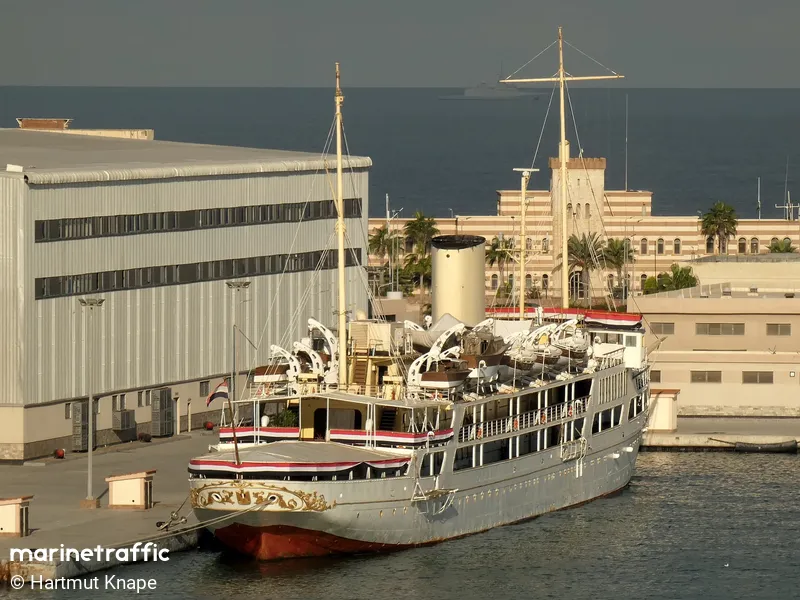
The record for the oldest commissioned hull in the register belongs to El Mahrousa, launched in 1865 by Samuda Brothers in London. She measures 145.72 metres and carries 4560 gross tons. The vessel was built for Khedive Ismail of Egypt and entered service as a royal yacht before being transferred to the Egyptian Navy. Her name changed to El Horriya following the 1952 revolution, but her structural continuity remains unbroken. No other entry in the top twelve predates the First World War.
The gap between her launch date and the next oldest hull, Belem in 1896, spans thirty-one years. That interval reflects a shift in maritime technology: iron and steel construction replaced wood, and steam propulsion displaced sail, making pre-1890 designs economically obsolete long before modern conservation standards existed. El Mahrousa survived because she was retained as a flagship for the Egyptian government. State vessels operate on different accounting cycles than private owners. Maintenance is funded through defence or cabinet budgets rather than charter income or asset depreciation. This funding model allowed her to remain in commission through two world wars, a republic, and multiple regime changes. The register lists her estimated value as undisclosed. The absence of a price tag is standard for state-owned assets and does not indicate a lack of upkeep.
Wartime seizures and return
The second cluster of old hulls shares a different mechanism of survival: Allied and Axis seizures during the Second World War. Fantome, launched in 1927 by Ansaldo in Livorno, measures 85.94 metres and carries 676 gross tons. She was ordered by the Italian navy before being sold to Prince Luigi Amedeo, Duke of Abruzzi. During the conflict, she was requisitioned and later returned to private hands. Her current use as a hotel ship demonstrates how decommissioned large vessels find secondary markets when leisure operations cease.
Haida 1929, measuring 66.41 metres and built by Friedrich Krupp Germaniawerft in Kiel in 1929, followed a similar path. Designed by Cox & Stevens for William K. Vanderbilt II, she was acquired by the United States Coast Guard, transferred to the French Navy, and eventually returned to civilian operation. Nahlin, launched in 1930 by John Brown & Co in Clydebank, measures 92.0 metres and weighs 1377 gross tons. She was seized by Italian forces, handed to the French, and restored to her original owner, Reginald Webster, before passing to subsequent private buyers. Talitha G, launched the same year by Friedrich Krupp Germaniawerft in Kiel, measures 80.0 metres and carries 1103 gross tons. Built for Sir Joseph Duveen, she was captured by German authorities, taken by the French, and returned to Duveen.
These four vessels demonstrate that wartime disruption preserved hulls that would otherwise have been sold for scrap in the 1930s. Military acquisition froze their commercial valuation. When the war ended, returning owners faced a market where spare parts, skilled labour, and fuel costs had risen sharply. Many older yachts were dismantled immediately after 1945. The ones that survived did so because their owners had the capital to refit them in the late 1940s and 1950s, often replacing engines and superstructures while retaining the original steel frames.
The commercial-to-leisure pivot
Not every survivor began as a luxury craft. Belem, launched in 1896 by Chantiers Dubigeon in Nantes, measures 58.0 metres and carries 507 gross tons. She was originally built as a collier, a commercial coal carrier, before being converted into a four-masted barque and later a training ship. Kalizma, launched in 1906 by Ramage & Ferguson in Leith, measures 45.0 metres and carries 278 gross tons. She was designed as a fishing trawler before being purchased and fitted out as a private yacht. Marala, launched in 1931 by Camper & Nicholsons in Gosport, measures 58.86 metres and carries 499 gross tons. She was constructed as a cargo vessel before conversion.
These entries prove that the register tracks hull age, not original intent. A vessel built for hauling coal or catching fish can enter the yacht register the moment it is refitted with passenger accommodation and leisure amenities. The conversion process usually strips the original machinery and replaces it with modern propulsion, which resets the mechanical age while leaving the hull plating intact. Savarona, launched in 1931 by Blohm & Voss in Hamburg, measures 124.0 metres and carries 4701 gross tons. She was built specifically for Mustafa Kemal Atatürk as a presidential yacht. Like El Mahrousa, she benefited from state funding. She served Turkey until 1996, when she was retired and converted into a hotel ship.
The distinction between state service and commercial conversion is clear in the register's layout. State vessels like El Mahrousa and Savarona remained in official commission for decades, accumulating maintenance records that justify their continued tracking. Commercial conversions like Belem and Kalizma relied on niche markets, training schools, heritage tourism, or charter operators, to cover operating costs. Both models outlasted the private luxury segment, where vessels typically change hands every seven to ten years and are scrapped when repair costs exceed market value.
The modern gap
The register contains 218 tracked hulls. The jump from the oldest twelve to the thirteenth entry reveals a structural break in yacht construction. All vessels listed above were built before 1932. The next oldest hull in the full register dates to 1952. That twenty-year gap corresponds to the post-war rebuilding period, when shipyards prioritised merchant shipping, naval reconstruction, and containerisation over private leisure craft. Steel prices, labour shortages, and changing regulatory frameworks made large yacht construction uneconomical until the 1950s.
The twelve oldest entries therefore represent a closed cohort. No new vessel will enter this group for at least forty years. The record for oldest commissioned hull will not change hands unless a pre-1932 vessel is removed from the register due to scrapping, loss, or reclassification. El Mahrousa remains at the top. Her continued AIS broadcast confirms she is still active. The other eleven vessels persist because they serve functions outside the traditional superyacht market. They are training ships, hotel vessels, research platforms, or privately owned historic craft. Their longevity is documented by AIS data, not by marketing brochures. The register tracks them because they meet the length and tonnage thresholds, not because they fit a modern lifestyle category. The oldest hulls in the register are working vessels that avoided demolition through institutional utility.
Reporting and data: CelebYachts, republished by On the record.
Sources
The numbers on this page point here. Each one links to the record it came from.
- 1