
 CelebYachts reportYards & Design
The interior designer inherited a hull built for speed
The volume Christophe Leoni received for Azzam’s interiors was shaped by hydrodynamic requirements.
By On the record · Jul 7, 2026 · Data from CelebYachts1
A vessel’s position is the boat’s, not the owner’s. Ownership is as reported, not certified.
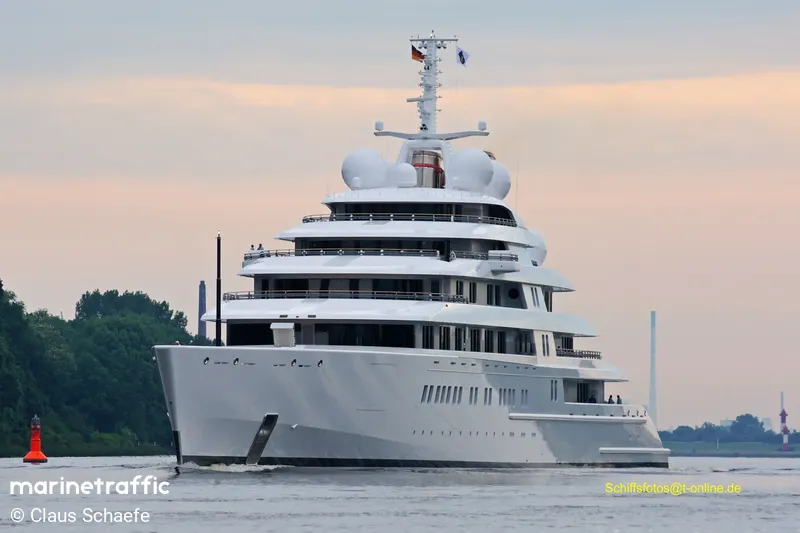
Azzam’s interior designer was handed a shell constrained by the demand for 32-knot performance and a 4.3-metre draft. The pillarless salon addresses a structural problem created by the propulsion layout.
The interior of Azzam has never been published. The floor plans, material specifications, and commissioned artworks remain undisclosed. What is recorded is the volume that remained after the engineering team allocated space for propulsion and stability. The yacht measures 180.61 metres in length and displaces 13,136 gross tonnes. Her beam is 21.69 metres. These dimensions define a large internal cavity, but the usable interior space is heavily restricted by the machinery required to move the hull.
The mechanical footprint
The powerplant occupies the forward and mid-sections of the lower decks. Azzam carries 35,048 kW of total output, generated by two gas turbines and two diesel engines. Gas turbines are compact but require significant airflow and exhaust routing, which consumes longitudinal volume that might otherwise be reserved for guest accommodation. The machinery feeds four pump-jets located at the stern. Two of these are fixed round water outlets positioned in the Middle of the stern. The other two feature movable duct water outlets that provide thrust vectoring capabilities. The installation of these movable units demands reinforced structural framing and additional hydraulic or mechanical control lines running through the hull. This infrastructure reduces the flexibility of the aft interior layout and limits the space available for tender storage or crew quarters in the lower decks.
The hull form imposes further constraints. Azzam operates with a draft of only 4.3 metres. This is unusually shallow for a vessel of her tonnage. A deeper hull would allow for a larger ballast reserve and more vertical interior volume, but it would restrict operations in the shallow coastal waters of the Arabian Gulf and the Mediterranean. The shallow draft compresses the interior vertically. The interior designer, Christophe Leoni, could not utilise a tall, deep hull to create expansive double-height spaces. The ceiling heights in the guest cabins and service areas were necessarily capped by the distance between the waterline and the main deck. The naval architect, working through Nauta Yachts, had to balance the need for speed against the desire for spacious interiors, and the hydrodynamic requirements won.
The pillarless salon
The most prominent feature of the interior is the main salon. It measures 29 metres in length and 18 metres in beam. The space is described as an open plan with no pillars. In a conventional superyacht of this beam, pillars are standard structural elements used to support the bridge and upper decks. Their removal is a significant engineering decision that directly impacts the interior layout.
The absence of pillars is a direct consequence of the propulsion and stability calculations. Azzam is designed to travel at speeds over 32 knots. High-speed operation generates substantial dynamic lift and places immense stress on the hull structure. To maintain stability at these velocities, the centre of gravity must be kept as low as possible. The heavy gas turbines and diesel engines are therefore positioned low in the hull, forward of the machinery spaces. This low mass distribution alters the load paths through the superstructure. Removing the central pillars allows the weight of the upper decks to be transferred directly to the hull sides via a continuous deckhouse framework. This structural arrangement reduces the bending moments on the hull girder at high speeds.
For the interior designer, the pillarless salon presented a specific set of challenges. The 29-metre span required careful attention to acoustic insulation and vibration damping, as the main salon sits directly above the heavy machinery spaces. The open plan layout allowed for flexible furniture arrangements, but it also meant that all circulation routes, lighting, and climate control systems had to be integrated into the perimeter walls or suspended ceilings. The designer worked within a shell where the primary structural decisions had already been made to accommodate the thrust vectoring pumps and the shallow-draft hull. The result is a volume that prioritises structural integrity and operational flexibility over traditional luxury zoning.
The build and the commission
Azzam was commissioned by Khalifa bin Zayed Al Nahyan, who served as President of the United Arab Emirates until his death in 2022. She is now owned by his brother, Mohamed bin Zayed Al Nahyan, who became President in May 2022. The construction was directed by Mubarak Saad al Ahbabi, with technical engineering handled by Lürssen Yachts. The project followed a rigorous timeline. A year of engineering preceded a three-year build, which was completed by a record pace for a vessel of this size. The yacht was launched on 5 April 2013 and delivered on 9 September 2013.
The rapid construction schedule meant that the interior fit-out had to proceed in parallel with the hull completion. This accelerated timeline locked in the design choices early, leaving little room for late-stage alterations to the layout. The estimated cost of the yacht is $605 million. This figure encompasses the hull, the complex propulsion system, and the interior finish. The cost per metre is notably higher than comparable yachts due to the expense of the gas turbines and the custom pump-jet systems. The interior budget was allocated from this total, and the financial priority was clearly placed on the mechanical systems that enable the yacht’s performance.
Lürssen, founded in 1875, brought extensive experience in naval vessel construction to the project. The shipyard’s background in building fast attack craft and patrol vessels informed the approach to the propulsion integration and the structural reinforcement required for the thrust vectoring units. This military-grade engineering philosophy extended to the interior design phase. The name of the yacht, Azzam, translates from Arabic as “Resolute”, a title that reflects the operational intent behind the design. The interior was conceived not as a floating residence but as a high-performance platform capable of sustained transit across multiple regions.
The charter listing for Azzam remains active, but the yacht is not available for charter. The listing appears to be a mechanism to avoid European property taxes, similar to the strategy employed for Eclipse. The interior remains entirely private. The only confirmed details are the dimensions of the main salon and the fact that it lacks pillars. Everything else—the materials, the colour palette, the commissioned artwork—remains undisclosed. The legacy of Azzam’s interior design lies in the spatial efficiency achieved under severe mechanical constraints. The designer successfully navigated a fixed architectural envelope to deliver a functional, unobstructed volume that serves the yacht’s primary purpose: speed.
The financial disparity between Azzam and her peers underscores the priority given to performance. The ship cost approximately $100 million more than the third-largest private motor yacht, Eclipse. This premium was not spent on additional length or gross tonnage, but on the proprietary propulsion technology and the shallow-draft hull form. The extra expenditure allowed Lürssen to engineer the movable duct water outlets and integrate the gas turbines without compromising the structural integrity of the lower decks. The interior designer received a budget that reflected these mechanical investments. The allocation left sufficient funds for a high-quality finish, but the spatial parameters were non-negotiable. The $100 million gap represents the cost of achieving 32-knot speeds in a 4.3-metre draft, a combination that forces the interior volume to yield to the machinery.
Reporting and data: CelebYachts, republished by On the record.
Sources
The numbers on this page point here. Each one links to the record it came from.
- 1