
 CelebYachts reportYards & Design
The Kortenaer constraint
A 1978 Dutch frigate rebuilt in Abu Dhabi retains the hydrodynamic penalties of its naval service, proving that conversion preserves the original hull form even when the interior becomes a superyacht.
By On the record · Oct 5, 2026 · Data from CelebYachts1
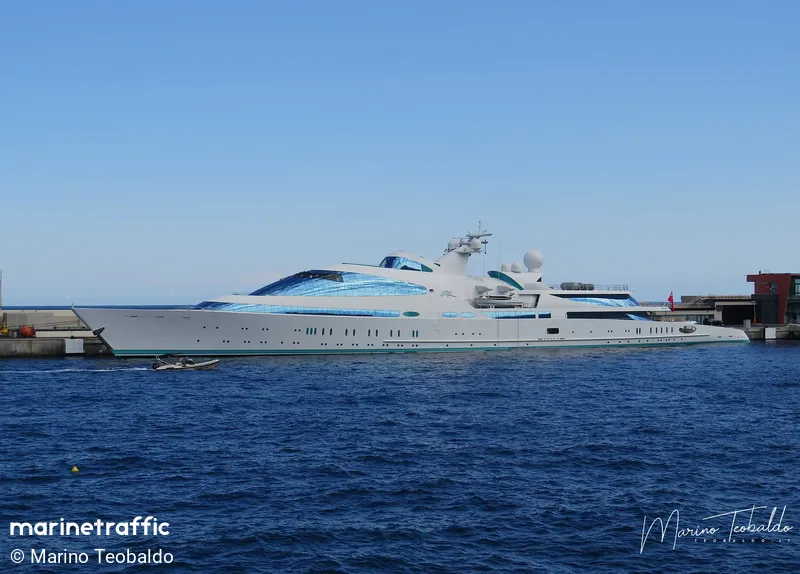
A vessel’s position is the boat’s, not the owner’s. Ownership is as reported, not certified.
HNLMS Piet Hein spent three decades in the Royal Netherlands Navy before being sold to the United Arab Emirates. Her transformation into Yas at ADM Shipyards used a 200-metre dry dock, but the 141-metre result still carries the length-to-beam ratio and propulsion limits of a 1970s warship.
The steel beneath the superstructure of Yas belongs to a different era than the amenities she now carries. Originally laid down as HNLMS Piet Hein in 1977 and launched in 1978, she was a Kortenaer-class frigate built for the Royal Netherlands Navy. When she entered service on 14 April 1981, she was designed to carry weapons systems, radar arrays, and a crew of sailors, not guest suites and helidecks. She was sold to the United Arab Emirates Navy in 1998, renamed Al Emirat, and served until decommissioning in 2008. The decision to convert her into a private superyacht did not erase the original displacement hull. It merely wrapped a new exterior around a frame that dictates her maximum speed, her fuel consumption, and the position of her machinery.
The dry dock and the frame
Conversion projects are often marketed as complete reimaginings, but the physics of a 141-metre displacement hull cannot be rewritten without cutting the vessel in half. The rebuild began at ADM Shipyards in Abu Dhabi in 2009. The yard was chosen because its infrastructure could accommodate the task; the group's docks are rated for ships up to 200 metres in length, providing the necessary clearance for a project of this scale. Abu Dhabi MAR, the holding company behind ADM, had been expanding rapidly since its founding in 2007, acquiring stakes in German and Greek yards while maintaining its home base across from Port Zayed. The 200-metre capacity was the hard constraint that made the conversion possible. Without a slipway of that dimension, the 141-metre hull could not have been accessed for the structural work required to transition from a naval platform to a civilian vessel.
Construction proceeded in phases. The ship was relaunched in 2011, four years after the initial work commenced, and finally delivered in 2015. The four-year gap between relaunch and delivery indicates the extent of the internal refit. A frigate's internal volume is organised around combat systems, ammunition magazines, and engine rooms configured for high-speed pursuit. Converting those spaces into residential accommodation requires stripping out military-grade equipment, reinforcing bulkheads for comfort, and rerouting piping and electrical systems. The original builder, KM de Schelde in Vlissingen, constructed Piet Hein with a keel laying date of 28 April 1977. That 1970s naval architecture prioritised seaworthiness and weapon deployment over the fine lines of a modern yacht designer. The result is a vessel with a beam of 14.4 metres, yielding a length-to-beam ratio of approximately 9.8 to 1. That ratio is wide for a displacement hull of 141 metres, a direct inheritance from her days as a patrol frigate.
Propulsion and performance
The most visible consequence of the original design is her speed. AIS broadcasts show her moving at 13.6 knots on average during a recent passage, with a recorded maximum of 14.6 knots. These figures cover a 184.2-nautical-mile run from 43 nautical miles off Olbia in Sardinia to Torre Annunziata in Campania, tracked between August 2026. For a 5002-gross-tonne vessel, those numbers are modest. They reflect the limitations of the propulsion plant inherited from the Kortenaer class. Naval frigates of the late 1970s were typically fitted with combined diesel and gas turbine arrangements optimised for bursts of speed rather than sustained economical cruising. When the original engines are retained during a conversion, they push a hull that has gained significant weight from luxury fittings, glass, and stabilisation systems. The extra tonnage increases drag, forcing the machinery to work harder to maintain speed. If the original powerplant was not upgraded alongside the hull, the yacht inherits the top-end speed of a 1970s warship, regardless of the teak decks or the lounge furniture installed later.

The position of the machinery is another legacy of the conversion. In a purpose-built yacht, the engine room is placed low and aft to lower the centre of gravity and improve trim. In a converted frigate, the engine room occupies the space originally allocated for naval propulsion, which fixes the weight distribution along the longitudinal axis. The original Kortenaer-class design placed heavy machinery amidships and aft, a configuration that affects how the vessel pitches in a seaway. A yacht designer would normally shift mass forward or aft to balance the load, but the conversion process is constrained by the existing watertight compartments and shaft tunnels. The result is a vessel that sits differently in the water than a newly built equivalent of the same length.
The ownership chain
Yas flies the flag of the Cayman Islands, a standard registry for vessels of this size seeking operational flexibility. The registered owner is Sheikh Hamdan bin Zayed Al Nahyan of Abu Dhabi. He was born in 1963, the fourth son of Sheikh Zayed bin Sultan Al Nahyan, the founder of the United Arab Emirates. His access to capital stems directly from his position within the ruling family and his executive roles. He serves as the ruler's representative in the Al Dhafrah region and chairs Dolphin Energy, a state-owned gas company, while also holding a seat as Deputy Prime Minister. The yacht bears the name of his son, Sheikh Yas bin Hamdan, who was born in June 1998. The naming convention confirms a personal motivation for the acquisition, but the financial mechanism relies on his corporate chairmanship and royal standing.
There is no public record of the purchase price, nor is there a detailed breakdown of the conversion costs. The financial terms remain undisclosed, so the focus shifts to the physical asset. The vessel's operational profile aligns with the requirements of a head of state or senior royal. She is tracked across the Mediterranean, with her last known position recorded in the Tyrrhenian Sea at 40.71° N, 14.47° E. The AIS data shows her moving under her own power, covering substantial distances at steady speeds. This pattern of movement suggests a vessel used for long-range transit rather than coastal loitering. The conversion preserved enough range and habitability to support extended voyages, a necessity for a yacht owned by someone managing regional government portfolios and energy assets.
Conversions are frequently cheaper on paper than new builds, but the hidden costs lie in the integration of old and new systems. The Kortenaer-class hull was designed to withstand combat damage and operate in open ocean conditions, which gives Yas a robust structural baseline. However, that same robustness comes with dead weight. Every tonne of steel that was welded for naval service remains in the waterline today. The conversion added luxury, but it did not remove the underlying naval architecture. The 141-metre length and 5002 gross tonnes represent a vessel that bridges two distinct maritime traditions. She is neither a frigate nor a conventional superyacht. She is a hybrid built to specific political and personal specifications, constrained by the dimensions of the shipyard that rebuilt her and the hydrodynamics of the hull she carried into the water in 1978.
Reporting and data: CelebYachts, republished by On the record.
Sources
The numbers on this page point here. Each one links to the record it came from.
- 1CelebYachtsCelebYachts: The Kortenaer constraint