
 CelebYachts reportProfiles
The kraken fleet
Gabe Newell did not accumulate yachts; he assembled a marine research platform by buying a seized hull, stripping its luxury amenities, and then purchasing a shipyard to build a laboratory afloat.
By On the record · Oct 2, 2026 · Data from CelebYachts1
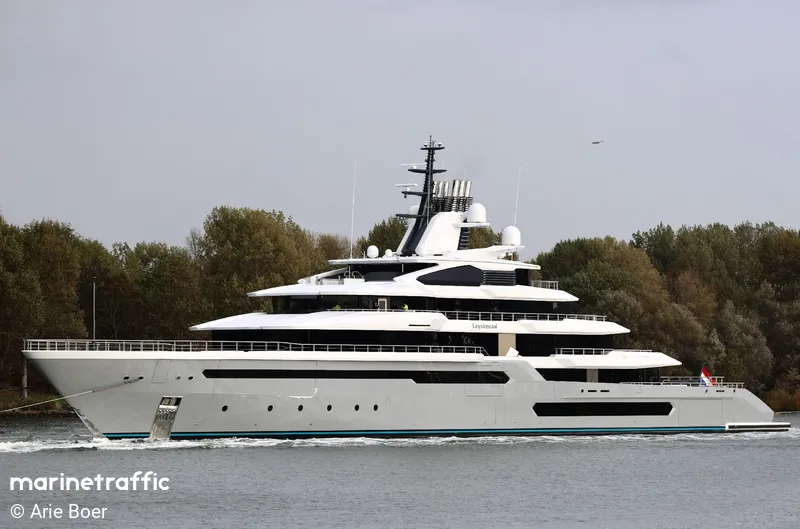
A vessel’s position is the boat’s, not the owner’s. Ownership is as reported, not certified.
From a Lürssen tender to a converted Oceanco support vessel, Gabe Newell’s sequence of acquisitions reveals a deliberate pivot from private cruising to institutional oceanography. The expansion of the fleet addressed a single constraint: a vessel of that size requires a dedicated support craft.
Gabe Newell built his fortune in software, not steel. He left Harvard in the early 1980s to join Microsoft, where he helped create the first versions of the Windows operating system and led the development of a port of Doom for Windows 95. In 1996, he co-founded Valve and released Half-Life in 1998. After his partner sold his stake in 2000, Newell launched Steam in 2003. Forbes estimated his net worth at $9.5 billion in 2025, owning at least half of the company. That capital allowed him to enter the superyacht market in 2008, but his subsequent purchases show a different trajectory than most owners who move from smaller pleasure craft to larger status symbols. Newell managed his fleet as a single operational project. He started with a conventional luxury yacht, identified the limits of a solo vessel for serious work, bought a second hull to serve as a support ship, and finally commissioned a third boat designed specifically as a floating laboratory.
The baseline
The first vessel in the fleet was Rocinante, delivered by Lürssen in Rendsburg in 2008. She measures 78.5 metres and flies the flag of the Cayman Islands. At the time of her delivery, she represented a standard configuration for a buyer of Newell’s means: a steel-hulled cruiser capable of long-range travel with guest accommodation and leisure facilities. She served as the primary vessel for roughly fifteen years. The register does not record her sale price, but her tenure establishes the baseline against which the later acquisitions must be measured. Rocinante was a private yacht. It carried guests and crew in separate compartments, prioritised comfort over utility, and operated as a self-contained unit. When Newell began expanding his interest in marine life through the Inkfish organisation, the limitations of a single hull became apparent. A vessel of that size cannot simultaneously host a large scientific team, store heavy research equipment, and maintain the living standards expected by private owners. The solution required splitting the mission.
The seized hull
Newell solved the capacity problem by acquiring a hull that had been abandoned by its original owner. Draak was originally launched as Equanimity in 2014 at the Oceanco yard in Alblasserdam. The Malaysian financier Jho Low purchased the yacht using funds transferred from the sovereign wealth fund 1MDB between 2009 and 2015. Indonesian authorities seized the vessel in February 2018 following a request for legal assistance from the United States. A Kuala Lumpur court declared Equanimity belonged to 1MDB subsidiaries in October 2018. Malaysia auctioned the yacht through Burgess, and the Genting Group purchased it in April 2019 for US$126 million, renaming her Tranquility. Newell bought the vessel in September 2023 and renamed her Draak.
The purchase of a seized, legally complicated hull indicates a buyer willing to navigate regulatory hurdles for a specific asset. More importantly, Newell did not restore Draak to her original luxury specification. He sent her to Oceanco’s Zwijndrecht yard for a refit that finished in 2026. The transformation stripped away the amenities that define a traditional superyacht. The beach club and spa were removed to make room for a fully equipped dive centre with a decompression chamber. The main deck saloon became a large crew mess. Former guest cabins were adapted into specialist personnel quarters. On the exterior, the helideck on the upper aft area was replaced by a tender deck with a heavy lift crane. The boarding platform at the stern was extended to accommodate retractable fenders. Draak now functions as a companion vessel to the main hull, carrying the equipment and personnel that the primary research ship cannot hold.
Buying the yard
The final step in the fleet’s evolution was the construction of a purpose-built laboratory. Leviathan, hull number Y722 at Oceanco, was launched in 2025. She measures 110 metres with a beam of 17.7 metres (58 feet) and weighs 4,970 GT. The naval architecture came from Lateral Naval Architects and Oceanco, with interiors by Mark Berryman Designs. About 2,000 people worked on the ship. Her cost was approximately $500 million. The vessel includes a submarine garage, a scientific laboratory, an onboard hospital, and a 3-D print shop. She also retains some leisure features, including a basketball court and a gaming lounge, handled by a crew of 33 across eleven cabins for twenty-two guests.
The construction of Leviathan required a level of control that goes beyond typical owner engagement. During the development of the vessel, Newell purchased the Oceanco shipyard from Mohammed Al Barwani. This acquisition ensured that the complex requirements of the marine research organisation could be met without commercial delay. The technical specifications confirm the shift from leisure to function. Leviathan uses a diesel-electric propulsion system with two ABB DO980P Azipods and access to a 5.5 megawatt-hour battery system, allowing prolonged silent operation. Her range is 6,500 nautical miles. A wastewater treatment system and waste-heat recovery system manage the output of the machinery. The choice of durable interior materials and the absence of teak decking simplifies maintenance in a working environment.
The fleet operates under the umbrella of Inkfish, the marine research organisation owned by Newell. Rocinante remains part of the registry, but the operational weight has shifted to the newer pair. Draak provides the heavy lift capacity and the decompression infrastructure required for deep-water work, while Leviathan houses the scientists and the laboratories. The separation of duties allows the main hull to focus on data collection and analysis while the support vessel manages logistics. This arrangement mirrors the structure of academic expeditions, where a primary research ship is accompanied by tenders and supply boats. Newell has effectively replicated that model on a superyacht scale.
Reporting and data: CelebYachts, republished by On the record.
Sources
The numbers on this page point here. Each one links to the record it came from.
- 1CelebYachtsCelebYachts: The kraken fleet