
 CelebYachts reportInvestigations
The geometry of evasion
The twenty-five-metre gap between Luna and Solaris measures regulatory distance, not luxury.
By On the record · Jul 15, 2026 · Data from CelebYachts1
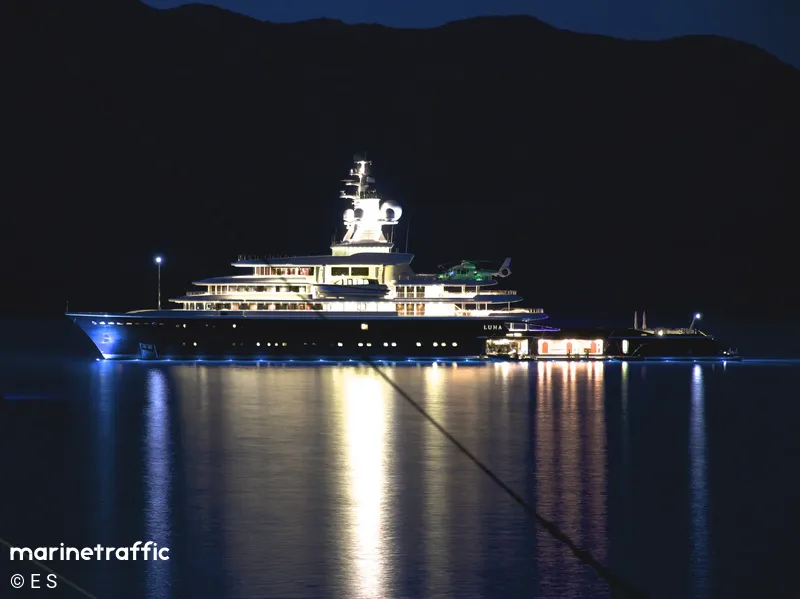
A vessel’s position is the boat’s, not the owner’s. Ownership is as reported, not certified.
Luna and Solaris share a builder but diverge completely in purpose. One was designed for transoceanic cruising; the other was engineered to survive the weaponisation of maritime law. The comparison reveals how Lloyd Werft adapted its slipways to build vessels that prioritise jurisdictional arbitrage over conventional performance.
The twenty-five-metre difference between Luna and Solaris measures more than deck space. It records a fundamental shift in superyacht engineering driven by the weaponisation of international sanctions. Luna, delivered in 2010, was designed for transoceanic expedition capability within a permissive regulatory environment. Solaris, delivered eleven years later, was engineered specifically to operate outside the reach of western port authorities. The physical divergence between the two hulls demonstrates how Lloyd Werft adapted its Bremen-Vegesack slipways to construct vessels that prioritise jurisdictional arbitrage over conventional cruising comfort.
The Lloyd Werft pivot
Luna measures 114.0 metres on the waterline and displaces 5655 gross tonnes. Her beam sits at 20.0 metres. Solaris extends to 139.0 metres with a beam of 26.0 metres. Both hulls carry the Lloyd Werft builder designation and share the same aluminium construction methodology. The additional twenty-five metres of length and six metres of width on Solaris are not aesthetic choices. They represent a calculated response to the closure of European marinas to sanctioned owners. A wider beam permits larger auxiliary power units and expanded fuel capacity, extending the radius at which a yacht can remain at anchor without requiring a port call. When the European Union and the United Kingdom began freezing oligarch assets in May 2022, the ability to stay offshore became a survival mechanism rather than a luxury feature. Luna, constrained by her narrower hull form, required regular resupply and maintenance that eventually forced her into Bremerhaven. Solaris, carrying nearly double the gross tonnage, could sustain herself for months in Turkish waters.
The classification societies that govern these vessels demand regular inspections and safety certifications that cannot be performed while drifting in open water. Luna’s Marshall Islands flag and Majuro home port indicate a continued attempt to project commercial availability despite the German freeze. Her AIS transponder broadcasts an MMSI identifier of 538071095 and an IMO number of 1010222. These identifiers link the vessel to her registration records, which list an estimated value of $360,000,000. The static signal confirms that the legal blockade holds. She has not moved since her last position update.
The transaction that bought time
Luna entered service on 10 April 2010 for Roman Abramovich. Her exterior design came from NewCruise of Germany and her interior from Donald Starkey. By April 2014, the vessel had changed hands for €200 million, transferring to Farkhad Akhmedov. The sale occurred after Akhmedov departed his role as a representative in the Federation Council of the Russian Federation in 2009. The transaction was intended to sanitise the asset, but it also initiated a period of heavy modification. In October 2014, Luna entered Bremerhaven for a sixteen-month refit costing €50 million. She emerged in March 2016 with updated systems and a reinforced hull structure capable of supporting heavier expedition gear.
The £453 million matrimonial settlement awarded to Tatiana Akhmedova in the English High Court complicated the title, ultimately placing the yacht under the Blue Sea Trust. Despite the corporate restructuring, the underlying ownership remained traceable to Akhmedov. When the EU imposed sanctions on him in March 2022, the trust structure offered no protection against the German Federal Prosecutor’s Office. Luna was frozen on 12 May 2022. Public prosecutors searched the vessel in early May 2023, alleging that Akhmedov had concealed substantial assets within Germany. The legal proceedings stalled her movement permanently. The Forbes report from March 2022 noted she was still registered in the Marshall Islands with a value of $196 million, highlighting the discrepancy between market estimates and official valuations during active litigation.
Solaris arrived at the opposite end of the timeline. Delivered in 2021, she was constructed specifically for Abramovich after he had already divested Luna. The eleven-year gap between the two deliveries coincided with a tightening of global financial compliance. Solaris carries the Cook Islands flag and lacks a registered home port, a configuration that obscures beneficial ownership and complicates port state control inspections. While Luna required a €50 million refit to maintain her operational status, Solaris left the Lloyd Werft slipway fully equipped for long-range autonomy. The estimated valuation of Solaris stands at $600,000,000, compared to Luna’s recorded figure. The premium reflects not only the increased displacement but also the insurance and logistical costs associated with operating a sanctioned asset in international waters.
The geography of evasion
Solaris operates under a different set of physical constraints. Her last recorded position sits at 40.73° N, 29.86° E, within the Marmara Sea. This location places her inside Turkish waters, a jurisdiction that declined to implement the EU and UK sanctions regimes following the invasion of Ukraine in February 2022. The vessel’s trajectory in March 2022 outlines the evasion protocol. She departed Barcelona for repairs on 8 March 2022. Between 12 and 14 March, she anchored off Tivat in Montenegro. From 21 March to 3 April, she docked at Bodrum in Turkey. By 5 May, she had relocated to another Turkish port. The sequence demonstrates a deliberate routing away from NATO member states and EU jurisdictions.
The contrast between the two hulls illustrates the lifecycle of a sanctioned megayacht. Luna represents the pre-2022 model: a high-value asset acquired through complex trusts, maintained in European shipyards, and ultimately captured by domestic prosecutors. Solaris represents the post-2022 adaptation: a larger, more self-sufficient platform deployed immediately to non-compliant jurisdictions. The yard that built both understood that the next generation of clients would not require faster engines or wider decks for leisure. They would require deeper drafts and larger fuel tanks to outlast diplomatic pressure. The AIS data tracks this shift in real time, showing one vessel immobilised by legal process and the other holding station in a geopolitical buffer zone.
Reporting and data: CelebYachts, republished by On the record.
Sources
The numbers on this page point here. Each one links to the record it came from.
- 1CelebYachtsCelebYachts: The geometry of evasion