
 CelebYachts reportYards & Design
How Lürssen built EOS and Nord for different worlds
Barry Diller’s sailing yacht and Alexei Mordashov’s motor yacht show how sanctions changed shipyard design.
By On the record · Aug 31, 2026 · Data from CelebYachts1
A vessel’s position is the boat’s, not the owner’s. Ownership is as reported, not certified.
Lürssen built two very different yachts for Barry Diller and Alexei Mordashov. The comparison reveals how regulatory risk reshaped megayacht architecture over fifteen years.
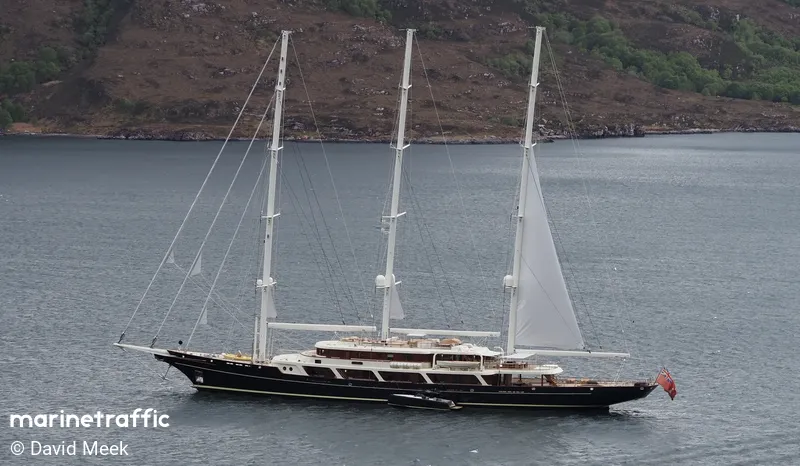
Lürssen built EOS in 2006 and Nord in 2021. Both are massive vessels from the same Bremen yard. Yet they share almost nothing except their builder. EOS is a three-masted schooner. Nord is a steel-hulled motor yacht.
The owners could not be more different. Barry Diller owns EOS. He made his money in media and technology. He founded Fox Broadcasting Company. He later led IAC and Expedia. His wealth came from public markets and corporate leadership.
Alexei Mordashov owns Nord. He is a Russian oligarch. He controls Severstal, Russia’s largest steel company. His wealth comes from heavy industry and raw materials. This difference in origin shows in the steel of each hull.
Who paid for these two very different ships?
Barry Diller built his fortune in broadcasting. He founded Fox Broadcasting Company with Rupert Murdoch. He later led IAC and Expedia Group. In 2005, he received $295 million in compensation. This was the highest pay for any US executive that year. His wealth is liquid and global. He buys what he wants when he wants it.
Alexei Mordashov built his wealth in steel. He is the chairman of Severstal. This is Russia’s largest steel and mining company. His fortune is tied to industrial output. The value of Nord stands at five hundred million dollars. This figure matches the estimated worth of EOS. Both ships represent huge capital outlays. The source of that capital dictates their use.
What does the size difference tell us?
Nord tells a different story. She measures one hundred forty-one point six three metres long. Her beam is twenty-two point four eight metres. Her gross tonnage reaches ten thousand one hundred fifty-four. She is nearly seven times larger inside than EOS.
Nuvolari & Lenard designed both the exterior and interior. Moran Yacht & Ship supervised the build. The goal was not bridge clearance. The goal was sovereign mobility. The owner needed a vessel that could operate far from Western ports.
Her size accommodates extensive amenities. She carries two helicopter landing pads. One sits on the bow. The other sits on the top deck, covered by a hangar in the main mast. These features support rapid, independent travel.
She also includes a movie theatre, spa, and swimming pool. These are standard for large motor yachts. But for Nord, they serve a specific purpose. They allow guests to remain onboard while the vessel moves through restricted waters.
How did sanctions change her route?
The divergence became critical after 2022. Russia invaded Ukraine in February. Sanctions targeted Mordashov and his assets. Nord faced potential seizure by Western authorities. The owner had to act quickly to protect the asset.
She left Seychelles on March 12, 2022. She turned off her transponders. This device tracks a ship’s location. Without it, she became invisible to most monitoring systems. She sailed full speed toward Vladivostok.
The journey covered six thousand seven hundred one nautical miles. She burned four hundred sixty-five thousand dollars in fuel. This cost was high but necessary. It bought time and distance from enforcement zones.
She arrived in Vladivostok on April 11. She then visited Busan in South Korea. She returned to Vladivostok by June. She spent October 2022 in Hong Kong harbour. Her path avoided all Western jurisdictions.
Where has Nord been since the sanctions hit?
After fleeing to Vladivostok, Nord did not stay still. She sailed through the Japan Sea. She stopped at Busan in South Korea. She returned to Vladivostok by June 2022. She spent October 2022 in Hong Kong harbour. On October 30, she was at Addu Atoll in the Maldives.
In early 2023, she moved again. She appeared in Praslin, Seychelles on February 23. She was seen in La Digue on March 8. Guests prepared for a barbecue on Petite Anse Beach. She re-enabled her transponders on June 12, 2023. She was found in the Indian Ocean near Indonesia.
Her route continued into late 2026. She arrived at Vladivostok again on June 28. She crossed the Strait of Hormuz on April 25, 2026. This happened after maintenance in Dubai. She appeared in Benoa Port, Bali on July 29, 2026. She stays within non-Western jurisdictions.
Why does Lürssen build both types?
Lürssen remains the world’s leading yacht builder. They constructed EOS for leisure sailing. They constructed Nord for geopolitical survival. The yard adapts its engineering to the owner’s needs. Both projects required immense skill.
The yard serves two distinct markets. One values open-water freedom. The other values secure mobility. Lürssen delivers both. Their ability to switch designs proves their technical range.
How did bridge limits shape EOS?
EOS was designed to sail anywhere. Her masts stand two hundred feet tall. The designers chose this height so she could pass under bridges worldwide. Antonio Ferrer designed the rigging. Bill Langan handled the naval architecture. François Catroux designed the interior. The team prioritised freedom of movement. They wanted a vessel that could reach remote anchorages without restriction.
What makes EOS different from modern superyachts?
EOS flies the Cayman Islands flag. Her home port is George Town. AIS data places her in the Aegean Sea. She remains active today. Her design prioritises sailing performance. Her masts are two hundred feet tall. This height allows her to pass under bridges globally.
The interior was designed by François Catroux. Little is known about the layout. Diller keeps the details secret. Reports mention a glass staircase and panoramic views. The outgoing captain said they had no set route. They travelled mainly between the Mediterranean and the Caribbean. The ship offers long, unstructured hours.
EOS caught fire in Oslo in 2012. The incident damaged the top decks. No one was injured. Diller called it no problem. The ship returned to port for repairs. This event shows the risks of large sailing yachts. It also shows the resilience of the design.
Diller valued exploration over static comfort. He described the experience as having long, unstructured hours. The crew had no set route. They travelled between the Mediterranean and the Caribbean. The design served this nomadic lifestyle.
EOS required complex rigging engineering. The masts must withstand ocean storms. The hull must balance sail power with stability. The construction took three years. It launched in Bremen in 2006.
She appeared in Bali in July 2026. Her movements suggest ongoing maintenance and relocation. She avoids Western ports entirely. Her presence near Indonesia reflects the new reality for sanctioned Russian assets.
Reporting and data: CelebYachts, republished by On the record.
Sources
The numbers on this page point here. Each one links to the record it came from.
- 1