
 CelebYachts reportYards & Design
The Lürssen pivot from speed to volume
Built twenty-seven years apart by the same German shipyard, these two hulls show how propulsion limits gave way to beam and gross tonnage.
By On the record · Sep 4, 2026 · Data from CelebYachts1
A vessel’s position is the boat’s, not the owner’s. Ownership is as reported, not certified.
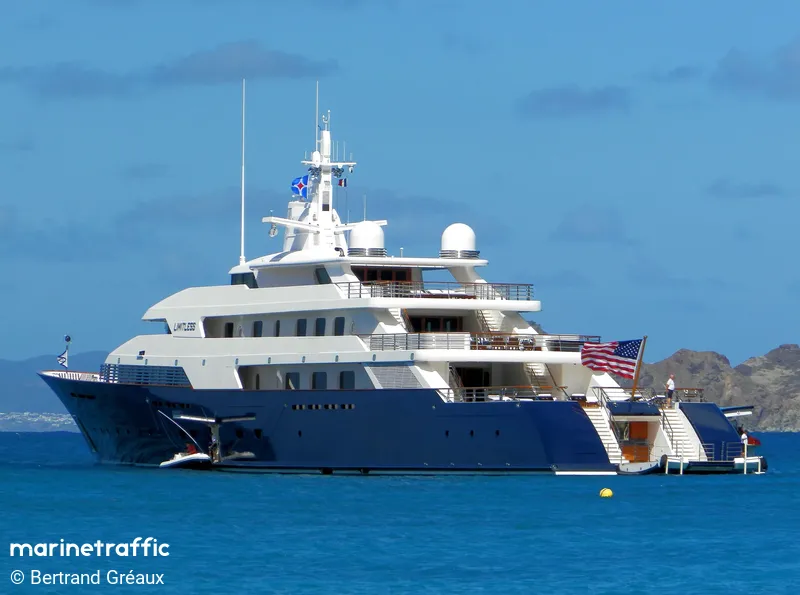
Limitless and Luminance share a builder but diverge sharply in form. The earlier vessel prioritised twenty-five-knot performance on a narrow beam; the newer one trades speed for a twenty-one-metre width and nine thousand tons of displacement.
Lürssen delivered Limitless in 1997 and Luminance in 2024. The interval spans nearly three decades of superyacht economics and naval architecture. The two vessels share a builder, but their dimensions reveal a fundamental shift in what an owner demands from a steel hull. Limitless measures ninety-six point two five metres long and twelve point four metres wide. Luminance stretches to one hundred and thirty-eight point eight metres and carries a beam of twenty-one metres. The difference in beam explains the jump in gross tonnage from two thousand one hundred and forty-six to nine thousand. Both are classified as motor yachts, yet their proportions place them in different categories of maritime engineering.
The width of the waterline
The beam of a hull dictates its internal volume and its initial stability. A twelve-point-four-metre beam on a ninety-six-metre length produces a ratio that favours hydrodynamic efficiency. The wider twenty-one-metre beam on Luminance sacrifices some of that efficiency for space. It allows for a foredeck pool and an aft infinity pool without compromising the structural integrity of the upper decks. The gross tonnage reflects this spatial expansion. Nine thousand tons is more than four times the volume of two thousand one hundred and forty-six. The extra width also accommodates the helicopter landing pads required by modern owners, placing them forward and aft rather than crowding the main deck. The colour scheme of blue and silver on Luminance contrasts with the exterior lines designed by Jon Bannenberg and Jonathan Quinn Barnett for Limitless. While Limitless relies on the architectural restraint of François Catroux for her interiors, Luminance employs Zuretti Design to fill the expanded volume with a spa room, jacuzzi, and beach club. The Cayman Islands flag and George Town home port of Luminance differ from the United States of America flag and unrecorded home port of Limitless, reflecting the different regulatory environments the newer vessel operates within. The estimated value of Luminance stands at five hundred million dollars, compared to one hundred and fifty million dollars for Limitless, a disparity that mirrors the increase in physical scale.
Propulsion and the speed trade-off
Limitless was engineered for velocity. She is powered by two Caterpillar 3616 engines producing five thousand four hundred and twenty kilowatts each. This setup reached a top speed of twenty-five knots and marked the first use of a combined diesel and diesel-electric propulsion system in a private yacht. Luminance uses twin MAN 16V28/33D engines delivering seven thousand three hundred kilowatts each. Her top speed sits at twenty knots, with a cruising speed of fifteen knots. The additional power in the newer vessel does not translate into higher speed because the wider beam creates greater drag. The engineering priority shifted from achieving a high maximum velocity to maintaining a comfortable cruising speed over longer ranges. The inclusion of underway stabilisers and an at-anchor stabiliser on Luminance further indicates a focus on motion control rather than raw performance. A bow thruster system assists with manoeuvring the larger hull. The draught of five-point-three metres on Luminance differs from the unspecified draught of Limitless, affecting where each vessel can anchor. Luminance is equipped with a tender garage and a swimming platform, amenities that require specific hull modifications absent on the older vessel. The IMO identifier 9865087 distinguishes Luminance from the 8975940 assigned to Limitless, tracking their separate operational histories in international waters.
Design lineage and classification
Espen Øino designed the exterior of Luminance, bringing a contemporary aesthetic that contrasts with the work of Jon Bannenberg and Jonathan Quinn Barnett on Limitless. The sources describe both vessels as among the largest superyachts based on their respective lengths at the time of their completion. The hull of Luminance is constructed of steel with an aluminium superstructure, a common modern configuration that balances strength and weight. Limitless shares the steel hull tradition but predates the widespread adoption of aluminium superstructures in this class. The interior layout of Luminance includes a gym, a deck jacuzzi, and a barbecue area, reflecting a shift towards outdoor living spaces on the upper decks. Air conditioning is listed as a standard amenity on Luminance, indicating the level of environmental control required for year-round operation in varying climates. The MMSI number 319271500 identifies Luminance on maritime networks, distinct from the 368344670 used by Limitless. These identifiers allow tracking agencies to monitor their movements independently. The annual running cost of fifty million dollars for Luminance highlights the ongoing financial commitment required to maintain a vessel of this size, a figure that likely exceeds the operating expenses of the older Limitless. The presence of two helicopter landing pads on Luminance necessitates reinforced deck structures, a feature not mentioned for Limitless, whose design focuses on a single helipad or open deck space. The evolution from a twenty-five-knot cruiser to a fifteen-knot luxury resort demonstrates how the definition of a superyacht has expanded from a fast transport to a floating residence.
The capital behind the steel
The owners of these vessels came from different economic sectors, which shaped their expectations of the final product. Les Wexner accumulated his wealth through retail, serving as chairman and former CEO of L Brands, formerly Limited Brands, which owns Victoria's Secret. His yacht reflects a preference for speed and established naval conventions. Rinat Akhmetov founded System Capital Management and controls assets across multiple industries in Ukraine. His wealth supports a larger operational budget, estimated at fifty million dollars annually, alongside the construction cost of five hundred million dollars. The scale of Akhmetov's investment allowed for the broader beam and the extensive amenity suite that define the newer hull. The AIS data places Limitless in the Balearic Sea near forty degrees north latitude, while Luminance appears in the Ligurian Sea near forty-two degrees north. The age of the vessels, nineteen years apart, separates two distinct eras of superyacht commissioning. Luminance includes an elevator and air conditioning throughout, standard features that have become mandatory in modern builds, whereas Limitless represents an era when such conveniences were bespoke additions. The categorisation of Wexner as a United States tycoon and Akhmetov as a European tycoon underscores the global distribution of capital that funds these projects.
Reporting and data: CelebYachts, republished by On the record.
Sources
The numbers on this page point here. Each one links to the record it came from.
- 1