
 CelebYachts reportInvestigations
The mechanics of the Saudi flag
The registry avoids open-market tax arbitrage in favour of sovereign control and commercial deployment, a strategy visible in its three superyacht entries…
By On the record · Aug 10, 2026 · Data from CelebYachts1
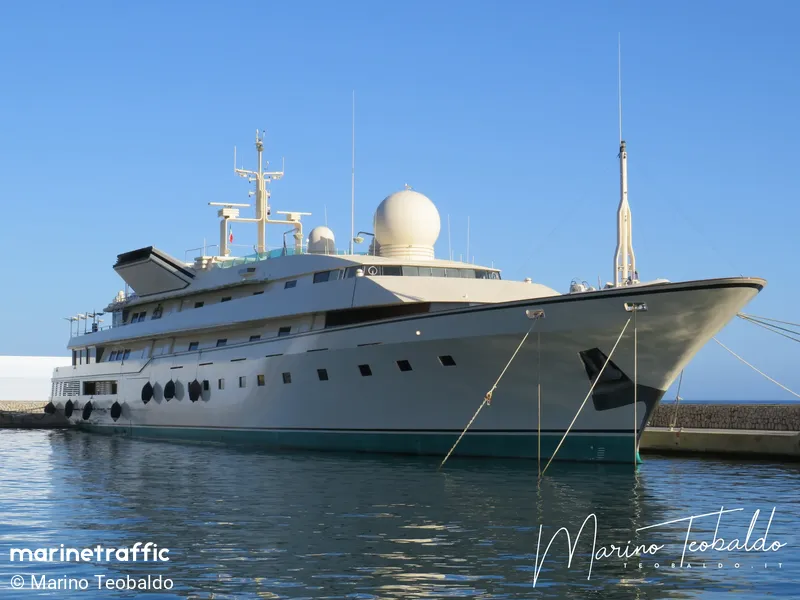
A vessel’s position is the boat’s, not the owner’s. Ownership is as reported, not certified.
Saudi Arabia maintains a closed national registry that trades the anonymity and lower costs of open flags for direct state oversight and operational continuity. The flag’s utility is measured not in superyacht brokerage but in the retention and conversion of large commercial vessels, a pattern confirmed by its current register of three hulls and the recent acquisition of the former World Dream by Cruise Saudi.
The Saudi Arabian registry operates as a closed national flag rather than an open registry, prioritising sovereign control and commercial deployment over the tax arbitrage that drives the global superyacht market. Its three registered hulls reflect state-linked ownership and strategic asset retention rather than the anonymous offshore structuring typical of Liberian or Maltese flags. The registry’s utility is demonstrated not in superyacht brokerage but in the operational reflagging of large commercial vessels, a pattern confirmed by its current register of three hulls and the recent acquisition of the former World Dream by Cruise Saudi.
The closed registry
International law requires every merchant ship to be registered in a country that exercises regulatory control over the vessel. A ship operates under the laws of its flag state, which must inspect the ship regularly, certify equipment and crew, and issue safety and pollution prevention documents. Open registries emerged during the American Prohibition era when shipowners registered vessels in Panama to serve alcohol to passengers. The practice expanded after the Seamen's Act of 1915 imposed baseline safety and wage standards on United States flagged ships, pushing owners toward jurisdictions with cheaper foreign labour and income tax exemptions. Liberia grew to surpass the United Kingdom with the world's largest ship register by 1968, followed by second registers in the Isle of Man, Norway, and the Netherlands during the 1980s and 1990s. As of 2025, more than half of the world's merchant ships in terms of deadweight tonnage are registered in open registries.
A closed national registry functions differently. It does not compete on registration fees or crewing flexibility. Instead, it requires a genuine link between the ship's owners and the flag state, a principle codified in Article 91 of the 1982 United Nations Convention on the Law of the Sea. The Saudi Arabian flag follows this model. Exact tonnage tax rates and survey schedules for the Saudi flag are not published in available records. The registry does not offer online transfer mechanisms or anonymous beneficial ownership structures. Owners who choose the Saudi flag accept higher compliance costs and direct state oversight in exchange for sovereign backing and domestic commercial continuity.
Three hulls, one strategy
The Saudi register currently holds three hulls, representing one percent of the tracked fleet. The vessels cluster at the upper end of the length spectrum, indicating ownership structures that do not rely on fractional investment or offshore holding companies. Al Salamah measures 139.0 metres. Turama sits at 117.0 metres. KINGDOM 5KR runs 86.01 metres. The absence of live AIS tracking data for these hulls suggests they operate within restricted waters or follow fixed commercial itineraries rather than transoceanic leisure routing. Their sizes imply capital tied to domestic energy or sovereign wealth sectors, where flag selection serves administrative convenience rather than regulatory evasion.
The register's composition reveals how a closed flag utilises its assets. Unlike open registries that attract vessels through minimal inspection regimes, the Saudi flag retains hulls that require substantial maintenance and state coordination. The three entries do not fluctuate rapidly. They remain registered because the administrative friction of transferring them to an open flag outweighs the cost savings. This stability contrasts with the high turnover seen in Panamanian and Maltese books, where vessels change hands multiple times per decade to optimise tax liability and crew nationality.
Commercial reflagging
The practical application of the Saudi flag extends beyond private yachts into large-scale commercial conversions. Cruise Saudi acquired the vessel formerly known as World Dream at auction in March 2023. The purchase price settled at approximately US$355 million. The ship had been ordered in February 2014 for Star Cruises, laid down on 29 July 2015, launched on 26 August 2017, and completed on 26 October 2017. It entered service for Dream Cruises before the parent company Genting Hong Kong collapsed in March 2022. The vessel was sold at auction with sealed bids due by 21 December 2022.
Following the acquisition, Cruise Saudi renamed the vessel Manara and moved it to Bremerhaven for an extensive refit at the yard Bredo, with structural modifications handled by Meyer Werft. The ship was formally renamed Aroya in July 2024, combining the words Arabian and roya to translate as vision or dream. She started operations under the Aroya Cruises brand in December 2024. This timeline demonstrates how the Saudi flag facilitates rapid commercial transition. The vessel moved from insolvency to auction, to domestic acquisition, to dry-dock conversion, and back to service within twenty-four months. The registry provided a stable legal platform for a multi-million-dollar retrofit without the delays typical of cross-jurisdictional flag transfers.
The purchase price settled at approximately US$355 million, funding a Bremerhaven refit that returned the vessel to service under a new domestic brand within twenty-four months.
Port state reality
Flag selection does not grant immunity from international enforcement. port state control regimes, notably the Paris Memorandum of Understanding and the Tokyo Memorandum of Understanding, conduct inspections regardless of flag state. Member states of the Paris MOU recorded 17,858 inspections in 2015, resulting in 595 detained vessels. Ships flying any flag face scrutiny over living conditions, Safety of Life at Sea protocols, and pollution prevention. The Aroya's history illustrates this reality. During a January 2020 quarantine in Hong Kong, three passengers tested positive for COVID-19. All 3,800 passengers and crew were quarantined until 9 February 2020. Indonesian nationals were evacuated using the hospital ship KRI dr. Soeharso and isolated on Sebaru Kecil Island for fourteen days. These events occurred under the original flag but demonstrate the operational vulnerabilities that apply to all large commercial vessels, irrespective of registry.
The Saudi Arabian registry remains a niche instrument. It does not chase volume through tax exemptions or crewing loopholes. It retains three superyachts and supports large commercial conversions through direct state coordination. The flag's value lies in regulatory certainty and domestic integration, not in the offshore financial engineering that defines the broader maritime market. Owners who select it accept transparency and compliance in exchange for a stable jurisdiction backed by sovereign infrastructure.
Reporting and data: CelebYachts, republished by On the record.
Sources
The numbers on this page point here. Each one links to the record it came from.
- 1CelebYachtsCelebYachts: The mechanics of the Saudi flag