
 CelebYachts reportProfiles
The monopoly dividend
Carlos Slim Helu’s wealth did not come from stock picking or early technology bets. It came from buying distressed Mexican assets in 1982 and capturing the…
By On the record · Oct 16, 2026 · Data from CelebYachts1
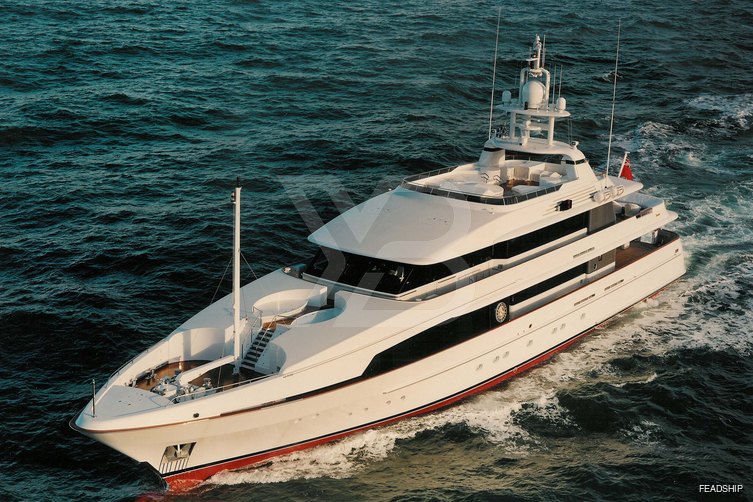
A vessel’s position is the boat’s, not the owner’s. Ownership is as reported, not certified.
The richest person in Latin America holds his position through Grupo Carso, a conglomerate structured around cash-flow monopolies rather than growth stocks. His fortune arrived when he converted nationalised infrastructure into private revenue streams, a mechanism that funded a 52-metre Cayman-flagged yacht called OSTAR and left him holding billions in non-voting equity.
Carlos Slim Helu built his fortune by converting state assets into private monopolies. The primary drivers were the rapid contraction of the Mexican economy in 1982 and the privatisation of the national telecommunications industry in 1990. His conglomerate, Grupo Carso, operates as a holding structure designed to capture cash flow from distressed or nationalised assets, retain them, and sell stakes when public markets price them higher. This model funded a diverse portfolio of global equities and a 52-metre yacht registered in the Cayman Islands under the name OSTAR.
The 1982 distress
Slim’s father, Julián Slim Haddad, established a dry goods retail store in Mexico City and invested in real estate during the 1910–1917 Mexican Revolution, acquiring prime property in the Zocalo District at fire sale prices. By 1922, his net worth reached 1,012,258 pesos. Carlos Slim Helu studied civil engineering at the National Autonomous University of Mexico, where he taught algebra and linear programming. That mathematical background informed his financial statement analysis, but the capital that built his empire came from the 1982 market crash and the 1990 state asset sales.
When the Mexican economy contracted rapidly in 1982, foreign investors cut back and local banks struggled. Slim deployed the income from Cigatam, a Mexican tobacco distributor he had purchased earlier, to buy flagship Mexican businesses at depressed valuations. He acquired shares outright in Empresas Frisco, a mining concessionary and chemical maker; Industrias Nacobre, a copper manufacturer; Reynolds Aluminio, an aluminium concern; Compañía Hulera Euzkadi, Mexico’s largest tire maker; Bimex hotels; and Sanborn Hermanos, a food retailer and restaurant chain. He also spent 13 million dollars to acquire Mexican insurance agency Seguros de México in 1984, later subsuming it into Seguros Inbursa. The value of that insurance stake grew to 1.5 billion dollars by 2007 after four spinoffs. From those holdings, he formed Grupo Financiero Inbursa, a financial services provider.
This strategy relied on retaining businesses for their cash flow rather than flipping them immediately. The complex corporate structure of Grupo Carso allowed Slim to hold stakes across multiple industries simultaneously, insulating the group from sector-specific downturns. The accumulated capital from these industrial and financial holdings financed subsequent acquisitions, including Hoteles Calinda in 1991, which later became OSTAR Grupo Hotelero, and a 52-metre yacht registered in the Cayman Islands under the same name. The estimated value of OSTAR has never been published; the register lists it as null. In 1988, Slim bought Nacobre, a Mexican copper manufacturer that manufactured, marketed and distributed copper and copper alloy products, along with Química Fluor, a Mexican chemical maker. He also acquired a 40 per cent and 50 per cent interest in the Mexican arms of British American Tobacco and The Hershey Company, respectively. He acquired large blocks of Denny's and Firestone Tires.
The 1990 telco auction
The second phase of Slim’s wealth creation occurred when the Mexican government began privatising its national industries at the turn of the 1990s. Capitalising on this political shift, Slim acted in concert with the French telecom operator France Télécom and the American telco Southwestern Bell Corporation to purchase the landline telecommunications service provider from the Mexican government. The acquisition took place in 1990, the same year Grupo Carso was floated as a public company initially in Mexico and then worldwide.
Telmex, the resulting entity, maintained a virtual monopoly for many years after the acquisition. By 2006, it controlled and operated 90 per cent of the telephone lines in Mexico. Slim’s wireless telecommunications company, Telcel, created out of the Radiomóvil Dipsa company, operated almost 80 per cent of the entire country’s cellphones. The core of his fortune derives from telecommunications, specifically América Móvil, which owns Telcel and operates throughout Latin America.
In 1996, Slim split Grupo Carso into three separate constituent companies: Carso Global Telecom, Grupo Carso, and Invercorporación. América Telecom, the holding company for América Móvil, was incorporated in 2000. Concurrently, Telmex spun off its international cellular phone division for a 15 billion dollar listing of América Móvil SA on the New York Stock Exchange. Telmex took numerous stakes of various international cellular telephone operators outside Mexico, including the Brazilian ATL and Telecom Americas concerns, Techtel in Argentina, and others in Guatemala and Ecuador. The company made further investments across Latin America, with operations in Colombia, Nicaragua, Peru, Chile, Honduras, and El Salvador, as well as a joint venture with Microsoft called Tlmsn, a Spanish-language web portal.
Between 2008 and 2010, Slim more than doubled his net worth from 35 billion dollars to 75 billion dollars. On 10 March 2010, Forbes reported that Slim had overtaken Bill Gates as the world’s richest person, with a net worth of 53.5 billion dollars. It was the first time in 16 years that the top spot was not held by an American, and the first time the person at the top came from an emerging economy. He maintained the position until 2013. As of July 2025, the Bloomberg Billionaires Index ranked him as the 18th-richest person in the world, with a net worth of 99.1 billion dollars, making him the richest person in Latin America. The discrepancy between the 2020 figure of 48 billion dollars and the 2025 figure reflects fluctuations in public equity valuations rather than a change in the underlying asset base.
The structure of the stake
The liquidity generated by Grupo Carso and América Móvil allowed Slim to diversify into global non-voting equity. He accounts for 40 per cent of the listings on the Mexican Stock Exchange. In the United States, he established a running presence among major retailers, purchasing large stakes in Barnes & Noble, OfficeMax, Office Depot, Circuit City, Borders, and CompUSA starting in 2003. He also set up a Telmex USA branch and acquired a stake in Tracfone, an American cellular telephone operator. During the same year, Slim underwent heart surgery and subsequently passed on much of his day-to-day corporate involvement to his children and their spouses.
His most significant overseas equity position was in the New York Times Company. In 2008, he took a 6.4 per cent stake valued at 27 million dollars. He increased it to 8 per cent by 2012. On 20 January 2015, he exercised stock options to purchase 15.9 million shares, increasing his stake to 16.8 per cent of the company’s Class A shares, making him the largest single shareholder of non-voting shares. According to the company’s 2016 annual filings, Slim owned 17.4 per cent of the Class A shares and none of the privately held Class B shares. In 2017, he sold half of his shares.
The corporate architecture of his wealth remains concentrated in cash-generating monopolies rather than speculative ventures. In 2007, after amassing a 50.1 per cent stake in the Cigatam tobacco manufacturer, Slim sold a large portion of his equity to Philip Morris for 1.1 billion dollars. During the same year, he sold off his entire stake of Porcelanite, a Mexican tile-maker he had acquired in 1990, for 800 million dollars. These exits demonstrate a pattern of accumulating state-backed or dominant market positions, holding them until public markets priced them at peak valuations, and then recycling the capital into new monopolies or diversified equity stakes.
A report released in early 2024 referenced the book Why Nations Fail, noting that Slim’s fortune was amassed by forming a telecommunications monopoly through close relationships with the government rather than through innovation. The structure of Grupo Carso, with its labyrinthine web of companies, ensures that the cash flows from Telmex and América Móvil continue to fund acquisitions across education, healthcare, industrial manufacturing, transportation, real estate, mass media, mining, energy, entertainment, technology, retail, sports, and financial services. In March 2015, Slim's investment company, Inmobiliaria Carso, announced it will buy a stake in the Spanish bank, Bankia, which couples with Slim's other purchase of Realia, a Spanish real estate company, where Slim is the second largest shareholder holding a 25 per cent equity stake. On 15 April 2015, Slim formed the oil company Carso Oil & Gas. A report that was released by the new company listed its assets at 3.5 billion pesos, approximately 230 million dollars, placed within 17.7 million shares. The yacht OSTAR sits in the Cayman registry as one of many discrete assets held within that structure, a small fraction of a portfolio defined by scale, state-originated monopolies, and public market liquidity.
Reporting and data: CelebYachts, republished by On the record.
Sources
The numbers on this page point here. Each one links to the record it came from.
- 1CelebYachtsCelebYachts: The monopoly dividend