
 CelebYachts reportProfiles
Why Shemara survived war and bankruptcy
The name Shemara stayed on the same steel hull through wartime service and financial collapse because the shipyard built it to last longer than its owners.
By On the record · Aug 24, 2026 · Data from CelebYachts1
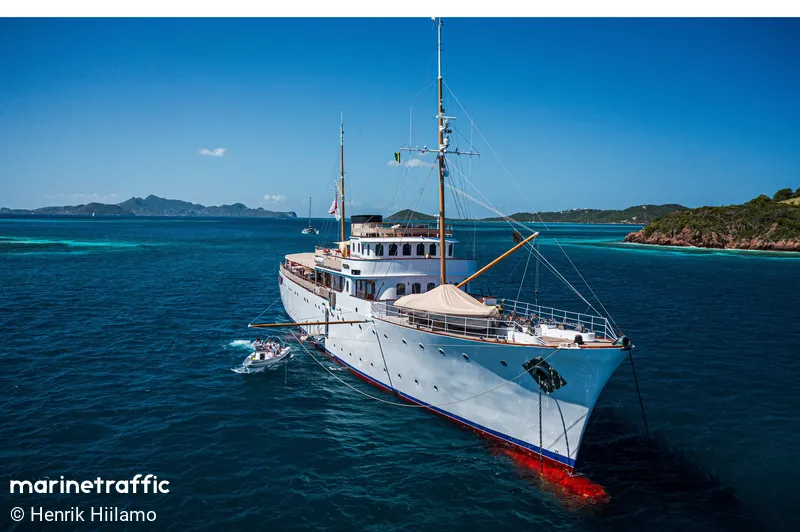
A vessel’s position is the boat’s, not the owner’s. Ownership is as reported, not certified.
Shemara is a 64-metre motor yacht built in 1938 by John I. Thornycroft & Co. Her owner, Sir Bernard Docker, commissioned her before the Second World War began. She served in the Royal Navy until 1946. The name has remained attached to this specific hull through every change of ownership since then.
The name Shemara appears on the register for a single vessel. It does not move to new hulls when the boat changes hands. This fact is rare for large yachts. Owners often rename vessels to signal a fresh start or a new identity. Shemara kept her name through seven decades of different captains.
The reason lies in the steel itself. The hull was built in 1938 at the Woolston yard in Southampton. John I. Thornycroft & Co. constructed it to rigorous naval standards. The shipyard had a long history of building fast torpedo boats and destroyers for the Royal Navy. That experience shaped the strength of this yacht.
Who built Shemara and why did she serve in the war?
Sir Bernard Docker ordered the yacht from Thornycroft. He was an English industrialist who managed the Birmingham Small Arms Company group. His wealth came from heavy industry and manufacturing. He wanted a large vessel for private use. The yard delivered a 64.09-metre motor yacht with a beam of 9.19 metres.
The Royal Navy took Shemara in 1939. This happened at the start of the Second World War. The navy used her as a training vessel for anti-submarine warfare. She operated in British waters during the conflict. Her strong build made her suitable for military duties.
A tragedy occurred during her naval service. A submarine named HMS Untamed was lost with all her crew. This incident happened while Shemara was conducting a training exercise. The loss highlighted the dangers of underwater warfare. Shemara left Royal Navy service in 1946 after the war ended.
Docker took the yacht back in 1946. He used it for leisure cruises and hosted lavish parties. King Farouk of Egypt visited as a guest. The yacht became known for these high-profile social events. Docker maintained the vessel until his own financial troubles grew.
How did corporate decline lead to the sale of Shemara?
Docker’s money ran out in the 1950s. He was removed from the board of BSA in May 1956. His position as chairman was taken by Jack Sangster. This event marked the end of his control over his main business interests. The Dockers began to run low on cash.
His second wife was Norah Collins. They lived at Heath House in Stockbridge. Their isolation increased as their income sources dried up. The autobiography of Lady Docker describes this time of strain. The yacht became a burden rather than an asset.
The yacht eventually sold to Harry Hyams. Potential buyers hesitated due to high costs. They needed modernisation work that few could afford. Hyams bought the vessel for £290,000. This price was half of the original asking price.
Hyams used Shemara for Mediterranean cruises. He enjoyed the space and the Historic character of the boat. After Hyams, the yacht entered a long period of layup. She sat in Lowestoft for many years. Regular use stopped between the 1980s and 2010.
After Hyams, the yacht entered a long period of layup. She sat in Lowestoft for many years. Regular use stopped between the 1980s and 2010. The hull remained intact despite the lack of activity. The steel structure proved more durable than the finances that owned it.
What happened during the major refit of Shemara?
Charles Dunstone bought Shemara in 2010. He is a businessman who saw potential in the Historic vessel. A project began to restore her to former glory. A new company, Shemara Refit LLP, was created to manage the work.
The refit lasted four years. It was completed in 2014. The team replaced almost everything inside the hull. They installed a contemporary interior design. However, they kept much of the original steel and teak. This preserved the Historic nature of the yacht.
The machinery was completely replaced with a new Rolls-Royce diesel-electric system.
The most significant change was mechanical. The old engines were removed entirely. A new Rolls-Royce diesel-electric system was installed. Five main generators provide power for two electrically driven azimuthing pods. A bow thruster assists with maneuvering in tight spaces.
This upgrade allowed the yacht to operate efficiently again. She can now carry 18 guests and 16 crew. Her maximum speed reaches 14 knots. The refit ensured that the 1938 hull could meet modern safety standards without losing its character.
Where is Shemara tracked today?
Shemara flies the flag of the United Kingdom. Her home port is London. AIS data shows her moving in the Mediterranean Sea. She spends time in the Balearic Islands, near Ibiza and Palma de Mallorca.
In September 2026, she sailed between Ibiza and Palma de Mallorca. One passage covered 76 nautical miles. Another trip went from Sant Antoni de Portmany to Formentera. These short hops are typical for charter operations in the region.
Her gross tonnage is 859. This measures the internal volume of the hull. It confirms her status as a large superyacht. The IMO number 8749717 uniquely identifies her. This number stays with the vessel for life, regardless of name or owner.
The name Shemara continues to appear on public records. It links directly to the 1938 Thornycroft hull. No other vessel uses this identifier. The persistence of the name reflects the durability of the build rather than loyalty to a brand.
Current tracking places her in the Ionian Sea. Her last recorded position was at latitude 39.22° N and longitude 20.17° E. She remains active and available for charter. The Historic yacht continues to sail under the same name that started it all.
Reporting and data: CelebYachts, republished by On the record.
Sources
The numbers on this page point here. Each one links to the record it came from.
- 1