
 CelebYachts reportInvestigations
Why Sir James Dyson's Nahlin stays in the Aegean
AIS data shows Nahlin moving slowly between Greek islands. Her 1930 hull and 2005 engine refit limit her speed to 14 knots. This makes long ocean crossings…
By On the record · Jul 2, 2026 · Data from CelebYachts1
A vessel’s position is the boat’s, not the owner’s. Ownership is as reported, not certified.
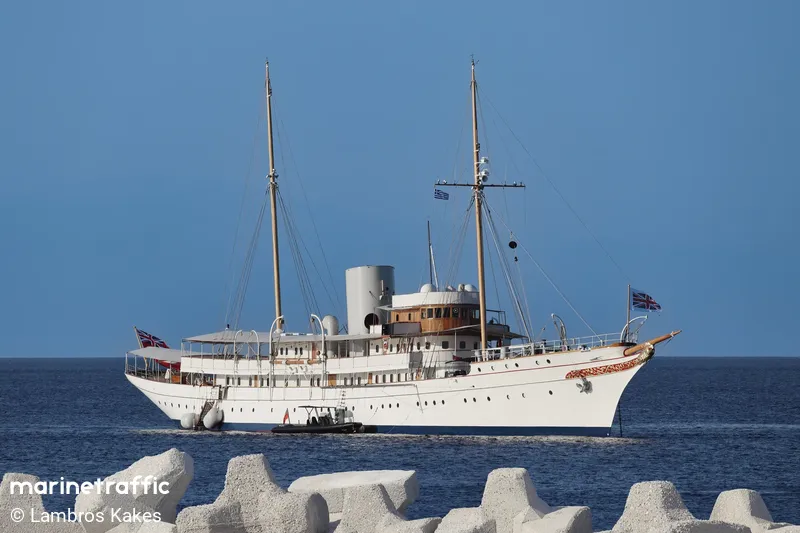
Nahlin, owned by Sir James Dyson, spends most months near Rhodes. The AIS track reveals short hops at low speeds. Her old engines cap her pace. She cannot cross oceans fast enough for regular blue-water cruising.
Nahlin has not left the Aegean Sea for weeks. Her last known position sits at 36.17° N, 28.11° E. This spot is just off the coast of Rhodes in Greece. The vessel belongs to Sir James Dyson.
The British inventor bought the yacht in 2006. He restored it after finding it rusting in Romania. Now he uses it for short trips around the Greek islands. The pattern is clear in our position logs.
Who owns Nahlin and why does he keep it?
Sir James Dyson founded the company Dyson. He is best known for the bagless vacuum cleaner. His family net worth stands at £23 billion according to the Sunday Times Rich List 2023. Forbes lists his net worth as $13.3 billion as of March 2025.
He acquired Nahlin from Anthony Bamford in 2006. The yacht had been restored in Germany. Blohm+Voss replaced the steam turbines with a new diesel-electric powertrain. MTU Friedrichshafen supplied the engines. The refit allowed berths for 14 passengers and up to 47 crew.
Dyson studied furniture and interior design at the Royal College of Art. He credits structural engineer Anthony Hunt with influencing his move to industrial design. He opened the Dyson Institute of Engineering and Technology in September 2017.
He holds the yacht through Weybourne Holdings Pte, a Singapore-based business. This entity owns 31 UK properties. The yacht serves as a private leisure vessel. It is the largest British-flagged and -owned superyacht with an overall length of 91 metres.
She moves in bursts. Then she stops. The distances are small. The speeds are slow. This physical limit is built into her steel frame and her diesel engines.
What limits Nahlin's top speed?
Her engines were replaced in 2005. The original steam turbines were gone. They had served her for seventy-five years. The new system came from MTU Friedrichshafen. It uses two sixteen-cylinder diesel engines.
Each engine produces 2,502 brake horsepower. This power drives electric generators. The generators feed electric motors. Those motors turn the propellers. Each motor delivers 2,000 kilowatts of thrust.
This setup trades raw speed for reliability. Steam turbines can spin faster. Diesel engines are more efficient. They suit coastal work better. They do not need constant high revs.
The result is a hard speed ceiling. Nahlin rarely exceeds 14.6 knots. Our data shows peaks of 14.1 knots on longer runs. Most daily movements stay below 13 knots. She simply cannot go faster.
Where does Nahlin spend her time?
The map shows her home base. She hovers near Rhodes for long periods. The track reveals repeated positioning manoeuvres. These happen within a thirty-nautical-mile radius of the island.
This pattern matches local service. It is not open-ocean travel. She visits nearby ports when she moves. The distances are short. The transits take only a few hours.
In August 2026, she made several short trips. One voyage covered just 6.8 nautical miles. Another loop ran 16.9 nautical miles around Rhodes. These are leisurely coastal hops.
Even her longer legs are regional. A trip from Piraeus to Rhodes took two days. It covered 734 nautical miles. The average speed was 12.6 knots. This is steady, not fast.
How did Nahlin survive its turbulent past?
Lady Yule commissioned Nahlin in 1930. John Brown & Co built it in Clydebank. It was launched as yard number 533. G L Watson & Co were her naval architects. Sir Charles Allom designed the interior.
King Edward VIII chartered the yacht in 1936. He cruised with Wallis Simpson from Šibenik to Istanbul. This trip alerted the world's media to the impending abdication crisis. King Carol II of Romania bought the yacht in 1937 for £120,000.
Romania renamed it Luceafărul, then Răsăritul, then Transilvania. After the war, it became Libertatea. It served as a museum ship and a floating restaurant at Galați. A British couple, Bill and Laurel Cooper, found it dripping and rusted in 1997.
Nicholas Edmiston bought Libertatea for $265,000 in 1998. He brought it to Falmouth aboard the heavy-lift ship Swift. Cammell Laird began restoration but went into receivership in 2001. Nobiskrug continued the refit in Rendsburg.
Blohm+Voss replaced the steam turbines in Hamburg. The original mahogany-hulled tender was found in Scotland. It had been lost for 60 years. Willie McCullough fully restored it. The tender reunited with the yacht during the refit.
How did Dyson acquire this historic yacht?
Dyson bought the yacht from Anthony Bamford. The sale happened in 2006. Before that, the vessel had a turbulent history. It changed hands many times.
It started as a private British yacht. Lady Yule commissioned it in 1930. John Brown & Co built it in Clydebank. It was launched as Nahlin.

King Edward VIII chartered it in 1936. He used it to cruise with Wallis Simpson. This trip caused a scandal. It contributed to his abdication later that year.
Romania then bought the yacht. King Carol II renamed it Luceafărul. After the war, it became a museum ship. Later, it served as a floating restaurant.
A British couple found it in poor condition. Nicholas Edmiston bought it in 1998. He brought it back to the UK for restoration. Dyson completed the project.
What does Nahlin's current operation look like?
Nahlin flies the United Kingdom flag. Her home port is London. Her IMO identifier is 1009417. Her MMSI is 235075032. She is registered under her original name Nahlin since 2010.
Her gross tonnage is 1,377. Her beam is 12.0 metres. Her length is 92.0 metres. She is a motor yacht. Her hull type is steel. She is the only vessel built by John Brown & Co still sailing.
Voyage 334 was a 16.9-nautical-mile loop. It departed and arrived at Rhodes on 2 August 2026. It averaged 12.3 knots with a peak of 14.0 knots. Voyage 2937 covered 466 nautical miles from Bizerte to Tarragona.
Voyage 2747 ran from Piraeus to Rhodes. It covered 734 nautical miles in two days. The average speed was 12.6 knots. Voyage 2631 went from Ermioni to Piraeus. It covered 74 nautical miles in six hours.
The data shows repeated positioning manoeuvres. These occur within a thirty-nautical-mile radius of Rhodes. The pattern is consistent with coastal transit. It is not open-sea passage. The speeds reflect the engine limits.
Why is Nahlin still sailing today?
Most yachts from 1930 are scrapped. Nahlin survived because of careful maintenance. The 2005 refit gave it a new heart. The diesel engines are modern and reliable.
The hull remains original. It is steel, built for endurance. The 92-metre length provides stability. The 12-metre beam offers room. These dimensions suit the Aegean waters.
Dyson values engineering. He designed bagless vacuums. He understands mechanical systems. He appreciates the challenge of keeping a vintage vessel running.
The yacht now carries fourteen guests. It requires forty-seven crew members. This is a large team for a small vessel. They keep the old systems working.
Nahlin is the only John Brown yacht still active. It is a unique survivor. Its slow pace is part of its charm. It moves like a classic, not a racer.
What does the AIS data tell us?
Our archives show her recent movements. She left Ermioni for Piraeus in late August. The trip took six hours. She covered 74 nautical miles.
She then moved to Paros and Milos. These are short hops in the Cyclades. The speeds varied between 7.6 and 9.5 knots. She stayed in port often.
The data confirms her operational range. She does not cross the Mediterranean in one go. She steps from island to island. This fits her engine profile.
Her flag is the United Kingdom. She is registered in London. This allows easy access to European ports. It also simplifies customs for a British owner.
Nahlin’s story is one of adaptation. It went from steam to diesel. It went from royal duty to private leisure. It remains a functional piece of history.
Reporting and data: CelebYachts, republished by On the record.
Sources
The numbers on this page point here. Each one links to the record it came from.
- 1