
 CelebYachts reportProfiles
The ninety-four-metre ledger
A Feadship built for the Cayman registry carries a name whose origin is unrecorded, but its dimensions reveal the engineering priorities of a hedge fund manager who treats a yacht as a mobile balance sheet.
By On the record · Oct 5, 2026 · Data from CelebYachts1
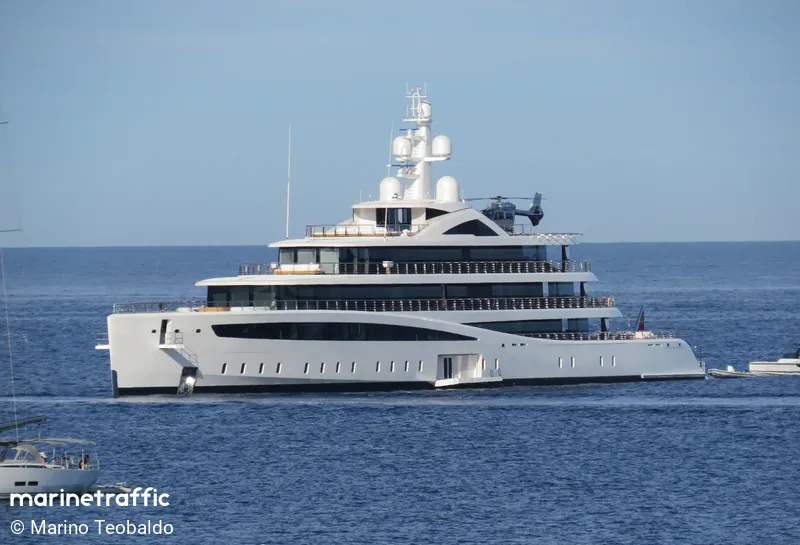
A vessel’s position is the boat’s, not the owner’s. Ownership is as reported, not certified.
VIVA measures 94 metres and displaces nearly three thousand gross tons. Her owner chose a name that leaves no trace in public records, yet the hull’s proportions and her recent movements through the Ligurian Sea show exactly how the capital behind her dictates her operation.
The name VIVA appears on the transom of a 94-metre steel hull launched in 2021, but its etymology has never been published. Where the provenance of a superyacht name usually traces back to a family holding, a personal nickname, or a foreign word, this entry offers no such anchor. The register simply records the designation alongside a Cayman Islands flag and a home port listed as Bloody Bay. That silence is typical of owners who treat their vessels as extensions of a corporate treasury rather than personal statements. Griffin has not explained the term, and the available records contain no interview or press release attaching meaning to it. The hull’s physical specifications, however, make clear what the name omits: a machine engineered for endurance and institutional anonymity rather than spectacle.
The corporate architecture
Ken Griffin founded Citadel LLC in 1990 with $5 million in seed capital provided by Frank Meyer at Glenwood Capital Investments. The firm generated approximately $90 billion in net gains after fees from that starting point, making it the most profitable hedge fund in history according to LCH Investments. By January 2026, Citadel managed roughly $67 billion in assets under management, and Griffin retained an eighty percent stake in the entity. His personal wealth, estimated at $23 billion in the current registry data, derives entirely from these trading and market-making operations. The capital that purchased VIVA did not come from a privatisation, a property development, or a single asset sale; it accumulated through daily volatility and retail order flow, particularly via Citadel Securities, which reported $2.36 billion in profit during the first half of 2020 alone. That continuous cash flow explains why the owner acquired a custom-built Feadship without negotiating a fixed yard price in public records. The vessel’s estimated value of $250 million reflects construction costs and interior fit-out rather than a speculative flip.
The builder, Feadship, operates as a cooperative venture between Royal Van Lent Shipyard and Koninklijke De Voogt Naval Architects, sharing a design centre in Hoofddorp. Hull 817 was constructed under this arrangement, which dates back to 1949 when Henri de Voogt formed the First Export Association of Dutch Shipbuilders to sell steel yachts to American clients. Feadship officially launched at the 1951 New York Boat Show, showcasing steel construction to a North American market that had previously relied on wood. With orders flowing for both steel and aluminium, the cooperative stopped building wooden yachts by the mid-1950s. A series of mergers followed, reducing the membership to just three yards within the agreement by 1966. The organisation secured royal charters for its component shipyards in 2001 and 2006 upon their centenaries, and LVMH acquired Royal Van Lent in 2008. In September 2025 it was reported that Feadship had joined the Nuclear Energy Maritime Organization, signalling a longer-term engineering pivot toward advanced propulsion systems, though VIVA herself predates that announcement and retains conventional diesel-electric machinery.
The cooperative model imposes specific dimensional constraints that dictate where a hull can be assembled. Royal Van Lent maintains two dry docks and slipways in Kaag capable of handling vessels up to 100 metres. The Amsterdam Westpoort facility opened in early 2019 accommodates builds up to 160 metres, while the Makkum yard features deep-water access and a 170-metre construction shed designed for projects exceeding 120 metres. VIVA’s 94-metre length places her squarely within the Kaag yard’s primary production range, avoiding the logistical bottlenecks that delay larger projects. Her beam of 14 metres and gross tonnage of 2,999 indicate a displacement hull optimised for fuel efficiency and seakeeping rather than high-speed performance. The interior layout remains unpublished, leaving the exact placement of machinery, crew quarters, and guest accommodations to inference. What the AIS data confirms is a consistent operational tempo: slow transits, extended stays in protected bays, and a reliance on established French ports that can accommodate a beam of 14 metres.
The dock, not the drawing
Her recent AIS broadcasts confirm a pattern of low-speed transit along a tight coastal circuit. Between late July and early August 2026, the hull completed three separate passages connecting Nice, Saint-Tropez, and Antibes. The longest leg covered 33 nautical miles from Saint-Tropez to Antibes, taking three hours and twenty-three minutes at an average speed of 12.2 knots, with a maximum recorded speed of 14.1 knots. Another passage ran 30 nautical miles from Nice to Saint-Tropez over two hours and twenty-six minutes, averaging 11.9 knots. A third run between Saint-Tropez and Antibes spanned 29 nautical miles in two hours and twenty-seven minutes, peaking at 15.6 knots before settling to a cruising speed of 12.1 knots. These figures align with the hydrodynamic profile of a 2,999-gross-ton steel hull designed for range rather than sprinting. The Ligurian Sea track demonstrates a vessel that remains anchored in European waters throughout the summer season, moving only between established marinas rather than undertaking transoceanic crossings.

The Riviera circuit
The absence of a named owner on the exterior, combined with the Cayman flag, creates a regulatory buffer that separates the hull from public scrutiny. Griffin’s political contributions and charitable donations, including a $150 million gift to Harvard University in 2014 and a $125 million endowment for the University of Chicago’s economics department in November 2017, remain matters of public record, but the yacht itself operates outside those disclosures. The vessel’s classification and safety compliance fall under Cayman Islands maritime law, which defers to international conventions like SOLAS for structural standards. Feadship’s engineering centre in Hoofddorp handles the naval architecture, ensuring that the 94-metre form meets Lloyd’s Register requirements for open-ocean stability. The home port registration in Bloody Bay contrasts with this Mediterranean routine, highlighting the administrative distance between the legal domicile and the operational theatre. The name VIVA carries no public meaning, but the hull’s dimensions and routing tell a complete story about how the capital behind it chooses to move.
Reporting and data: CelebYachts, republished by On the record.
Sources
The numbers on this page point here. Each one links to the record it came from.
- 1CelebYachtsCelebYachts: The ninety-four-metre ledger