
 CelebYachts reportData
The ninety-nine-metre cadence
Moonrise’s passage from Sorrento to Split tracks a displacement hull optimised for range, maintaining a steady 9.7 knots across 633 nautical miles without…
By On the record · Sep 2, 2026 · Data from CelebYachts1
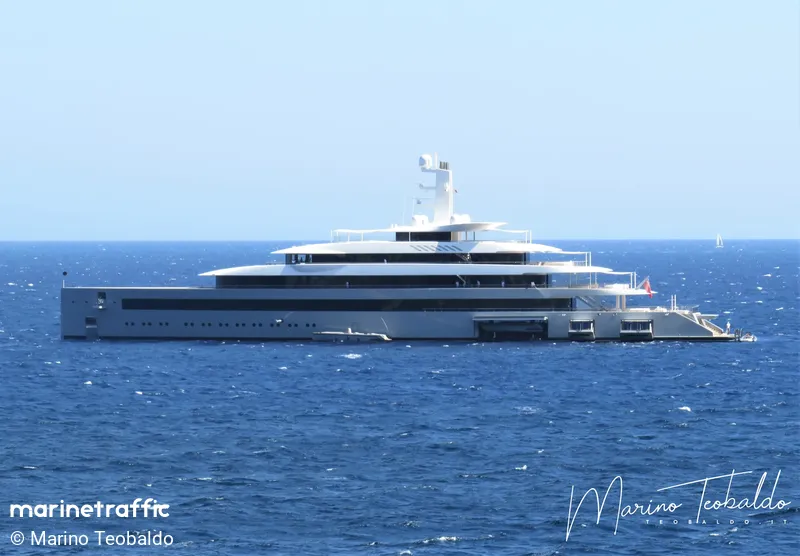
A vessel’s position is the boat’s, not the owner’s. Ownership is as reported, not certified.
The AIS log records a three-day run from the campanian coast to Dalmatia that reveals how a 3,900-gross-tonne Feadship balances fuel consumption against Adriatic currents. The data shows a vessel that prioritises continuous monitoring over speed, leaving no gap in the signal while keeping engine load within a narrow band.
Moonrise departed Sorrento on 2 August 2026 at 13:34 and arrived in Split three days later, having covered 633 nautical miles at an average speed of 9.7 knots. The track contains 195 discrete fixes, recorded continuously from the moment she cast off until she made fast. There are no gaps in the signal. The vessel maintained a steady engine load throughout the crossing, pushing a 3,900-tonne displacement hull through the central Adriatic without exceeding 10.6 knots. This passage demonstrates how a modern 99.95-metre Feadship operates when prioritising range and acoustic signature over sprint performance. The telemetry shows a captain holding a constant throttle setting, relying on the vessel’s hydrodynamic efficiency rather than raw power to cover the distance.
The corridor and the cadence
The departure point sits at 40.52° N, 14.39° E, directly off the Sorrentine peninsula. The arrival lies at 43.54° N, 16.40° E, approaching the harbour entrance at Split. The great-circle distance between these coordinates is 633 nautical miles. The observed track matches this line almost exactly, indicating minimal deviation for weather avoidance or traffic separation. The vessel ran a straight course across open water. The maximum speed recorded during the entire leg was 10.6 knots. This peak occurred briefly and did not alter the overall average. The engine load remained stable. The AIS transmitter fired at standard Class A intervals, producing one fix approximately every 20 minutes. The archive captured every single pulse. The consistency of the speed band proves that the propulsion system was not being modulated for acceleration or deceleration. The hull was already planing at its economic cruise speed, and the throttle was held steady.
A motor yacht of 3,900 gross tonnes requires significant power to overcome water resistance. At 9.7 knots, Moonrise is operating well below her theoretical hull speed, which means she is displacing water rather than riding up on her own bow wave. The resistance curve for a displacement hull rises exponentially past a certain threshold. By capping her speed at 10.6 knots, the crew avoided the steep fuel penalty associated with higher velocities. The AIS data confirms this restraint. The speed variance is less than 1 knot for the majority of the passage. The vessel did not surge. She did not idle. She moved through the water at a uniform pace, burning fuel at a predictable rate. The 195 data points form a smooth curve on any plotting software, reflecting a steady-state operation. The bridge team likely set the engines to a fixed rpm and allowed the ocean conditions to dictate minor adjustments, which the autopilot absorbed automatically.

The weight of the water
The routing choice reveals an awareness of the seabed topography. The central Adriatic deepens significantly as you move east from the Italian coast. A vessel drawing several metres of water benefits from staying in deeper channels to avoid squat effects and shallow-water drag. Moonrise stayed close to the great-circle line, which naturally routes her through the deepest available water between the two ports. The absence of sharp turns or zig-zags in the AIS record confirms that the navigator did not need to adjust course for shoals or restricted drafts. The track is clean. The satellite receivers picked up the VHF signals reliably throughout the crossing. The 100% coverage rate means that every transmitted position was logged by at least one shore-based antenna or orbiting satellite. The signal strength remained constant. There were no dropouts. The vessel did not enter any dead zones.
The duration of the passage provides further insight into the operational strategy. The log opens at 13:34 on 2 August and closes at 06:44 on 5 August. The total elapsed time is 65 hours and 9 minutes. Dividing the 633 nautical miles by this duration yields the 9.7-knot average. The crew could have increased the speed to reduce the transit time, but doing so would have raised the fuel consumption non-linearly and increased the acoustic footprint. For a private yacht owned by Jan Koum, where privacy and low visibility are often priorities, running quietly at a moderate speed makes more sense than racing across the sea. The AIS broadcasts themselves are a necessary compromise for safety regulations, but the vessel’s physical presence remains subdued. The steady speed band reflects a deliberate choice to balance comfort, economy, and discretion.
The Italian coast as a holding pattern
The Sorrento-to-Split leg did not occur in isolation. The telemetry shows a clear staging pattern along the Italian coastline in the days leading up to the crossing. On 1 August, Moonrise completed a 69-nautical-mile run from a position 72 nautical miles off Salerno to Naples. She arrived in the bay and remained there. The following morning, she executed a short 5-nautical-mile loop within the Naples area before departing Sorrento later that day. These movements indicate a methodical approach to positioning. The vessel used the sheltered waters of the Tyrrhenian Sea to stage, provision, or wait for optimal weather windows before committing to the longer Adriatic transit. The short Naples loop served as a final adjustment, possibly to align with tide tables or to verify systems before the open-sea run.
An earlier passage, recorded on 29 July, shows a different operational environment. Moonrise travelled from Licata to Catania, covering 179 nautical miles. The coverage for that leg was only 37%. The signal dropped out for a significant portion of the journey. This contrast highlights the difference between the Tyrrhenian and Adriatic tracking networks, or simply the duration and openness of the leg. The Tyrrhenian segment benefited from closer proximity to mainland relay stations, ensuring continuous logging. The Adriatic crossing, despite its greater length, achieved perfect coverage, suggesting either stronger satellite handover reliability in that sector or a more consistent broadcast power setting during the main transit. The variation in coverage does not reflect a change in the vessel’s equipment, but rather the geography of the receiving infrastructure. The 100% rate on the recent legs proves that the AIS system functioned without fault throughout the entire Italian coastal phase.
The data paints a picture of a vessel designed for endurance rather than exhibition. Built by Feadship in 2020, Moonrise carries the hallmarks of a Dutch yard that values structural integrity and mechanical reliability over flashy performance metrics. The 99.95-metre length and 3,900-tonne displacement place her firmly in the upper tier of superyachts, yet her movement profile is restrained. High-speed dashes are absent from the telemetry. She moves steadily, covers vast distances efficiently, and maintains a predictable schedule. The AIS log records disciplined seamanship. Every fix aligns with the next. The speed holds. The course stays true. The passage from Sorrento to Split follows a calculated transit path, executed with precision and concluded without incident.
Reporting and data: CelebYachts, republished by On the record.
Sources
The numbers on this page point here. Each one links to the record it came from.
- 1CelebYachtsCelebYachts: The ninety-nine-metre cadence