
 CelebYachts reportYards & Design
The ninety-three-metre coincidence
Identical length on paper does not mean shared architecture. A comparison of Lady S and Royal Romance shows how a single yard’s slipway limits dictate…
By On the record · Sep 14, 2026 · Data from CelebYachts1
A vessel’s position is the boat’s, not the owner’s. Ownership is as reported, not certified.
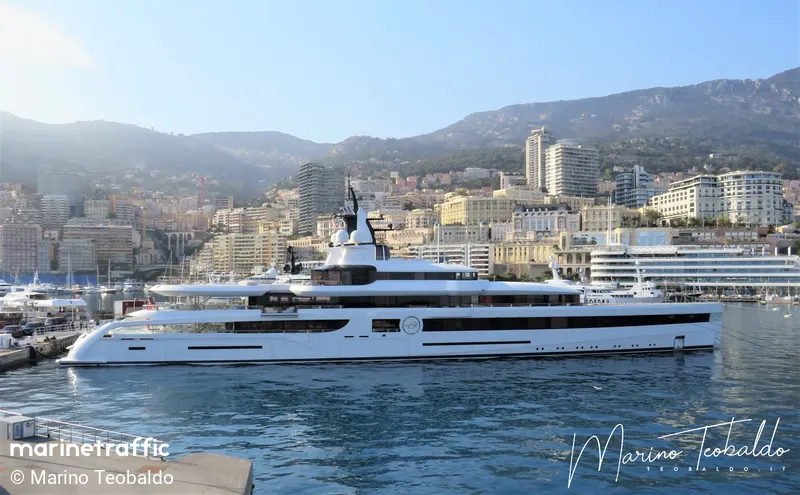
Two Feadships measure exactly ninety-three metres overall. The match is a product of Dutch shipyard capacity and standardised naval architecture, not a sisterhood on the slipway. Divergence in beam, gross tonnage, and delivery dates proves that each hull was engineered to separate specifications.
AIS data places both vessels in the Mediterranean, separated by roughly one hundred nautical miles. One sat off the Ligurian coast near forty-three point two seven degrees north, six point six two degrees east. The other loitered in the Adriatic near forty-three point five three degrees north, sixteen point four three degrees east. They shared a builder, a length, and a naval architect. They did not share a platform.
The shed, not the mould
Feadship operated as a cooperative between Royal Van Lent and Koninklijke De Vries, sharing a design centre at De Voogt Naval Architects in Hoofddorp. The yard system dictated the available envelopes. Royal Van Lent’s Kaag facility handled steel and aluminium construction on two dry docks and two slipways designed for vessels up to one hundred metres. The Amsterdam yard, which opened in early twenty nineteen, extended capacity to one hundred and sixty metres. Both Lady S and Royal Romance launched before the Amsterdam dock reached full operational maturity, placing them squarely within the Kaag yard’s primary production window.
A ninety-three metre length aligned with the structural bays of the Kaag sheds and satisfied the transatlantic range requirements that defined the Feadship market. Clients ordering from this cooperative expected ocean-going capability, which fixed minimum displacement and engine room volume. The length converged because the slips converged. The hull numbers confirmed independent projects. Royal Romance carried hull number one thousand and five. Lady S entered the register later, with no shared serial designation.
The sources did not indicate a common mould or a repeated template. Feadship built custom superyachts since nineteen fifty one, when the association launched its first steel vessel at the New York Boat Show. The cooperative model relied on shared engineering rather than shared hulls. De Voogt Naval Architects produced the exterior lines and naval architecture for each commission, tailoring the internal layout to the buyer’s specification. The matching length reflected yard geometry rather than a shared design template.
Beam, tonnage, and the space between
The identical length masked significant structural differences. Lady S measured sixteen metres across the beam and registered at two thousand nine hundred and ninety-nine gross tonnes. Royal Romance measured fifteen metres wide and sat at two thousand nine hundred and thirty-three gross tonnes. The six hundred and sixty-six tonne gap represented a substantial difference in internal volume, machinery weight, and fuel capacity. Both vessels carried twin MTU diesel engines rated at three thousand and four horsepower, yielding a combined output of six thousand and eight horsepower. Royal Romance achieved a maximum speed of fifteen knots. Lady S shared this propulsion configuration but carried a wider beam, which altered hydrodynamic resistance and stabiliser placement.
The beam differential also dictated deck layout. A wider hull allowed for broader guest cabins and a more expansive main salon without increasing overall length. The extra tonnage suggested different interior fit-outs, heavier machinery arrangements, or additional tender storage. The sources do not disclose unpublished interiors, so the exact distribution of that mass remained unrecorded. What appeared on the register was the constraint: the owners selected different volumes within the same length envelope.
Dan Snyder purchased the Washington Commanders franchise in nineteen ninety nine for eight hundred million dollars after founding his marketing company in eighteen eighty nine. His acquisition of Lady S followed a career built in sports media and telecommunications. Viktor Medvedchuk, the original owner of Royal Romance, operated as a Ukrainian lawyer and business oligarch before entering politics. He acquired the yacht in July twenty fifteen and held it until its transfer to the Ukrainian state. The wealth behind each purchase originated in entirely separate industries, explaining why neither owner constrained the other’s specifications.
The arrest and the ledger
Royal Romance left the private market in March twenty twenty two when Croatian authorities arrested the vessel in the port of Rijeka. The seizure followed sanctions imposed by the United States, the European Union, and Ukraine against Medvedchuk, who had been handed over to Russia in September twenty twenty two during a prisoner exchange. The Croatian court granted a search warrant on behalf of the American FBI in November twenty twenty two, citing alleged money laundering. The court subsequently ruled that the yacht should be transferred to the Ukrainian Asset Recovery and Management Agency to preserve its economic value through auction. By May twenty twenty four, the ownership transfer process completed, and the vessel registered to the state of Ukraine.
Lady S remained under Cayman Islands registration with George Town as her home port. She appeared in AIS broadcasts near the Ligurian Sea, maintaining a steady track consistent with private leisure operations. The contrast between the two hulls stood as legal as much as mechanical. One sat in a Ukrainian registry awaiting disposition. The other continued to broadcast positions across the western Mediterranean.
The identical length on their registration documents represented a statistical overlap. It resulted from a Dutch yard optimising its slipways for a specific transatlantic class, and from two buyers accepting the standard envelope while diverging on width and internal mass. The evidence did not support a shared origin beyond the cooperative’s standard engineering practices. A serious answer to whether they shared a platform would require access to De Voogt’s original CAD files and Royal Van Lent’s construction logs. Those records were not public. The register showed only what fitted into a spreadsheet: two names, two flags, and a length that matched by design, not by accident.
Reporting and data: CelebYachts, republished by On the record.
Sources
The numbers on this page point here. Each one links to the record it came from.
- 1