
 CelebYachts reportData
The non-stop run across the Tyrrhenian
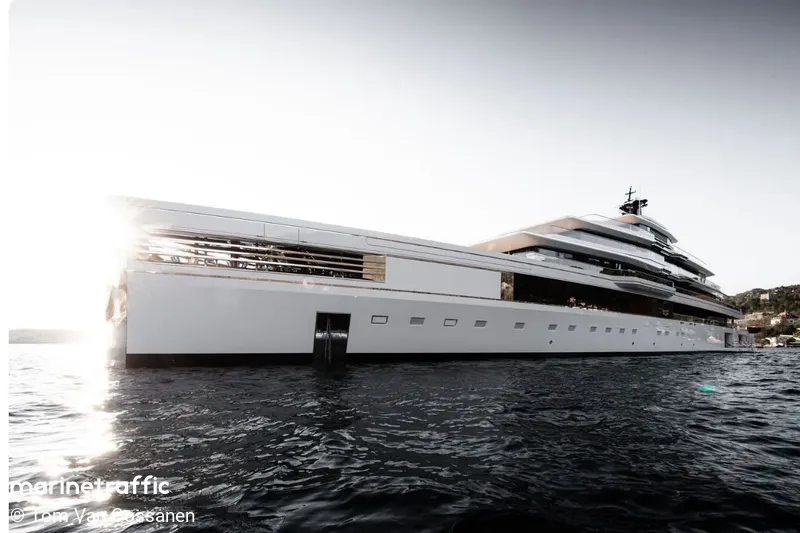
Ulysses averaged 15.9 knots over 987 nautical miles between Sorrento and Gibraltar, revealing a 102-metre hull built for sustained speed rather than coastal loitering.
By On the record · Oct 28, 2026 · Data from CelebYachts1
A vessel’s position is the boat’s, not the owner’s. Ownership is as reported, not certified.
AIS data tracks a 2024 delivery completing a fast western Mediterranean circuit. The passage to Gibraltar shows a vessel operating well outside normal displacement parameters, prioritising range and pace over static luxury.
The departure from Sorrento on 27 August marks the beginning of a sustained run. The yacht cast off at 08:59 local time. For the next thirty-six hours she maintained a steady course south-west, covering 987.3 nautical miles to the Rock. The AIS log records an average speed of 15.9 knots and a maximum of 17.5 knots. These figures are not typical for a vessel of 102.6 metres. Displacement yachts of this size usually top out between twelve and fourteen knots at cruise. To sustain fifteen point nine knots requires a power-to-weight ratio that points directly to her construction era. Launched in 2024, Ulysses carries the engineering priorities of a new decade, where lightweight composites and high-output machinery allow larger hulls to operate at speeds previously reserved for much smaller craft.

The telemetry of a long leg
The track itself tells the story of the engine room more clearly than any specification sheet. Of the 987.3 nautical miles, our position archive witnessed 840.19 nautical miles. The remaining 147.16 nautical miles fall into the reconstructed category, where satellite pings replaced direct VHF broadcasts. Terrestrial AIS signals typically cover roughly twenty nautical miles from the coast, depending on antenna height and atmospheric conditions. As Ulysses pushed into the central Tyrrhenian, the signal would have faded, forcing receivers to rely on satellite relay. Satellite coverage introduces latency and occasional packet loss, which explains the 85 per cent observation rate. Even accounting for the missing fixes, the speed profile remains consistent. She did not idle. She did not anchor mid-channel. She held her line. The duration of the passage, from 08:59 on the twenty-seventh to 22:18 on the twenty-ninth, spans exactly two days, thirteen hours and nineteen minutes. At that average, she covered roughly twenty-five nautical miles every hour without pause. The route bypasses the usual coastal waypoints, cutting a straight line across the basin. This routing decision reflects a priority on time over scenery, treating the sea as a thoroughfare rather than a destination. The consistency of the speed suggests favourable sea states and a hull form that maintains efficiency even at higher displacements.
The circuit rhythm
The pace fits the rhythm of her entire summer. The AIS history shows a vessel that treats the Mediterranean as a highway rather than a marina. Ten days before the Gibraltar run, she departed Portofino for Sorrento, a 322.8 nautical mile leg that required similar endurance. Before that, she crossed from Barcelona to Saint-Tropez, covering 252.2 nautical miles in a single push. The sequence began in Sète on 10 August, moved through Barcelona, up the French Riviera past Antibes and Nice, then east to Sestri Levante and Portofino. Each segment is measured in hundreds of miles, not tens. The only exceptions were the final days in Campania, where she shuttled between Castellammare di Stabia and Sorrento over distances of sixteen and twenty-six nautical miles. Those short hops suggest a change in operational mode, perhaps preparing for the long exit or dealing with local traffic restrictions. The return to high speed for the Gibraltar crossing confirms that the slow manoeuvring was temporary. The vessel uses the sheltered bays for loading and crew changes, then returns to open water as soon as possible. The summer itinerary follows a logical geographical sweep, moving counter-clockwise around the western basin before executing a rapid exit through the Strait. Such a pattern requires precise logistical planning and a crew accustomed to long watchkeeping periods.
The numbers on the steel
The physical dimensions of the hull explain how she achieves these numbers. At 102.6 metres, Ulysses sits comfortably in the superyacht class, yet her gross tonnage is recorded at just 2,999. Tonnage measures internal volume, and a ratio of roughly thirty cubic metres per metre of length indicates a relatively slender superstructure. Builders typically inflate tonnage with wide beam, multi-deck lounges, and massive beach clubs. Ulysses appears to have sacrificed some of that interior sprawl for a lower centre of gravity and reduced windage. The result is a hull that cuts through water with less resistance. The builder is not listed in the public register, which leaves the specific naval architecture open to interpretation, but the performance data speaks for itself. The flag is the Marshall Islands, a common choice for vessels prioritising privacy and streamlined administration over traditional European registry. The owner is Graeme Hart, a New Zealand-based investor whose wealth stems from his stake in SkyCity Entertainment. The origin of the capital places no constraint on the hull's design beyond the initial commissioning phase. A vessel of this performance tier demands significant fuel capacity to sustain twenty-five nautical miles an hour over thousands of miles. The absence of mid-voyage stops for bunkering implies large tankage integrated into the lower decks, further lowering the centre of gravity and improving stability at speed.
The arrival and the pause
Arrival at Gibraltar occurred at 22:18 on 29 August. The strait is a natural choke point, and holding patterns are frequent here due to commercial shipping lanes. Ulysses made fast, but only briefly. By 03:58 on 30 August, she had cast off again, heading north-east towards Tangier. The distance to Morocco is negligible compared to the Tyrrhenian crossing, and the AIS signal dropped immediately after departure, leaving her current position unconfirmed. The track ends there. The vessel is now sitting off the Moroccan coast, her summer circuit apparently complete. The data shows a machine built for transit, moving efficiently between major ports, using the sea as a corridor rather than a destination.
Reporting and data: CelebYachts, republished by On the record.
Sources
The numbers on this page point here. Each one links to the record it came from.
- 1