
 CelebYachts reportThe Fleet
The northern anchor and the Mediterranean drift
Twelve of the sixteen tracked Tech-founder hulls are clustered in the western basin and the Aegean, while four operate in the North Sea and the Elbe. Their…
By On the record · Aug 7, 2026 · Data from CelebYachts1
A vessel’s position is the boat’s, not the owner’s. Ownership is as reported, not certified.
AIS data from July and August shows the cohort abandoning the cross-channel run. The majority remain in the Mediterranean, executing long coastal transits, while a quartet stays in northern European waters, running short hops between fjords and ports.
The AIS broadcasts for the Tech-founder cohort record a complete rejection of the traditional summer circuit. Twelve of the sixteen tracked hulls are positioned in the Mediterranean and the Aegean, while four hold the North Sea and the German-Dutch coast. The data from July and August 2026 shows no vessel crossing between these basins. The majority of the group executes long coastal runs across southern waters, whereas a northern quartet maintains short, repetitive loops along fjords and rivers. The seasonal migration model does not apply to this ownership class.
The Mediterranean baseline
Twelve hulls occupy the western basin and the Aegean. Three sit in the Ligurean Sea, three in the Tyrrhenian, two in the Balearic, and two in the Aegean. Single vessels are logged in the West Mediterranean and the Adriatic. The distribution is dense but not uniform, and the movement patterns within each sub-basin differ significantly from the standard anchorage-hopping routine seen in other cohorts. The tracked passages reveal a preference for sustained transit over stationary periods. Norn, owned by Charles Simonyi, covered 677 nautical miles in a single push from Messina to Barcelona, departing on 28 July 2026. The run bypassed the usual stopover ports along the French and Spanish coasts, indicating a direct routing strategy. Nebula, belonging to Jan Koum, executed a 328 nautical mile run from Palma de Mallorca to Cagliari on 30 July. Skat, registered to Kjell Inge Røkke, covered 202 nautical miles from La Maddalena to Imperia on 1 August. These distances are substantial for a seven-day window, and the AIS data shows the vessels maintaining steady courses for hours at a time rather than drifting between marinas.
Jan Koum’s five-hull group is spread across three adjacent areas, which fragments the expected fleet concentration. Moonrise 2025 is logged in the Ligurean Sea. Moonrise 2020 operates in the West Mediterranean. Mogambo, Nebula, and Power Play are recorded in the Tyrrhenian Sea. The separation forces each asset to operate independently, relying on local support rather than a shared logistical chain. Moonrise 2020 illustrates this dispersed approach with a 615 nautical mile run from Torre Annunziata on 2 August, followed by a 69 nautical mile leg from Salerno to Naples on 1 August. A further 179 nautical mile run from Licata to Catania on 29 July completes a complex routing pattern that covers nearly nine hundred nautical miles in ten days. The vessel covers high mileage in concentrated bursts, a pace that requires continuous engine operation and strict crew rotation schedules.
Eric Schmidt’s trio follows a similar long-range pattern. Whisper is positioned in the Adriatic Sea and ran 137 nautical miles from Pula to Sibenik on 1 August. Infinite Jest sits in the Aegean Sea and logged a 15 nautical mile run around Paros on 27 July. Oasis occupies the Tyrrhenian Sea and completed a 120 nautical mile run from Naples to Messina on 4 August. The three hulls are separated by thousands of miles of water, yet all follow the same principle of sustained coastal transit. The AIS records confirm that none of the twelve Mediterranean-based vessels returned to their original departure points within the tracking window, suggesting a linear progression through the basin rather than a circular cruise. Nebula alone logged four separate passages: a 64 nautical mile run from Ibiza to S'Arenal on 28 July, a 328 nautical mile run from Palma de Mallorca to Cagliari on 30 July, a 175 nautical mile run from Cagliari to Torre Annunziata on 31 July, and a 192 nautical mile run from Torre Annunziata to Civitavecchia on 3 August. The cumulative distance exceeds six hundred nautical miles, demonstrating a routing discipline that prioritises open-water passage over coastal shelter.

The northern holdout
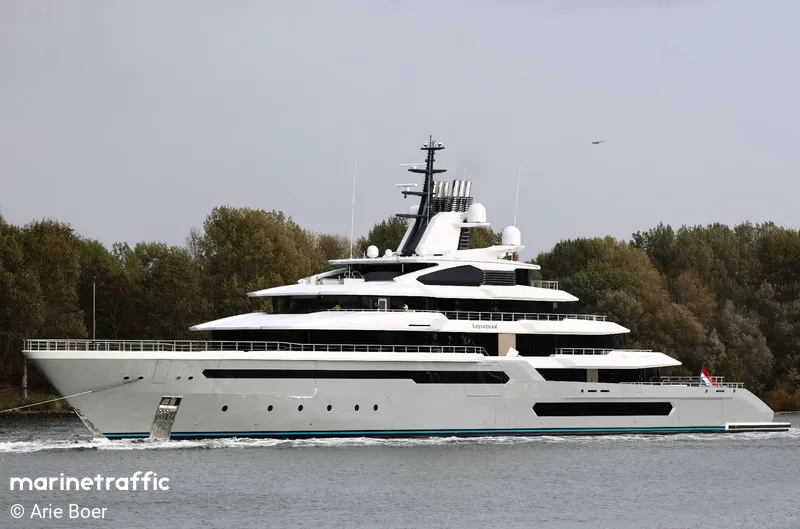
Four hulls did not cross the channel. Three belong to Gabe Newell and one to Jim Clark. Leviathan and Draak are logged in the North Sea. Rocinante, also Newell, is in the Rotterdam Area. Athena, owned by Clark, is on the Elbe River. The AIS data places them firmly outside the Mediterranean circulation pattern, and their movement profiles are markedly different from the southern fleet. Leviathan and Draak are shuttling between Floro and Bergen. The runs are short and repetitive. Leviathan departed Floro on 4 August 2026, ran 45 nautical miles to a point 49 nautical miles off Bergen, and returned 55 nautical miles on 3 August. Draak followed the identical corridor, covering 39 nautical miles outbound and 54 nautical miles inbound over the same dates. The distances are consistent with coastal pilotage or scheduled ferry-style routing, not open-ocean passage making. The vessels turn back after reaching the outer limit of the fjord system, suggesting a deliberate boundary rather than a navigational error.
Rocinante remains logged in the Rotterdam Area throughout the tracking window. No long-distance passages are recorded for the 78.5 m hull. Athena is recorded on the Elbe River, another confined waterway that limits open-sea transit. Neither vessel appears in the passage log for extended runs, indicating a stationary or highly localised operational mode. The contrast with the Mediterranean fleet is stark. The northern quartet covers less than sixty nautical miles round trip, while the southern dozen regularly exceeds three hundred. The difference in scale is visible in the AIS broadcast density and the course stability. The northern hulls maintain low speeds and frequent heading changes, typical of riverine or fjord navigation, whereas the Mediterranean hulls hold fixed headings for extended periods, optimising fuel efficiency over long stretches of open water.
Routing and operational tempo
The AIS data confirms a complete absence of cross-basin traffic. No hull moved between the North Sea and the Mediterranean during July and August. The twelve-to-four split is absolute, and the routing choices reflect two distinct operational tempos. The Mediterranean hulls treat the sea as a transit corridor, executing high-mileage runs that bypass traditional anchorage zones. The northern hulls treat the coastline as a fixed perimeter, running short loops that return to the same starting points within days. The structural division aligns with ownership groups but does not dictate it. Newell’s three hulls are split between the North Sea and the Rotterdam Area. Koum’s five are scattered across the Ligurean, Tyrrhenian, and West Mediterranean basins. Schmidt’s three occupy the Adriatic, Aegean, and Tyrrhenian seas. The geographic spread prevents fleet coordination, forcing each captain to manage independent logistics. The AIS records show that this fragmentation has not reduced activity; it has merely redirected it. The vessels that remain in the Mediterranean run further and faster. The vessels that stay in the north run shorter and slower.
The tracking window closes on 4 August 2026. At that moment, Leviathan and Draak are still positioned off Bergen. Norn is logged in the Balearic Sea after its run to Barcelona. Nebula is heading north from Cagliari toward Civitavecchia. The cohort has not converged. The seasonal migration pattern remains unbroken by the data, and the northern holdouts continue to operate on a completely separate schedule. The AIS archive provides a clear snapshot of how modern yacht operators have decoupled their cruising habits from historical precedent, replacing the unified summer circuit with a fragmented network of regional transit corridors.
Reporting and data: CelebYachts, republished by On the record.
Sources
The numbers on this page point here. Each one links to the record it came from.
- 1