
 CelebYachts reportThe Fleet
The operational limits of the second-tier Sanctioned fleet
AIS data from August 2026 maps eight Sanctioned-linked yachts across four continents. Their tracks show a split between remote anchoring and active European…
By On the record · Sep 16, 2026 · Data from CelebYachts1
A vessel’s position is the boat’s, not the owner’s. Ownership is as reported, not certified.
Eight vessels linked to Sanctioned individuals or entities span the globe, from the Gulf of Alaska to the Ligurean Sea. AIS broadcasts reveal that movement is determined by local maritime density rather than uniform restriction, with some hulls cruising established routes while others remain fixed in remote waters.
The eight vessels in the Sanctioned-seized-yachts-2nd-tier cohort occupy a fragmented geographic range. AIS broadcasts place them in the Adriatic Sea, the Gulf of Alaska, the Balearic Sea, the US East Coast, the Ligurean Sea, the Black Sea, the West Mediterranean, and the coast of West South America. The distance between the northernmost and southernmost positions exceeds ten thousand nautical miles. This dispersion creates three distinct operational profiles based on location rather than ownership structure. Two vessels operate in remote anchorages with minimal transit. Two vessels maintain regular passage through high-traffic European waters. Four vessels show no recorded movement during the reporting period. The data suggests sanctions affect financial access more than physical location, allowing vessels to relocate to jurisdictions where enforcement is less visible.
The Alaskan and Patagonian anchors
Q, owned by Roy E. Carroll, measures 68.2 metres and operates in the Gulf of Alaska. AIS records show her making short transits between Juneau, Hoonah, Gustavus, and Elfin Cove throughout August 2026. On 7 August, she moved 29 nautical miles off Juneau before returning to port. Earlier that day, she completed a 10-nautical mile run from Hoonah. Between 5 and 7 August, her total logged distance remained below 100 nautical miles. Her movements suggest a base of operations fixed to the Inside Passage rather than open-ocean cruising. The cluster of waypoints around Juneau and Gustavus indicates a preference for sheltered waters typical of the region. Firebird, owned by Andrey Yakunin, stays near Puerto Natales on the West South America coast. She measures 27 metres. Her passages between 1 and 2 August cover distances of 12 to 22 nautical miles, confined to the waters surrounding the Chilean town. Puerto Natales serves as a gateway to Patagonia, a region with limited superyacht infrastructure. Both vessels demonstrate that sanctions do not always result in total immobilisation; they often result in relocation to jurisdictions with limited maritime traffic. The AIS data for both hulls is consistent with leisurely coastal navigation rather than long-distance voyaging.
For Q, the sequence of movements on 5 August began with a 29-nautical mile run from a position 44 nautical miles off Gustavus to Gustavus itself. Later that day, she moved 32 nautical miles from Gustavus to Elfin Cove. These legs connect key stops along the Alaska Marine Highway. The return to Juneau on 7 August completes a circuit of the region's major ports. For Firebird, the passages on 1 August include a 22-nautical mile run from a position 101 nautical miles off Puerto Natales to the same offshore mark, followed by a 16-nautical mile leg to the town itself. These movements suggest a routine of checking conditions or waiting for weather rather than destination-driven travel. The consistency of these short loops indicates a fixed operational radius.
The Riviera and Aegean crossings
In contrast, Zig Zag Ocean and Amore Mio traverse established luxury routes. Zig Zag Ocean, owned by Saleh Assi, measures 44.6 metres. Her AIS track places her in the Ligurean Sea. On 4 August, she ran 41 nautical miles from Nice to Saint-Tropez. Two days later, she completed a 7-nautical mile transfer from Villefranche-sur-Mer to Monaco. She also moved between Cannes and Monaco on 4 August, covering 28 nautical miles. These are standard coastal hops for a vessel of her size. The frequency of her movements—four distinct passages in three days—suggests active use rather than storage. Amore Mio, linked to Viktor Medvedchuk, measures 45 metres and operates in the West Mediterranean. On 2 August, she completed a 637-nautical mile passage from Valletta, Malta, to Kos in Greece. This crossing connects the central Mediterranean to the Aegean, a route used regularly by commercial and private traffic. The presence of these vessels in the French Riviera and the Greek islands indicates that movement continues in regions with dense regulatory oversight.
The contrast between their activity and the stillness of the larger hulls in the same cohort highlights the variability of enforcement. Zig Zag Ocean's movements in the Ligurean Sea follow a predictable pattern. The run from Nice to Saint-Tropez covers 41 nautical miles, a standard coastal transit. The subsequent move to Cannes and then Monaco covers 13 and 7 nautical miles respectively. These short hops are typical of a vessel visiting multiple marinas in a single week. The use of Villefranche-sur-Mer, a major superyacht anchorage, suggests access to shore-side services. Amore Mio's crossing from Valletta to Kos is the longest passage in the cohort. At 637 nautical miles, it requires several days of steaming. The arrival at Kos places her in the Dodecanese, a popular cruising ground. This long-distance capability distinguishes her from the Alaskan and Patagonian hulls, which are confined to narrow waterways.
The silent fleet
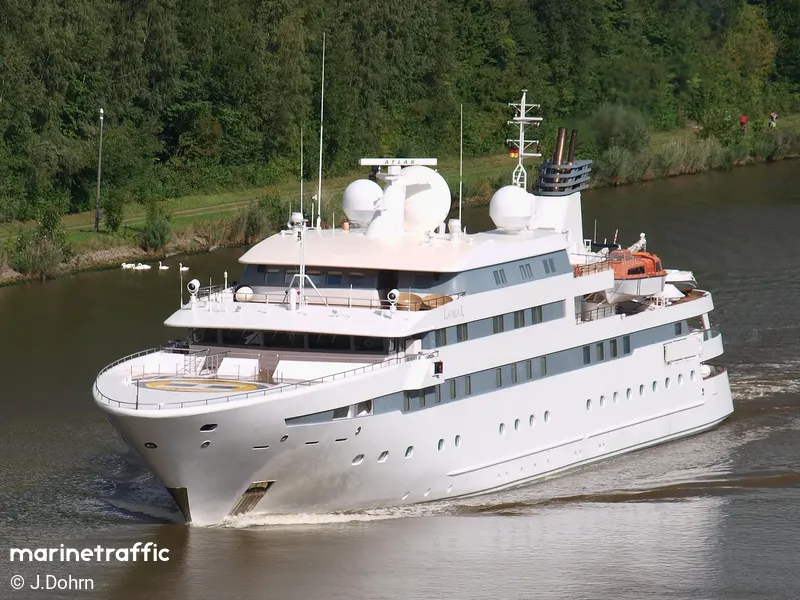
The remaining four hulls in the cohort show no AIS passages in the provided data. Lauren L, owned by Ihor Kolomoyskyi, is the largest vessel in the group at 88.5 metres. She sits in the Adriatic Sea. Lady Anastasia, owned by Alexander Mikheyev, measures 47.7 metres and is located in the Balearic Sea. Divina Barbara, owned by Eduard Khudainatov, measures 32 metres and rests on the US East Coast. St. Vitamin, owned by Beratex Group, measures 37 metres and is positioned in the Black Sea. The absence of tracking data for these vessels could indicate they are anchored, their transponders are inactive, or they are operating in areas with poor AIS coverage. The data confirms their positions but does not confirm their activity levels. Lauren L remains the most significant static asset, given her length and the profile of her owner.
Her position in the Adriatic places her near major shipping lanes, yet she shows no transit logs. Lady Anastasia and Divina Barbara occupy similar quiet zones in the Balearics and the US East Coast respectively. St. Vitamin is held by a corporate entity, Beratex Group, which may imply different operational protocols than individual ownership. The lack of movement for these hulls might reflect a deliberate choice to minimize visibility. Larger vessels like Lauren L require deeper drafts and more extensive support, which might be harder to secure in a Sanctioned status. Smaller vessels like Divina Barbara might be easier to hide, yet they also remain static. The common factor is the absence of AIS data, which prevents any further analysis of their activities.
The cohort composition
This group of eight hulls spans a length range from 27 metres to 88.5 metres. The distribution of sizes does not correlate with movement status. Zig Zag Ocean at 44.6 metres is active, while Amore Mio at 45 metres is also active, yet Lauren L at 88.5 metres is static. Firebird at 27 metres is static in terms of long-range travel, though she makes short hops. The owner descriptors vary from named individuals to linked entities. Saleh Assi and Roy E. Carroll are listed as non-Russian owners, while Viktor Medvedchuk is described as linked. Beratex Group is a corporate owner. This mix suggests the cohort is defined by regulatory action rather than nationality or legal structure. The geographic spread covers four time zones and multiple jurisdictions. The vessels are not clustered in a single haven but are scattered across the globe. This scattering complicates any unified enforcement strategy.
All passages occur in August 2026. The earliest log is for Firebird on 1 August. The latest is for Q on 7 August. This concentrated timeframe suggests a snapshot of activity rather than a seasonal trend. The clustering of movements in the first week of the month might indicate a response to changing conditions or a planned itinerary. The lack of data after 7 August leaves the status of these vessels uncertain for the remainder of the month. The classification of this cohort as 'second tier' implies a hierarchy of Sanctioned assets. The pack lists eight hulls, all tracked. The term 'seized' in the subject label suggests legal action, yet the AIS data shows some vessels still operating. This discrepancy highlights the difference between legal seizure and practical control. A vessel can be legally seized but physically absent or difficult to locate. The AIS data provides a proxy for physical control. Where AIS shows movement, practical control may still lie with the operator. Where AIS is silent, the vessel may be impounded or hidden. The eight hulls in this cohort illustrate the limitations of AIS as a tool for monitoring sanctions. It tracks location, not ownership or legal status. The data shows where the boats are, but not who controls them or why they move.
Reporting and data: CelebYachts, republished by On the record.
Sources
The numbers on this page point here. Each one links to the record it came from.
- 1