
 CelebYachts reportInvestigations
The density premium on the register
Valuation tracks internal volume and builder overhead rather than overall length, making the widest hulls the most expensive assets on the market.
By On the record · Jul 9, 2026 · Data from CelebYachts1
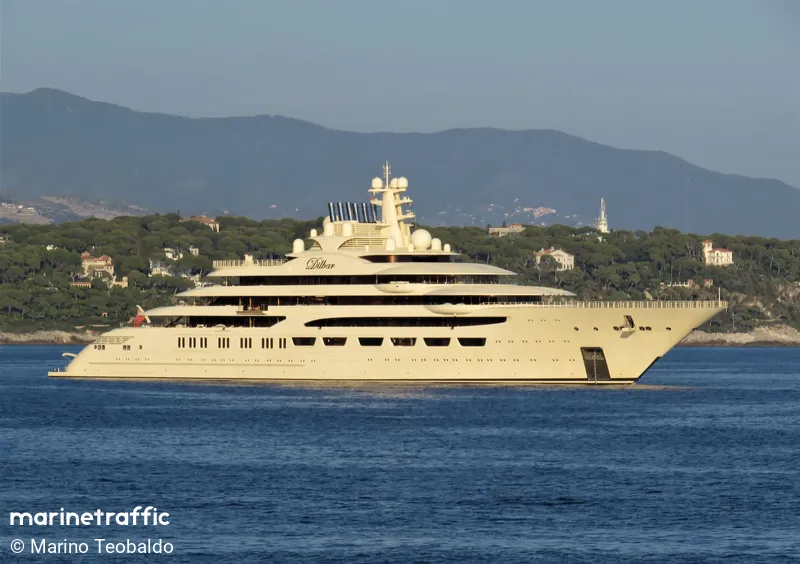
A vessel’s position is the boat’s, not the owner’s. Ownership is as reported, not certified.
Dilbar holds the record at seven hundred and fifty million dollars because she carries fifteen thousand nine hundred and seventeen gross tons in a one hundred and fifty-six-metre frame. The next two positions belong to Eclipse and Scheherazade, both valued at seven hundred million dollars, proving that a shorter beam and heavier machinery can command the same ledger space as a longer, lighter vessel. The record belongs to the shipyard that maximises tonnage per metre, not the one that stretches the longest keel.
The top three hulls on the register share a builder and a structural logic that correlates with internal volume rather than overall length. Dilbar sits at the summit with an estimated value of $750,000,000. She measures 156.0 m in length, which places her sixth on the length table, yet she carries 15,917 gross tons. That volume dwarfs the 13,564 tons of Eclipse, which sits second at $700,000,000, and the 10,167 tons of Scheherazade, which shares that same valuation. The spread between the leader and the runner-up is $50,000,000, a margin that matches the difference in their internal capacity rather than any visible difference in their exteriors.
The trust and the tonnage
Dilbar was built as Project Omar at the German Lürssen shipyard and launched on 14 November 2015. The interior design came from Andrew Winch and the exterior from Espen Oeino. She was registered in the Cayman Islands and named after Alisher Usmanov’s mother. Ownership passed through an irrevocable discretionary trust called The Sister Trust, settled by Usmanov for estate planning. In 2017 he left the trust, leaving his sister Gulbakhor Ismailova as the sole beneficiary. When hostilities began in Ukraine, Dilbar was undergoing maintenance at Lürssen in Hamburg. German authorities moved to seize the yacht in March 2022, citing an investigation that alleged Usmanov had transferred assets to Ismailova. The EU sanctioned Ismailova in April 2022, stating that Usmanov no longer held shares in the trust company and that she remained the beneficial owner.
The legal architecture surrounding Dilbar complicated her status for years. The charter contained a clause that automatically removed any sanctioned person from the beneficiary list. Ismailova signed a waiver in 2024 refusing further benefits from the trusts, which meant she could not restore her rights even if sanctions were lifted. In February 2025 Deutsche Presse-Agentur retracted its 2022 reporting that referred to Ismailova as the owner. On 11 June 2026 the court of Frankfurt am Main upheld Lürssen’s claim, ruling that the yacht could not be considered frozen under the EU sanctions regime because the authorities failed to prove that Usmanov or his sister retained influence over the trust. The registration remains unchanged, but the ownership trail is now legally severed from the original financier. The register lists her value at $750,000,000, though contemporary reports placed her construction cost at $600,000,000; the discrepancy reflects renovation budgets and corporate holding costs added after delivery.
The Lürssen cluster
Lürssen occupies six of the top twelve positions on the value table. Blue follows Azzam and Crescent at $600,000,000, carrying 14,785 gross tons in a 160.0 m hull delivered in 2022. Crescent measures 135.61 m and carries 9,034 tons. Solaris, built by Lloyd Werft in 2021, also sits at $600,000,000 with 11,247 tons. The consistency of these valuations points to a yard that standardises its overhead across large projects. A hull of that tonnage requires reinforced deck structures and heavy lifting gear, costs that scale with volume rather than length.
Eclipse breaks the pattern. Built by Blohm+Voss in 2010, she measures 162.5 m and carries 13,564 gross tons. Her length exceeds Dilbar’s by almost seven metres, yet her valuation trails by $50,000,000. The difference lies in the age of the build and the density of her fit-out. A vessel delivered in 2010 carries older propulsion systems and a lower ceiling for modern luxury specifications, which depresses the replacement cost estimate. Scheherazade, delivered in 2020, measures 140.01 m and carries 10,167 tons. She matches Eclipse in value despite being nearly twenty-three metres shorter and carrying four thousand fewer tons, indicating that the buyer paid for a highly specialised interior layout rather than raw displacement.
The register contains 2,115 hulls in total. The step change between the top three and the rest of the field happens at $600,000,000. Seven vessels hold that valuation: Azzam, Blue, Crescent, Solaris, Serene, Nord, and Fulk Al Salamah. Only two of them are not Lürssens. Serene, built by Fincantieri in 2011, carries 8,231 tons and is valued at $560,000,000. Fulk Al Salamah measures 164.0 m, carries 20,361 gross tons, and is valued at $500,000,000. The disparity between Fulk Al Salamah’s volume and her valuation suggests that the builder, Mariotti in Genoa, did not apply the same overhead multiplier as the German yard, or that the asset was acquired at a discount during a period of fleet consolidation.
The five-hundred-million floor
The drop from $600,000,000 to $500,000,000 reveals how opaque the market is for private acquisitions. Koru, delivered by Oceanco in 2023, measures 113.26 m and carries 3,493 gross tons. She is valued at $500,000,000. Leviathan, also by Oceanco and scheduled for delivery in 2025, measures 110.0 m and carries 4,970 tons. She shares the same valuation. The difference in tonnage between Koru and Leviathan is 1,477 tons, yet the register assigns them identical values. The figures suggest that valuation relies heavily on the initial contract price rather than current market comparisons, and that Oceanco’s smaller hulls carry a premium per tonne that offsets their lack of volume.
Nord, delivered by Lürssen in 2021, measures 141.63 m and carries 10,154 tons. She sits at $500,000,000, placing her below Solaris and Crescent despite carrying significantly more internal volume. The inconsistency confirms that the register’s estimates are not derived from a single formula. They reflect individual sale prices, renovation budgets, and the financial position of the holding companies at the time of the last update. Where the sources are silent on a transaction, the estimate rests on the builder’s known rate card and the gross tonnage of the completed hull.
The bottom of the top twelve includes Fulk Al Salamah at $500,000,000, a vessel that carries 20,361 gross tons. She is the heaviest hull on the entire register, exceeding REV Ocean by 3,553 tons. Her valuation sits exactly $100,000,000 below Dilbar, despite carrying 4,444 more tons of internal volume. The gap indicates that the premium for German engineering and high-specification interiors caps out well before the maximum physical limits of the slipway are reached. A buyer who prioritises sheer displacement over speed or luxury finishes pays less per tonne, which keeps the total estimate lower even when the hull dwarfs its competitors.
The missing valuations
The register lists 2,115 hulls, but only a fraction carry an estimated value. REV Ocean, the longest vessel on the water at 182.0 m, has no valuation attached. She was delivered in 2021 and carries 16,854 gross tons, a volume that would place her third in the weight table if she were priced. El Mahrousa / El Horriya, built by Samuda Brothers in London in 1865, measures 145.72 m and carries 4,560 tons. She has no valuation. The absence of figures for these two hulls does not mean they lack worth; it means their ownership structures or operational purposes fall outside the commercial metrics used for private superyachts.
The valuation mechanism on this site relies on published sale records, builder announcements, and cross-referencing with corporate filings where available. When those sources are missing, the estimate cannot be generated. The hulls that do carry numbers are the ones whose transactions entered public record, either through litigation, sanctions proceedings, or deliberate press releases. Dilbar’s value appears because the Frankfurt court case and the EU sanctions dossier forced the financial details into the open. Eclipse and Scheherazade appear because their owners or yards disclosed the figures to establish market positioning. The rest of the fleet moves in silence, and their true worth remains locked in offshore accounts.
Reporting and data: CelebYachts, republished by On the record.
Sources
The numbers on this page point here. Each one links to the record it came from.
- 1