
 CelebYachts reportYards & Design
Why Savarona is Turkey's longest yacht
Savarona kept her original hull shape after a diesel conversion. The trade-off explains why Turkey keeps her as a state asset.
By On the record · Aug 26, 2026 · Data from CelebYachts1
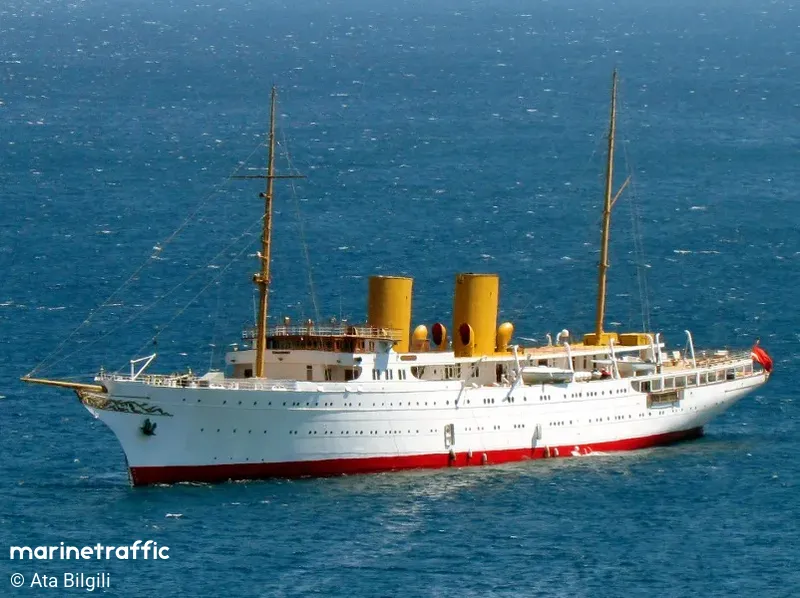
A vessel’s position is the boat’s, not the owner’s. Ownership is as reported, not certified.
Savarona began as a luxury motor yacht for Emily Roebling Cadwalader in 1931. She spent decades as a Turkish training ship before a $45 million refit. The conversion swapped steam turbines for diesels but kept the original beam and sheerline. This design choice limits her speed but preserves her Historic status.
Savarona holds the title of the longest yacht in the world. She measures 136 metres from stern to bowsprit. This length comes from her original 1931 construction. A modern refit did not shorten her hull. It only changed the engines inside.
The vessel was built for American heiress Emily Roebling Cadwalader. She commissioned Gibbs & Cox to design the yacht. Blohm & Voss in Hamburg built the steel hull. The project cost about four million dollars at the time.
Turkey acquired the yacht in 1938. They gifted it to Mustafa Kemal Atatürk. He died shortly after taking possession. The ship then served as a training vessel for naval cadets. It remained in that role for most of its life.
Who owned Savarona before Turkey bought her?
Emily Roebling Cadwalader commissioned the yacht in 1931. She was an American socialite based in Philadelphia. Her grandfather John A. Roebling engineered the Brooklyn Bridge. Her father ran the steel wire company that built suspension cables.
She designed the yacht with Gibbs & Cox. The yard created a vessel for transatlantic travel. She named it after an African swan. The ship launched in February 1931. It was the largest yacht in the world at the time.
Cadwalader died in 1941. The yacht stayed in her family until 1938. Turkey bought it for Mustafa Kemal Atatürk. He used it for only six weeks. He died a few months later in 1938.
Where has Savarona been since the 2015 refit?
The ship operates out of Istanbul. Her flag is Türkiye. Her home port is Istanbul. AIS data shows her moving in the Marmara Sea. She stays close to the coast.
Recent voyages show short coastal runs. She sailed from Gölcük to Pendik in August 2026. That trip covered sixty-seven nautical miles. Her average speed was eight point two knots. Her maximum speed reached eleven point six knots.
Another voyage linked Istanbul to Gebze. That trip took under two hours. The distance was fifteen nautical miles. The average speed was six point four knots. These slow speeds match her diesel engines.
How did the fire change Savarona's structure?
A fire destroyed the ship in 1979. It burned at the Turkish Naval Academy. The blaze left the hull abandoned for ten years. The interior was gutted completely. The steel shell survived the flames.
Kahraman Sadıkoğlu chartered the hull in 1989. He spent three years rebuilding the interior. The work cost forty-five million dollars. Tuzla Shipyards handled the reconstruction. They installed modern Caterpillar diesels.
The refit kept the original exterior lines. The beam remains sixteen metres. The length stays at 136 metres. The gross tonnage is four thousand seven hundred one. The draft is twenty feet.
Why did Turkey end the charter in 2010?
Sadıkoğlu used the yacht for private charters. Media reported scandals involving underage prostitutes. The Turkish government terminated the lease. The contract ended abruptly in 2010.
The Cultural Ministry bought the ship. They restored it for official use. The work took ten months. President Erdogan hosted his first guest in March 2015. The guest was Bakir Izetbegović from Bosnia.
The state now controls all operations. The ship hosts diplomatic receptions. It sails along the Bosporus for ceremonies. The crew size is forty-four. The staterooms hold seventeen double suites.
How did the 1993 conversion change Savarona?
A fire gutted the ship in October 1979. It lay abandoned for ten years after the blaze. Turkish businessman Kahraman Sadıkoğlu chartered the hull in 1989. His firm spent three years restoring the vessel. The total cost reached forty-five million dollars.
The restoration team removed the original machinery. The ship originally carried six geared steam turbines. These engines produced ten thousand seven hundred fifty horsepower. They drove two shafts at high speed.
The new engines were two Caterpillar diesels. Each unit produced three thousand six hundred horsepower. The combined output was seven thousand two hundred horsepower. This represented a significant drop in power.
The conversion traded speed for reliability. The original turbines could push the hull to twenty-one knots. The new diesels limit her maximum speed to eighteen knots. Her cruising speed sits at fifteen point five knots.
The hull form remained untouched. The beam stays at sixteen metres. The gross tonnage dropped to four thousand seven hundred one tons. The displacement tonnage was five thousand seven hundred one in 1949.
What does the original hull impose on her today?
The 1931 design dictates her current profile. The sheerline and deck layout are unchanged. The interior includes an Islamic bath and a swimming pool. A grand staircase trimmed in gold remains intact.
The machinery footprint forced a compromise. The new diesel engines occupy less space than the old turbines. This allowed for more cabin space. However, the hull shape was never optimized for lower speeds.
Her draft is now twenty feet. This allows access to many ports. The original draft was twenty feet six inches. The reduction came from the lighter diesel setup.
The crew size reflects her dual nature. The 1949 register listed seventy-nine crew members. The 2010 refit reduced this to forty-four staff. They maintain both the Historic features and the modern systems.
The ship carries seventeen double suites. These rooms cater to state guests. The library suite is dedicated to Atatürk. It holds many of his personal artifacts.
Why does Turkey keep Savarona as a state asset?
Sadıkoğlu leased the yacht for forty-nine years. He used it for private charters and events. The Turkish government terminated the lease in 2010. A scandal involving underage prostitutes ended the arrangement.
The Cultural Ministry purchased the vessel. They completed a ten-month restoration. The ship returned to official use in August 2014. President Recep Tayyip Erdogan hosted his first reception on board in March 2015.
The decision to retain the hull avoids commercial risk. Selling a converted training ship is difficult. Its unique history limits the buyer pool. Keeping it as a state asset ensures preservation.
The conversion preserved the ship's identity. It remains the largest yacht in the world by length. The diesel engines provide stable operation. The original hull provides Historic prestige.
AIS data shows her moving in local waters. She recently sailed between Gölcük and Pendik. Her average speed during these trips was eight point two knots. This confirms her operational role as a coastal vessel.
How does Savarona compare to other long yachts?
Most modern superyachts prioritize speed. They use advanced hull forms for efficiency. Savarona prioritizes volume and history. Her length-to-beam ratio is low. This creates a roomy interior but limits agility.
The conversion saved the ship from scrap. Without the refit, she might have been broken up. The Turkish government recognized her symbolic value. She represents a link to Atatürk's era.
The original owner intended luxury. Emily Roebling Cadwalader wanted the most expensive private yacht ever created. The 1931 launch fulfilled that ambition. The 1993 refit adapted it for a new purpose.
The result is a unique hybrid. She has the dimensions of a liner. She has the machinery of a workboat. This combination defines her current service life.
Reporting and data: CelebYachts, republished by On the record.
Sources
The numbers on this page point here. Each one links to the record it came from.
- 1