
 CelebYachts reportProfiles
The scaling of Dreamboat
Arthur Blank’s two Oceanco hulls demonstrate a shift from operational support to sovereign display, funded by the same retail capital that launched in 1979.
By On the record · Oct 5, 2026 · Data from CelebYachts1
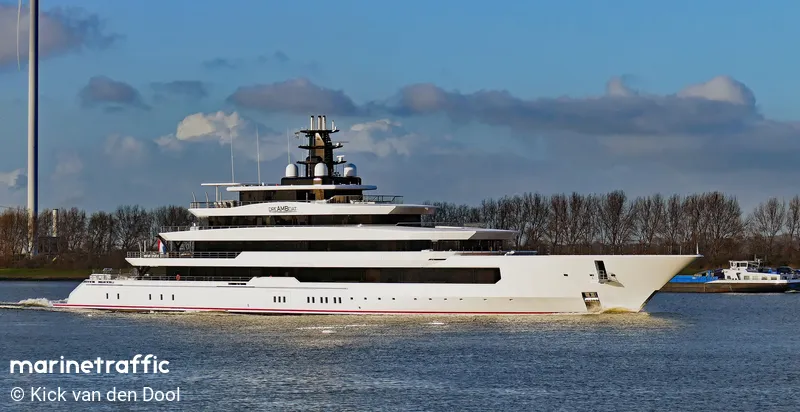
A vessel’s position is the boat’s, not the owner’s. Ownership is as reported, not certified.
Arthur Blank replaced a 90-metre Oceanco hull with an 111-metre sister project without abandoning the original vessel. The sequence tracks a deliberate expansion of tonnage at a single yard, revealing how retail wealth translates into maritime architecture when the owner prioritises scale over novelty.
Arthur Blank co-founded The Home Depot in 1978 alongside Bernard Marcus. The first two stores opened on 22 June 1979 in Atlanta, Georgia. The concept relied on a warehouse model that revolutionised the home improvement sector. Blank served as president for nineteen years before succeeding Marcus as chief executive, eventually retiring in 2001 as co-chairman. The venture generated a fortune that now sits at $11.4 billion according to 2025 valuations. That capital did not dissipate after his departure from the retail board; it migrated into heavy industry. The registration of two superyachts at Oceanco, a Turkish yard known for steel construction, marks the final phase of that migration. The wealth origin explains the durability of the fleet. Retail margins are thin and require volume; superyacht construction requires liquidity. Blank possessed both.
The transition from warehouse logistics to maritime logistics shares a common thread: the management of complex supply chains. The discipline required to run a global retail network translates directly to overseeing a multi-million-dollar shipyard project. There is a notable gap between his commercial exit and his maritime entry. Blank retired in 2001. The first hull, DREAMBOAT 1, did not appear until 2019. Eighteen years passed between his departure from The Home Depot and the launch of his first superyacht. The capital accumulated over those decades sat dormant before migrating into steel. This delay suggests that the yachts were not impulsive purchases but calculated deployments of retained wealth. The corporate architecture of AMB Group LLC, which manages his sports franchises, mirrors this approach. Assets are grouped under a unified banner rather than treated as isolated acquisitions. The naming of the fleet follows the same disciplined logic.
The Oceanco corridor
The register lists two distinct hulls under the Blank portfolio. DREAMBOAT 1 measures 90.0 metres. She was delivered in 2019, constructed by Oceanco under the internal designation Project Y717. Her estimated value stands at $200 million. Six years later, the register records a second vessel, simply named DREAMBOAT. She measures 110.9 metres. She was delivered in 2025, also built by Oceanco. Her estimated value is $300 million. Both vessels fly the flag of the Cayman Islands. The choice to remain within the Oceanco ecosystem is significant. Shipyards operate on fixed dry-dock schedules. Moving between yards introduces design friction and scheduling delays. By commissioning two successive projects at Aliağa, Turkey, the owner secured continuity in the supply chain. The naval architect remains unknown, but the structural kinship between a 90-metre hull and an 111-metre hull from the same builder is predictable. The framing, the machinery layout, and the classification requirements follow a similar logic. The repetition of the builder reduces the cognitive load on the owner. One set of engineers, one set of subcontractors, one set of compliance standards.
The shadow fleet
Most owners dispose of their previous hull upon taking delivery of a new one. The market absorbs the older vessel, and the owner moves on. Blank has not followed this pattern. The simultaneous existence of DREAMBOAT 1 and DREAMBOAT indicates a dual-hull operational model. A 90-metre yacht is large enough to serve as a primary platform, capable of carrying tenders, helicopters, and a full crew complement. An 111-metre yacht pushes the limits of marina access and requires deeper drafts. The retention of the smaller hull suggests a division of labour. The larger vessel likely serves as the primary residence during extended cruises, while the 90-metre hull operates as a dedicated support vessel or a secondary platform for shorter trips. The naming convention reinforces this interpretation. Designating the earlier hull as DREAMBOAT 1 rather than adopting a completely new title signals a fleet structure. It treats the vessels as components of a single maritime asset class rather than as individual luxury purchases.
The cost of scale
The financial progression from the first hull to the second reflects the economics of modern shipbuilding. DREAMBOAT 1 carried an estimated valuation of $200 million in 2019. DREAMBOAT carries an estimated valuation of $300 million in 2025. The price increase accounts for inflation, rising material costs, and the premium associated with exceeding the 100-metre threshold. Hulls over 100 metres face stricter regulatory scrutiny under international safety conventions. Specifically, the International Convention for the Safety of Life at Sea imposes additional stability criteria and fire protection requirements. The additional tonnage demands more powerful propulsion systems and larger fuel capacities. The jump from 90.0 metres to 110.9 metres is not linear. Volume scales with the cube of the length increase. The interior space, the deck area, and the machinery weight all grow disproportionately. The $100 million difference represents the engineering tax imposed by the extra twenty-one metres. The yard had to reinforce the deck structures to accommodate the increased displacement. The stability calculations shifted significantly. These are not minor adjustments; they require a complete re-evaluation of the hull form. SOLAS compliance dictates the placement of emergency exits and the segregation of watertight compartments. Every extra metre adds complexity to the certification process.
The silence of the AIS
The register provides no voyage data for either hull. The AIS broadcast track is empty in the current window. This absence of movement does not indicate inactivity. It often points to a vessel being maintained in a home port or undergoing refit. DREAMBOAT 1 has been in service since 2019, giving her a six-year operational history before the arrival of her larger sister. DREAMBOAT arrived in 2025, placing her at the very beginning of her lifecycle. The lack of positional data makes it impossible to confirm whether the two hulls operate in tandem or maintain separate itineraries. The classification society records would clarify the current status of each vessel, but those documents are not public. What remains certain is the architectural commitment. The owner has invested $500 million in combined estimated value across two Oceanco steel hulls. That figure excludes the cost of outfitting, crew training, and ongoing maintenance. The scale of the investment confirms that the water remains a priority destination for capital deployed outside the retail sector.
Reporting and data: CelebYachts, republished by On the record.
Sources
The numbers on this page point here. Each one links to the record it came from.
- 1CelebYachtsCelebYachts: The scaling of Dreamboat