
 CelebYachts reportYards & Design
Why Archimedes and Sherpa share the same length
Two Feadship yachts measure within half a metre of each other. This coincidence reveals how Dutch shipyards manage their slipways.
By On the record · Oct 1, 2026 · Data from CelebYachts1
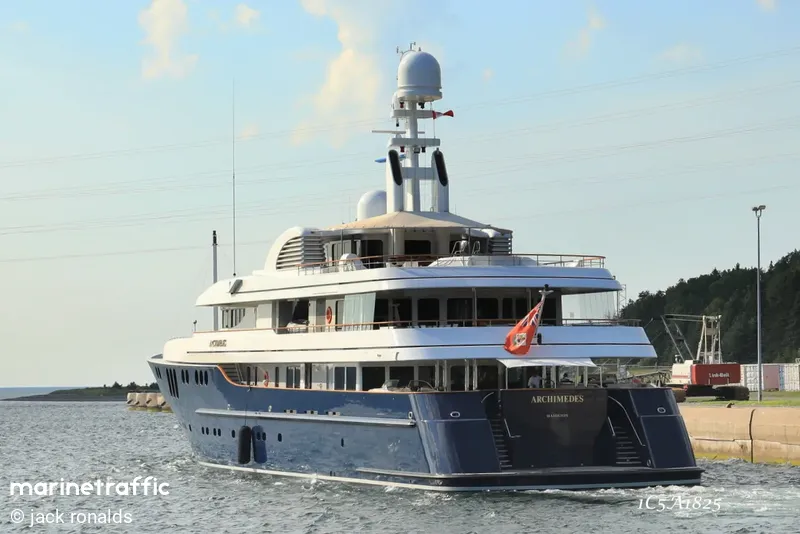
A vessel’s position is the boat’s, not the owner’s. Ownership is as reported, not certified.
ARCHIMEDES and SHERPA measure within half a metre of each other despite being delivered ten years apart. The coincidence points to Feadship’s physical infrastructure and client demand for a specific volume, not to a hidden sistership programme.
ARCHIMEDES and SHERPA are two separate motor yachts from the same builder. They arrived at different times. One came in 2008. The other followed a decade later in 2018. Their lengths sit close together on paper. ARCHIMEDES measures 70.6 metres. SHERPA measures 71.2 metres. That is a difference of just six tenths of a metre.
The owner of ARCHIMEDES is the Estate of James Simons. He was a quantitative investor. The yacht flies the flag of Bermuda. It has been seen off the US East Coast recently. The owner of SHERPA is Jim Ratcliffe. He founded the INEOS chemical group in 1998. His yacht holds the Cayman Islands flag. It was last recorded off the east coast of Canada.
What do these two yachts have in common?
They share a builder. Both were constructed by Feadship. This is a cooperative venture between two Dutch shipyards. The yards are Royal Van Lent Shipyard and Koninklijke De Vries Scheepsbouw. They share a design and engineering center called De Voogt Naval Architects. The cooperation started in 1949. It began as an export association to sell to American clients.
The shared design office is key. De Voogt Naval Architects works for both yards. They create the hull forms and layouts. Clients choose their preferred yard for construction. But the design work comes from the same pool. This means similar design philosophies appear across different hulls. It does not mean the hulls are identical. It means they follow similar rules of volume and flow.
The owners chose very different paths. James Simons bought ARCHIMEDES when it was new. He held it for many years. Jim Ratcliffe ordered SHERPA as a custom build. He wanted a vessel for Support and explorer duties. The gross tonnage shows this difference clearly. ARCHIMEDES sits at 1,462 tons. SHERPA is heavier at 1,804 tons. The extra weight comes from equipment and structure. It does not come from length.
How did Feadship decide on this size?
The length overlap is a product of shed economics. Feadship operates four shipyards. Two belong to De Vries in Aalsmeer and Makkum. Two belong to Royal Van Lent in Amsterdam and Kaag. Each yard has physical limits. The sheds and dry docks have fixed dimensions. These dimensions set the maximum size for a single block of construction.
The 70-metre range is a sweet spot. It fits comfortably inside most standard sheds. It allows for efficient workflow. Builders can move materials easily. Cranes can reach all parts of the hull. The beam supports this choice too. ARCHIMEDES has a beam of 13.3 metres. SHERPA has a beam of 13.0 metres. Both are wide enough to carry significant volume. Neither requires special handling for extreme width.
Clients also drive this size. Wealthy buyers often want trans-Atlantic capability. A length near 70 metres provides good sea-keeping. It offers stability in rough water. It also provides ample interior space. Owners get large guest cabins and social areas. They do not need a larger vessel to achieve comfort. The market has settled on this range as a practical standard.
Are they sisterships or just similar?
There is no evidence they are sisterships. Sisterships share a mould or a platform. They are built from the same drawings. ARCHIMEDES and SHERPA do not share that origin. They have different IMO numbers. ARCHIMEDES is 1009637. SHERPA is 9795529. They have different MMSI codes too. These identifiers prove they are distinct vessels.
The sources confirm separate histories. ARCHIMEDES was launched in 2008. SHERPA was launched in 2018. Ten years separates their births. The technology and regulations changed in that time. SOLAS rules evolved. Environmental standards tightened. SHERPA incorporates newer systems. ARCHIMEDES reflects the standards of its era. The similarity in length is a coincidence of scale.
Convergence is more likely than kinship. A yard that builds at this scale has a length its sheds favour. Clients also converge on popular sizes. They see what others buy. They want similar experiences. The result is a cluster of yachts with matching dimensions. This clustering happens at every major yard. It is a feature of mass-customisation. The matching dimensions reflect shared constraints.
What does the data show about their value?
We can estimate the cost of these builds. ARCHIMEDES has an estimated value of $100 million. This figure reflects its age and condition. It was built over fifteen years ago. Maintenance costs add up. The interior may need updates. SHERPA has no listed value in our records. It is newer. It retains more original value. Its price would be higher today.
The price difference tells a story. Newer yachts command premium prices. Older ones depreciate unless restored. ARCHIMEDES remains valuable because of its brand. Feadship yachts hold value well. The reputation of the builder matters. So does the quality of the fit-out. James Simons likely maintained her carefully. Jim Ratcliffe uses his yacht actively. Usage affects value differently than storage.
The registry notes give us clues. ARCHIMEDES is homeported in Hamilton. This is in Bermuda. It suggests regular cruising in the Atlantic. SHERPA is homeported in Bloody Bay. This is in the Cayman Islands. It implies tropical operations. The owners use their vessels in different ways. The similar length does not force them into the same routine.
Why does this comparison matter?
It shows how industrial logic shapes luxury goods. We often think of yachts as unique art objects. They are not. They are engineered products. They must fit through doors. They must sit in dry docks. They must be lifted by cranes. These physical constraints limit the choices available to designers. The designer works within a box. The box is defined by the yard's tools.
The cooperative model amplifies this effect. Two yards share one design team. They share best practices. They share lessons learned. When one yard solves a problem, the other benefits. This efficiency lowers costs. It also standardises outcomes. The result is a fleet of yachts that look familiar. They share proportions and lines. They feel like part of a family.
This is a strength. Buyers get proven designs. They avoid experimental risks. They trust the yard's experience. The yard trusts its own methods. The system works because it is stable. It produces reliable results year after year. ARCHIMEDES and SHERPA are testaments to that stability. They are successful because they fit the system perfectly.
Reporting and data: CelebYachts, republished by On the record.
Sources
The numbers on this page point here. Each one links to the record it came from.
- 1