
 CelebYachts reportYards & Design
Why Spectre is exactly 69.3 metres long
Spectre’s length is a limit set by the Viareggio shipyard’s indoor building shed.
By On the record · Oct 6, 2026 · Data from CelebYachts1
A vessel’s position is the boat’s, not the owner’s. Ownership is as reported, not certified.
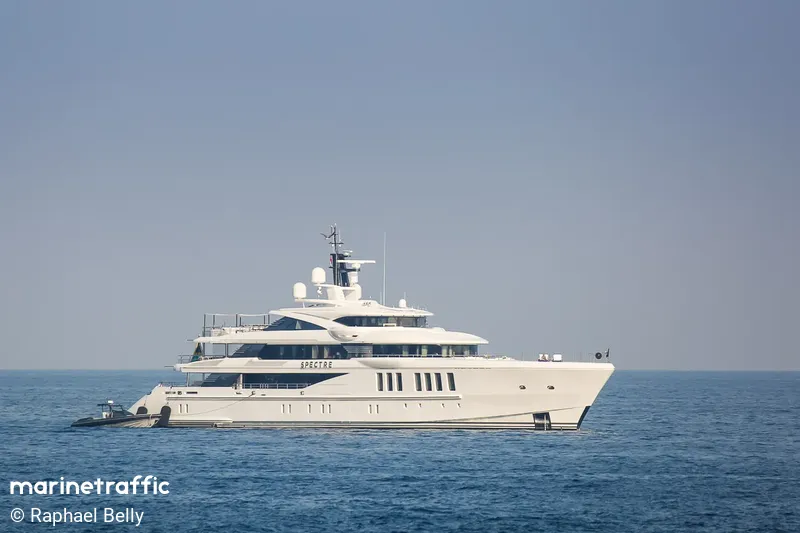
Rob Sands owns Spectre, a 1403 gross tonne Benetti delivered in 2018. Her length of 69.3 metres hits the hard ceiling of seventy metres for covered construction at that yard. The rule shapes her volume and speed.
Spectre sits in the Ligurean Sea near Viareggio. AIS data shows her last position at 43.54° N, 10.30° E. She flies the Jamaican flag. Rob Sands owns her. He is an American businessman with a net worth of one billion dollars.
The yacht measures 69.3 metres from bow to stern. That number is precise. It falls just under the seventy-metre limit. The length comes directly from the roof of the Benetti shed in Viareggio.
The shipyard expanded its indoor building area in 1997. The expansion created a space for yachts up to seventy metres. Spectre fits inside that space. She leaves only 0.7 metres of clearance. Every metre of her hull was planned around this limit.
How did the Viareggio shed set this limit?
Benetti has built ships in Viareggio since 1873. The yard moved from wood to steel in the twentieth century. Paolo Vitelli bought the company in 1984. He added it to his Azimut group. The yard grew steadily over the decades.
In 1990, Benetti took over the Lusben yard. This gave them forty-seven thousand square metres of space. They used it for smaller Azimut boats and composite Benetti yachts. The main hall remained open water.
The 1997 expansion changed everything. The yard added ten thousand square metres of covered space. This allowed builders to work on vessels up to seventy metres indoors. Weather no longer stopped the work. Production could continue through winter.
Spectre was launched in 2018. She falls within this seventy-metre window. Her length of 69.3 metres respects the structural limits of the shed. A yacht of seventy-one metres would need outdoor assembly. The cost and schedule would change completely.
What does the shed limit do to her volume?
Gross tonnage measures the internal volume of a ship. It is not weight. Spectre carries 1403 gross tonnes. This is a large volume for a sixty-nine-metre hull. The beam supports this capacity. Her width is 11.7 metres.
The ratio of length to beam matters here. Spectre is nearly six times wider than she is long. This shape creates space. It allows for large decks and deep tanks. The narrow profile keeps the hull efficient.
A longer hull usually moves faster. Spectre cannot be longer than sixty-nine-point-three metres. She trades top speed for interior room. The design prioritises living space over racing performance. The shed constraint forces this trade-off.
The displacement confirms the heavy build. The fully loaded weight reaches 1450 tonnes. This mass requires significant engine power. Benetti typically pairs this size with robust diesel engines. The machinery sits low in the hull to balance the weight.
How fast can Spectre actually go?
AIS records show her recent movements. She travelled from Syracuse to Valletta in Malta. The trip covered eighty-two point eight nautical miles. She averaged ten point nine knots. The maximum speed reached thirteen point three knots.
Another leg ran from Palermo to Siracusa. This distance was one hundred fifty-one point three nautical miles. The average speed rose to eleven point six knots. The maximum speed stayed at thirteen point three knots.
Her cruising speed sits around twelve knots. This matches the design intent. She is built for range, not sprinting. The hull form resists wave-making resistance at moderate speeds. Higher speeds would burn fuel too quickly.
Benetti designs these hulls for comfort. The wide beam reduces rolling in choppy seas. Passengers feel less motion. The trade-off is lower maximum speed. Spectre accepts this compromise to gain interior volume.
Where has Spectre been recently?
She has spent months in Italian waters. AIS tracks show her moving between Sicily, Sardinia, and the mainland. She visited Sorrento and Bagnara Calabra. She also sailed from Monaco to Palau in Sardinia.
A long passage linked La Maddalena to Sorrento. The distance was two hundred fourteen point seven nautical miles. She maintained an average of ten point five knots. The max speed hit thirteen point eight knots.
Short hops connect the French Riviera ports. She moved from Nice to Saint-Tropez. Then from Imperia to Nice. These legs cover thirty-four to thirty-five nautical miles. She completes them in about three hours.
Why does the owner choose this yard?
Rob Sands chose Benetti for their history. The yard has built commercial vessels since the nineteenth century. They switched to luxury yachts in the twentieth. Their reputation rests on steel-hulled motoryachts.
The Viareggio location offers specific advantages. The indoor shed protects the build from rain and cold. This ensures consistent quality. The yard controls the entire process under one roof. Supply chains are shorter.
Sands values the predictability of indoor construction. Delays due to weather are rare. The schedule stays tight. For a buyer with a billion-dollar portfolio, time is money. The shed delivers certainty.
The result is a yacht that fits the roof. Spectre is exactly 69.3 metres long because the shed is exactly 70 metres wide. She is not smaller because the client wanted more. She sits exactly at the limit. The limit defines the boat.
Who is Rob Sands and what did he buy?
Rob Sands is an American businessman. He holds a net worth of one billion dollars. His occupation is listed as business executive. He was born in 1958. He owns Spectre through private arrangements. The registration lists him as the owner.
Spectre is a Benetti model. Benetti is part of Azimut Benetti S.p.A. The group also owns Fraser Yachts. Benetti has won the Showboats International magazine "shipyard number 1" award six times in a row. It is the only yard to have done so.
The yard has a long history. Lorenzo Benetti founded it in 1873. He bought the Darsena Luca shipyard. His sons Gino and Emilio took over after his death in 1914. They renamed the yard Fratelli Benetti. They continued using wooden construction.
The family split the business in 1954. Gino's family kept the sailing and yacht business. Emilio's family kept the commercial ship building. Emilio chairs both companies. The yacht business moved to steel construction under Lorenzo's son.
How does the shed compare to other yards?
Viareggio is the historical home of Benetti. The yard expanded significantly in 1997. It added ten thousand square metres of covered space. This allowed indoor building of yachts up to seventy metres. The expansion was vast.
Other Benetti yards exist elsewhere. The Fano yard was purchased in 1998. It has a sixty-metre wharf in the port. The Livorno yard was acquired in 2003. It has a covered area of thirty thousand square metres.
Livorno has a total area of one hundred ninety thousand square metres. It includes a production area of twenty-eight thousand square metres. The open area covers one hundred thirty thousand square metres. Six huge sheds were built there.
Spectre was built in Viareggio. The seventy-metre limit applies specifically to the indoor halls there. The Livorno yard can handle larger vessels outdoors. Spectre fits the Viareggio constraint perfectly. Her length is a direct result of that choice.
Reporting and data: CelebYachts, republished by On the record.
Sources
The numbers on this page point here. Each one links to the record it came from.
- 1