
 CelebYachts reportYards & Design
The shared shed, not the shared hull
Hampshire II and Tango measure within a metre of each other, yet their construction records prove independent designs shaped by Feadship’s engineering infrastructure rather than a common mould.
By On the record · Oct 1, 2026 · Data from CelebYachts1
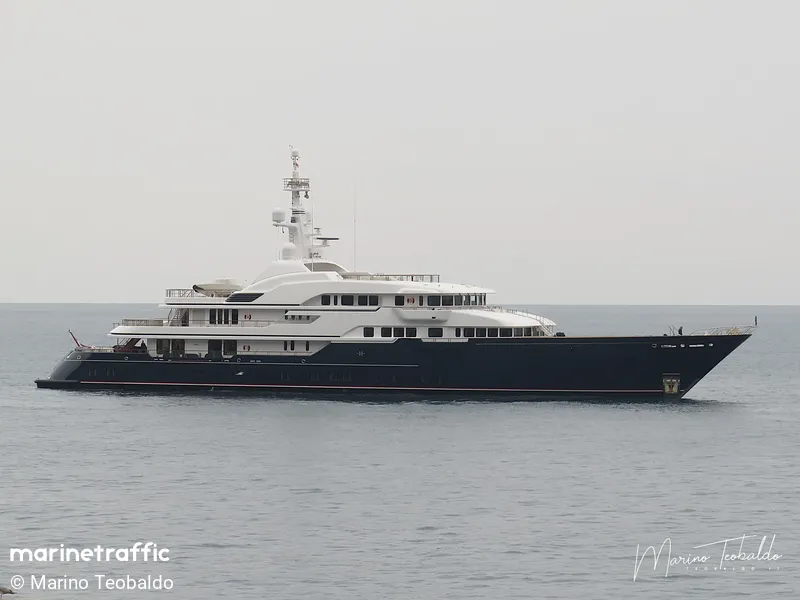
A vessel’s position is the boat’s, not the owner’s. Ownership is as reported, not certified.
Two Feadship motor yachts launched in consecutive years hover around seventy-eight metres. The similarity in length reflects shipyard economics and shed dimensions. The difference in gross tonnage confirms separate internal geometries and distinct owner mandates.
Hampshire II and Tango measure within a metre of each other, yet their construction records and internal volumes point to independent designs shaped by Feadship’s shared engineering infrastructure rather than a common mould.
The register shows two Feadship motor yachts launched in consecutive years, both hovering around seventy-eight metres. To call them sisterships would require proof of a shared hull plate or a joint naval architecture brief. Neither exists in the public record. The similarity in length is a product of shipyard economics and the physical dimensions of Feadship’s Dutch sheds. The difference in gross tonnage proves that the two vessels occupy entirely different internal geometries.
The shed and the shared centre
Feadship traces its organisational roots to 1949, when Henri de Voogt established the First Export Association of Dutch Shipbuilders to sell steel-hulled pleasure craft to American buyers. The original membership included multiple small yards across the Netherlands, including Scheepswerf De Vlijt, Jacht & Scheepswerf Van Lent, and Scheepswerven Nicolaas Witsen & Vis. Consolidation reduced the network to two primary builders over subsequent decades. Royal Van Lent received a royal charter in 2001, followed by Koninklijke De Vries Scheepsbouw in 2006. LVMH acquired Royal Van Lent in 2008, integrating it into a broader luxury portfolio while preserving its custom-build mandate. Despite the change in ultimate ownership, the two yards continue to share the De Voogt Naval Architects design centre in Hoofddorp. This arrangement means that exterior lines and stability calculations originate from a single desk. It does not mean the steel is cut from the same schedule. Royal Van Lent maintains headquarters in Kaag and a newer dock in Amsterdam’s Westpoort area, opened in early 2019, capable of accommodating vessels up to one hundred and sixty metres. De Vries operates yards in Aalsmeer and Makkum. The Makkum location utilises deep-water access and a giant construction shed designed for hulls exceeding one hundred and twenty metres. A length of approximately seventy-eight metres sits comfortably within the optimal range for all these facilities. The yard repeats this dimension because the infrastructure supports it, not because the clients ordered identical platforms. The convergence on paper is a reflection of shed capacity and engineering standardisation, not architectural kinship.
The cooperative’s transition away from wooden hulls began in the mid-1950s, accelerated by American demand for steel construction. Don Kenniston served as Feadship America’s first general manager in 1977, holding the post until 2008, before Ted McCumber took over the Americas office. These managerial shifts professionalised the export pipeline, allowing the yards to handle complex international contracts with predictable timelines. The steady cadence of launches—averaging two custom motor yachts per year at Royal Van Lent—relies on this administrative maturity. When Hampshire II and Tango arrived at the end of the decade, the yards were operating with refined logistical precision. The shared engineering centre ensured that hydrodynamic testing and resistance calculations were applied consistently across the fleet. This consistency reduces development costs but does not force identical external proportions. Clients retain the freedom to adjust deck heights, superstructure bulkheads, and interior partitioning. The resulting vessels share a builder’s signature but diverge in measurable metrics.
Divergent volumes
The gross tonnage differential demands closer examination. One thousand eight hundred and eighty-seven tons versus two thousand and eighty-three tons represents a substantial variance in internal geometry. Gross tonnage calculations account for all enclosed spaces above and below the waterline. The beams differ by three tenths of a metre, leaving the waterplane area nearly identical. The additional volume on Tango therefore resides vertically. A taller bridge structure, an extended upper deck, or a deeper hull plating would account for the discrepancy. Propulsion systems also influence tonnage. While the pack does not specify the engine models for either vessel, larger generator sets or more complex stabilisation equipment add weight and require additional housing. The estimated market values reflect these internal choices. Hampshire II carries an estimated valuation of one hundred million dollars. Tango is valued at one hundred and twenty million dollars. The twenty-million-dollar spread tracks the difference in registered volume and likely interior complexity. There is no evidence of a shared platform fee or a discounted sister-ship rate. Each contract was priced against the specific material and labour requirements of its own build. The fifty-four-year gap between the initial Akerboom family purchase and the modern cooperative structure demonstrates how Feadship has evolved from a small repair yard into a consolidated engineering entity. That evolution prioritises standardised naval architecture over uniform hull moulds.
The owners' constraints
Ownership structures dictate the administrative signatures on the register. Sir Jim Ratcliffe established INEOS in 1998 after leaving Imperial Chemical Industries. The chemical engineering background informs a pragmatic approach to asset acquisition. Hampshire II entered service in 2012, flying the Cayman Islands flag. Her home port is listed as Bloody Bay. Viktor Vekselberg built Renova Group into a Russian conglomerate. According to Forbes, his fortune reached nine point three billion dollars in November 2021. His citizenship spans Ukraine, Russia, Israel, and Cyprus, reflecting the multinational nature of his holdings. Tango was completed in 2011, taking the Cook Islands registry. George Town serves as her port of registry. Flag selection follows commercial logic regarding crew employment laws, VAT treatment, and routing flexibility. The Cook Islands registry often appeals to operators seeking a balance between European oversight and Caribbean administrative convenience. The Cayman Islands flag provides a well-established framework for UK-linked owners. These choices are unrelated to the hull construction. They demonstrate how separate principals utilise the same builder to meet distinct operational mandates. The AIS data places Hampshire II off the Ligurian coast at forty-three point seven four degrees north, seven point four three degrees east. Tango tracks near the Balearic Sea at thirty-nine point five six degrees north, two point six three degrees east. Their cruising grounds overlap geographically but remain administratively separate. The register holds no blueprint confirming a shared origin. The tonnages, flags, and valuations confirm independent contracts.
Reporting and data: CelebYachts, republished by On the record.
Sources
The numbers on this page point here. Each one links to the record it came from.
- 1