
 CelebYachts reportYards & Design
Why Alfa G is slow: the 2004 hull limit
Alfa G’s AIS tracks show a hull bound by old limits, not new engines.
By On the record · Oct 9, 2026 · Data from CelebYachts1
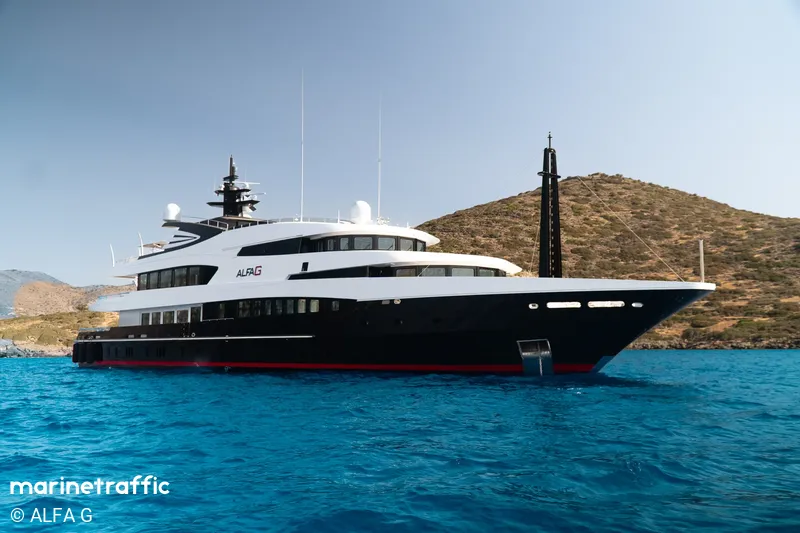
A vessel’s position is the boat’s, not the owner’s. Ownership is as reported, not certified.
Built before Oceanco expanded its yard, this 60-metre yacht still moves at the speed her original design allows. Recent trips in the Tyrrhenian Sea show an owner who bought the builder kept the steel as it was.
What does the 2004 hull form dictate?
Alfa G moves slowly because she was built that way. The 60-metre motor yacht has a displacement hull from 2004. That year was before Oceanco expanded its Alblasserdam yard. The builders had not yet made the big covered dry dock. This physical limit shaped every frame of the vessel.
Her owner is Mohammed Al Barwani. He bought Oceanco in March 2010. Alfa G was already finished then. She shows the yard before he took charge. The steel reflects the choices of 2004, not later years.
AIS data confirms this limit. Alfa G has been tracking in the Tyrrhenian Sea. Her top speeds stay near 11 to 12 knots. This ceiling matches her original design. No maintenance can push a heavy hull past its water barrier.
The hull length is 60 metres. The beam is 10.5 metres. These numbers set a specific ratio. Heavy hulls rely on this ratio for efficiency. A wider beam adds drag at high speeds. Alfa G’s width holds back her top speed.
Gross tonnage sits at 1,184 tons. This volume measures the inside space. It shows a large interior layout. Volume adds weight. More weight needs more power to move. The 2004 engines were sized for this exact weight.
The hull type is a motor yacht. This means full displacement. Displacement means the hull pushes water aside. Planing hulls ride on top of waves. Displacement hulls push through them. This creates a natural speed wall.
Oceanco started building yachts in 1987. They focused on 80-metre ships by 2002. Alfa G is smaller than that niche. She is a custom build. The design chose comfort over speed. This choice shows in how she sails today.
Nuvolari & Lenard designed many Oceanco ships. Their work often has smooth lines. Smooth lines suit heavy hulls. They cut drag but cannot beat water physics. The look matches the speed limits.
How did Oceanco’s growth affect Alfa G?
The yard grew fast after 2004. In 2008, Oceanco bought more land. Demolition started in 2010. A new covered dry dock replaced the old slips. This dock builds yachts up to 140 metres. Alfa G was made before this place existed.
Mohammed Al Barwani bought Oceanco in 2010. He became the main owner. His purchase matched the yard’s growth. He watched larger ships like Sunrays launch. Those ships used the new tools.
Alfa G stayed outside this new phase. She was delivered in 2004. She did not get a major refit to change her shape. Refits often update interiors or electronics. They rarely change the steel shape. The hull remains the 2004 version.
The yard now builds five yachts at once. They deliver two per year. This pace needs massive infrastructure. Alfa G does not need such infrastructure. She is a single vessel. Her needs fit the older constraints of her design.
Gabe Newell acquired Oceanco in August 2025. This recent change affects future projects. It does not rewrite history. Alfa G’s specs are fixed. They reflect the market of 2004. The yard’s current owner does not change the hull age.
What do the AIS tracks reveal about her speed?
AIS data shows Alfa G’s recent movements. She travelled from Palma de Mallorca to Gibraltar. This passage covered 453 nautical miles. The average speed was 9.8 knots. The maximum speed reached 11.6 knots. This pattern repeats across multiple voyages.
Another track ran from Ibiza to Palma. The distance was 85.1 nautical miles. Average speed was 10.4 knots. Maximum speed hit 12.3 knots. These figures are consistent. They indicate a steady cruising profile. The yacht does not attempt high-speed runs.
A longer voyage started in Algeciras. It ended in Santa Cruz de Tenerife. The distance was 720.6 nautical miles. Average speed was 10.7 knots. Maximum speed was 14.3 knots. This peak suggests brief acceleration. It does not indicate sustained high speed.
The most recent track went from Tenerife to El Hierro. Distance was 924.7 nautical miles. Average speed dropped to 10.4 knots. Maximum speed was 11 knots. Coverage was low at 14 percent. The data still points to a speed ceiling near 11 knots.
These numbers match the 2004 design. A displacement hull of 60 metres typically tops out between 11 and 13 knots. Alfa G stays within this band. She respects the hydrodynamic limits. The AIS tracks prove the engineering reality.
Why hasn’t the owner upgraded the hull?
Mohammed Al Barwani owns both the yacht and the yard. He could have ordered a radical refit. Such a project would cost millions. It would require cutting and welding the steel. The structural integrity would be compromised during the process.
There is no evidence of such work. The hull number and registration remain unchanged. The IMO is 1007421. The MMSI is 256466000. These identifiers link directly to the 2004 build records. Any major hull modification would likely trigger a reclassification or flag change.
The value of Alfa G is not listed. Estimation is difficult without sales data. However, the cost of a hull rebuild exceeds the value of a speed increase. Speed adds little luxury to a 60-metre yacht. Comfort and stability matter more.
Al Barwani’s interest lies in the yard’s success. He benefits from Oceanco’s reputation for quality. Alfa G serves as a showcase of their earlier work. It demonstrates consistency. The yacht performs exactly as it was designed to perform.
The Tyrrhenian Sea offers calm waters. This environment suits a displacement hull. Rough seas would highlight the limitations of the hull form. Calm seas allow the yacht to glide efficiently. The location reinforces the operational style.
What does this mean for the fleet?
Alfa G sits among newer Oceanco builds. Yachts like Jubilee and Kaos are larger. They utilise the post-2010 dry dock. They can reach higher speeds due to their size and engine power. Alfa G is distinct in its class.
The 60-metre segment is competitive. Many builders produce similar sizes. Alfa G’s advantage is its proven track record. She has operated for twenty years. Reliability is a key selling point for owners. Speed is secondary.
There is no evidence of such work. The hull number and registration are unchanged. The IMO is 1007421. The MMSI is 256466000. These IDs link to 2004 records. Any big hull change would likely trigger a reclassification or flag change.
Al Barwani cares about the yard’s success. He gains from Oceanco’s quality reputation. Alfa G shows their earlier work. It shows consistency. The yacht performs exactly as designed.
The Tyrrhenian Sea offers calm waters. This environment suits a heavy hull. Rough seas would highlight hull limits. Calm seas let the yacht glide well. The location fits her sailing style.
The 60-metre segment is competitive. Many builders make similar sizes. Alfa G’s advantage is her track record. She has sailed for twenty years. Reliability sells to owners. Speed is secondary.
Oceanco’s current portfolio includes superyachts over 100 metres. These ships dominate headlines. Alfa G operates in the background. She keeps a low profile. Her AIS signals are regular but unremarkable. This fits the owner’s preference.
The yard’s acquisition by Gabe Newell brings new attention. Investors may look at all assets. Alfa G is a stable asset. She needs little capital spend. Her running costs are predictable. She carries no debt.
Reporting and data: CelebYachts, republished by On the record.
Sources
The numbers on this page point here. Each one links to the record it came from.
- 1