
 CelebYachts reportYards & Design
The sixty-metre workboat
SPUTNIK proves that converted offshore Support vessels carry a distinct engineering logic, where gross tonnage and beam dictate performance far more than luxury specifications.
By On the record · Oct 9, 2026 · Data from CelebYachts1
A vessel’s position is the boat’s, not the owner’s. Ownership is as reported, not certified.
Built by Boustead Langkawi Naval Shipyard in 2006, the sixty-metre SPUTNIK retains the boxy proportions and high displacement of her industrial parent design. Her registered owner, Oleg Deripaska, acquired the hull after building a fortune in aluminium, a background that matches the vessel's utilitarian character. The AIS data shows her anchored in the East Mediterranean, a quiet existence for a vessel whose 2306 gross tons dwarf those of conventional yachts of similar length.
The hull known as SPUTNIK does not follow the slender proportions of a conventional superyacht. Measuring exactly sixty metres in length with a beam of sixteen metres, she presents a blocky silhouette that prioritises internal volume over hydrodynamic efficiency. The register records her gross tonnage at 2306, a figure that sits well above the norm for a vessel of her length and points directly to her origins as a converted offshore Support vessel. She was launched in 2006 by Boustead Langkawi Naval Shipyard in Malaysia, a facility accustomed to building robust workboats rather than leisure craft. The classification 'Support & explorer vessels' captures the hybrid nature of the conversion, blending the structural demands of industrial operations with the space requirements of private accommodation.
The geometry of conversion
Her dimensions reveal the engineering compromise inherent in the project. A beam-to-length ratio of one to three point seven five is characteristic of vessels designed for station-keeping and heavy lifting, not for cutting through water at high speeds. The International Maritime Organization identifier 9327920 and the MMSI number 518999810 anchor her identity in global tracking systems, yet they cannot convey the spatial reality of her interior. Gross tonnage is a volumetric measure, calculated from all enclosed spaces within the hull. A standard sixty-metre luxury yacht typically registers between one thousand and one thousand two hundred gross tons. SPUTNIK's figure of 2306 gross tons indicates a superstructure that rises significantly higher and extends further aft than conventional designs allow. This excess volume is a direct inheritance from her life as an offshore Support vessel, where workspace and storage take precedence over passenger comfort.
Naval architects designing a pure yacht would typically reduce the beam to improve the length-to-beam ratio, allowing the hull to slice through waves with less resistance. SPUTNIK retains the full width of her parent design, which dictates a lower maximum speed and a heavier motion profile in rough seas. The AIS data tracks her under the flag of the Cook Islands, a jurisdiction often selected for its flexible registration policies, though the specific technical specifications of the conversion remain unpublished. The lack of published charts or interior photographs further obscures the extent of the modifications made during the refit.
The industrial logic
The acquisition of a converted OSV aligns with the industrial trajectory of her registered owner, Oleg Deripaska. Deripaska accumulated his wealth through the privatization of the Sayanogorsk aluminium smelter in the aftermath of the Soviet Union's collapse, using trading profits to secure stakes that formed the foundation of Rusal, a dominant force in global aluminium production. His career began in metals trading, where he applied a systematic, scientific approach to commodity arbitrage, buying metal at low domestic prices and exporting it abroad. This background in bulk commodities and heavy industry mirrors the utilitarian character of SPUTNIK, which functions more as a floating platform than a traditional pleasure craft.
Deripaska's educational background reinforces this pattern of acquisition. He graduated with honours in physics from Moscow State University in 1993 before entering the volatile markets of post-Soviet Russia. His early career involved export arbitrage, a discipline requiring precise calculation and risk management, skills he later applied to consolidating aluminium assets. Beyond metals, his corporate portfolio includes Kuban Agroholding, established in 2011, which manages seventy-five thousand hectares of agricultural land across the Krasnodar region. This vast control over raw material production and logistics infrastructure parallels the operational mindset required to manage a converted Support vessel. The vessel's current flag, the Cook Islands, offers a neutral registry, though Deripaska's own citizenship shifted to Cyprus in 2017 through an investment programme.
Operations and current status
Current tracking data places SPUTNIK in the East Mediterranean, recorded at coordinates thirty-six point six seven degrees north and twenty-eight point eight nine degrees east. The AIS signal indicates a stationary or slow-moving status, consistent with anchorage or mooring in a sheltered bay. The absence of recent voyage logs in the available records limits the ability to assess her operational range or cruising habits. Without historical passage data, it is impossible to verify the performance claims associated with her original OSV designation or to gauge how the conversion has affected her fuel consumption and range.
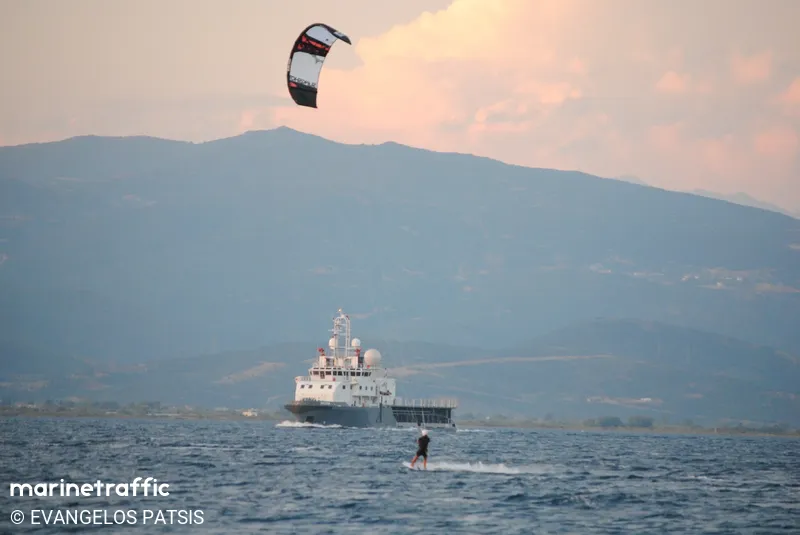
Despite these gaps, the physical evidence of her hull form speaks to the practical realities of repurposing industrial steel. The sheerline and freeboard height, visible in available imagery, retain the functional characteristics of a workboat, offering stability and load-bearing capacity that a sleeker hull would sacrifice. The conversion process likely involved reinforcing the main deck to Support heavy equipment and installing marine-grade accommodations within the existing framework. Such projects require careful integration of new systems into old structures, a task that demands precision but rarely yields the seamless finish of a purpose-built yacht.
The geopolitical environment surrounding Deripaska has grown increasingly restrictive. The United States imposed sanctions on him in 2022, citing connections to the annexation of Crimea, while the British government followed suit later that year with asset freezes and travel bans linked to the invasion of Ukraine. These measures triggered the seizure of a major asset valued at one billion dollars earlier that same year. Despite facing pressure from pro-Kremlin figures, Deripaska publicly characterised the conflict as madness in August 2024, a stance that underscores the ongoing volatility of his public profile. For SPUTNIK, these sanctions create an uncertain operational future, as access to European ports and maintenance facilities may be restricted. The estimated value of the vessel remains unconfirmed, leaving the financial terms of the acquisition opaque.
Reporting and data: CelebYachts, republished by On the record.
Sources
The numbers on this page point here. Each one links to the record it came from.
- 1CelebYachtsCelebYachts: The sixty-metre workboat