
 CelebYachts reportYards & Design
The slipway limit and the energy dividend
Top Five II was not converted from a working vessel. She is a new build whose dimensions, flag choice, and AIS tracks reveal how a Dutch yard survives market…
By On the record · Aug 28, 2026 · Data from CelebYachts1
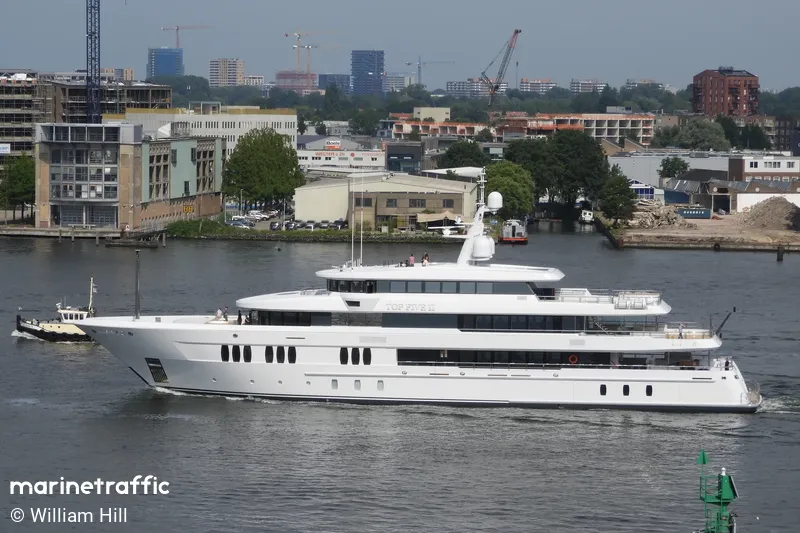
A vessel’s position is the boat’s, not the owner’s. Ownership is as reported, not certified.
Royal Hakvoort delivered hull YN251 in 2021 as a fresh steel motor yacht for Terry Pegula. Her 61-metre length, 11-metre beam, and subsequent Florida-bound movements demonstrate a specific calculation about maintenance overhead, coastal logistics, and the structural legacy of a shipyard that pivoted from fishing trawlers to luxury yachts after international sanctions collapsed its Russian order book.
Top Five II measures 61.0 metres in length and carries a gross tonnage of 1,291. She was delivered by Royal Hakvoort in 2021 as hull number YN251. She did not arrive through a conversion programme. She was constructed as a new motor yacht for an American energy executive who has chosen to fly the Cayman Islands flag from her home port of George Town. The decision to commission a fresh hull at a Monnickendam yard rather than purchase a larger superyacht reflects a specific calculation about maintenance overhead and operational range. Her subsequent AIS broadcasts show a vessel that rarely leaves the immediate vicinity of South Florida, moving in short bursts at low speeds. The architecture of Top Five II explains both the yard’s survival strategy after the collapse of its Russian order book and the practical limits of an owner whose wealth originates in domestic natural gas extraction rather than global shipping.
The slipway limit
Royal Hakvoort extended its main construction hall to 66 metres in the aftermath of the 2008 financial crisis, a move that secured orders for two Russian-owned vessels in the 60-metre class before international sanctions dismantled those contracts in 2014. The yard recovered by pivoting back to the segment that had remained stable during the downturn: the 60-metre luxury motor yacht. Top Five II sits precisely within that window. A 61.0-metre hull requires a beam that can accommodate a full-width master suite and a central stairwell without sacrificing interior volume, which pushes the design toward the 11.0-metre maximum that Hakvoort routinely achieves. That beam width dictates a displacement profile that favours comfort over velocity.
The yard’s earlier experience building seventy fishing trawlers between 1959 and 1980 left a legacy of robust framing and high freeboard, traits that persist in their modern sport-fishing-derived designs. The transition from steel fishing vessels to luxury yachts occurred when the third generation of the Hakvoort family shifted focus, but the underlying engineering philosophy remains anchored in utilitarian seaworthiness rather than hydrodynamic minimalism. Top Five II inherits that lineage. Her proportions suggest a hull form optimised for stability in choppy coastal waters rather than efficiency at sustained cruising speeds. The yard received its royal designation in November 2020, shortly before delivering this hull, signalling a formal recognition of the craftsmanship required to maintain such traditional steel methods while competing against aluminium-hulled manufacturers. The choice of a heavier upper deck structure reduces acceleration compared to composite alternatives, a trade-off that becomes visible in the vessel’s actual operating speeds.
The energy dividend
Terry Pegula, born in 1951 in Carbondale, Pennsylvania, accumulated his capital through investments in fracking and natural gas development. He holds a bachelor’s degree in petroleum and natural gas engineering from Penn State University and operates his primary business interests from New York and Florida. His net worth stands at approximately nine billion three hundred million dollars, derived largely from the expansion of unconventional gas reserves in the Marcellus shale region. Pegula also owns the Buffalo Sabres of the National Hockey League and a controlling stake in the Buffalo Bills of the National Football League, positions that require substantial annual capital expenditure but generate steady cash flow through media rights and stadium revenue.
The acquisition of Top Five II aligns with a broader portfolio strategy that treats leisure assets as extensions of operational logistics rather than purely recreational purchases. He resides in Boca Raton, Florida, with his second wife, Kim, and maintains a presence across multiple time zones through his sports franchises. The choice of a Cayman Islands flag for a vessel owned by a US citizen simplifies tax administration and customs clearance when entering Caribbean waters, while the George Town home port satisfies registration requirements without exposing the asset to domestic probate courts. Pegula’s daughter Laura assumed a minority ownership stake in the Bills in 2024, following legal proceedings that placed her mother’s assets into a trust managed by Pegula and his business partner Bob Long. The yacht’s registration mirrors that corporate structuring: clean, offshore, and insulated from domestic litigation risk. Additional ventures including Black River Entertainment, Impact Sports Performance facilities, and a July 2022 consulting service called Bison Wealth demonstrate a capital allocation model that prioritises diversified cash flow over concentrated leverage, allowing the $75,000,000 asset to sit on a balance sheet without financing constraints.
The Florida radius
AIS tracking places Top Five II at 26.72° N, 80.05° W off the United States East Coast. Her most recent recorded passage, logged on 28 July 2026, covered a distance of one nautical mile between two points in Palm Beach, Florida. The vessel maintained an average speed of 7.4 knots and reached a maximum of 8.8 knots during the transit. These figures are consistent with a displacement hull operating well below its theoretical Top speed. A 61-metre yacht of 1,291 tons typically cruises between 12 and 14 knots under normal conditions; the observed velocities indicate either heavy loading, restricted engine power, or deliberate fuel conservation.
The short distance and low speed point to a routine transfer between marinas or a sheltered anchorage rather than a blue-water crossing. The vessel’s operational footprint matches the geography of her owner’s residence. Boca Raton lies roughly sixty nautical miles south of Palm Beach, a distance easily covered in a single day’s run, but the AIS record shows no evidence of longer passages beyond the Florida Straits or the Bahamas. This pattern suggests a platform designed for local regattas, family gatherings, and proximity to Pegula’s primary residences rather than transatlantic deployment. The absence of high-speed runs also aligns with the mechanical constraints of a yard that prioritises structural integrity over lightweight construction. Hakvoort continues to use traditional steel methods, which add weight to the upper decks and reduce acceleration compared to aluminium-hulled competitors. Top Five II moves slowly because her builder chose durability over performance, and her owner appears content with the resulting pace.
Reporting and data: CelebYachts, republished by On the record.
Sources
The numbers on this page point here. Each one links to the record it came from.
- 1