
 CelebYachts reportThe Fleet
The spatial distribution of the European tycoon fleet
AIS tracking shows a clear split between high-transit activity in the western Mediterranean and stationary positioning in the Aegean, with three vessels…
By On the record · Aug 4, 2026 · Data from CelebYachts1
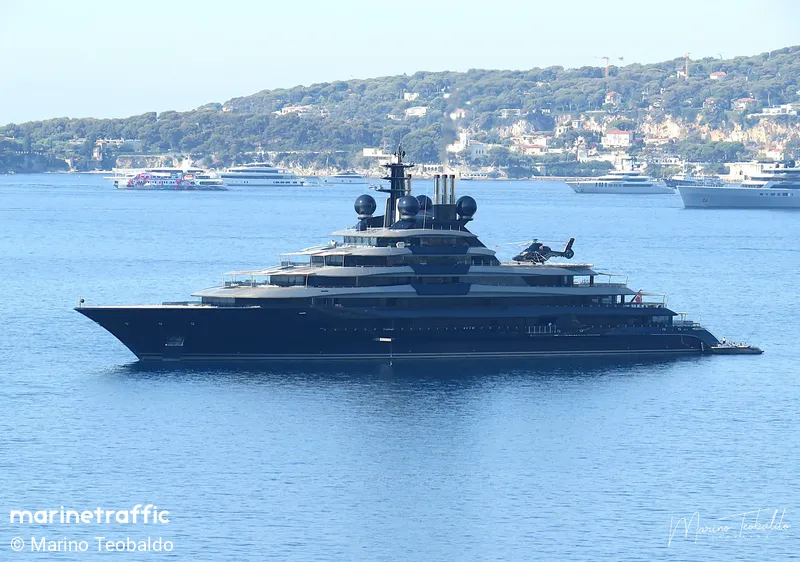
A vessel’s position is the boat’s, not the owner’s. Ownership is as reported, not certified.
A review of twenty-two tracked hulls belonging to European and international owners reveals a summer defined by regional clustering rather than continuous cruising. Nine vessels occupy Italian waters, six remain fixed near Greek islands, and four have completed transits across national borders, while the remainder show no recorded movement since late July.
The western Mediterranean accounts for nine of the twenty-two hulls in this cohort, with five positioned in the Ligurean Sea and four in the Tyrrhenian Sea. This concentration reflects a functional geography where large vessels operate along a continuous coastline rather than crossing open water. The most active participants in this zone are Luminance, Atlantis II, and IJE. Luminance, measuring 138.8 metres, logged four separate passages between Bastia, Cannes, Golfo Aranci, and Portoferraio, covering a cumulative distance of 390 nautical miles. Her routing follows the standard coastal hop pattern, avoiding the longer open-sea legs that would take her into the Balearic or Tyrrhenian basins. Atlantis II, at 115.82 metres, executed a linear transit from Monaco through Genoa and Civitavecchia before terminating in Naples, accumulating 412 nautical miles across three tracked legs. IJE, measuring 108.0 metres, reversed the typical flow by moving from Palma de Mallorca to Martigues before heading south to Olbia, adding another 394 nautical miles to the seasonal total. These three vessels demonstrate that the largest hulls in the group are still utilizing the western Mediterranean as a connected highway, prioritising port access over offshore loitering.
Other vessels in the same waters show different operational profiles. Drizzle, owned by the Estate of Amancio Ortega, departed La Maddalena for Olbia and then Corfu, covering 601 nautical miles across three passages. Her route cuts across the northern Tyrrhenian and into the Ionian Sea, breaking the Ligurean-Tyrrhenian containment that holds the rest of the cohort. M'Brace, measuring 73.52 metres, operated exclusively in the western French Riviera, shuttling between Monaco, Cannes, Saint-Tropez, and Nice across four passages that ranged from 8 to 26 nautical miles. His routing mirrors the short-haul pattern seen further east, despite the vessel being based in the Ligurean Sea. The absence of recorded passages for Hampshire II, Main, Siren, Force Blue, and Virginian indicates they are either moored for extended periods or operating under AIS protocols that do not trigger the site passage-tracking algorithm. Their static presence in the Ligurean and Tyrrhenian seas reinforces the observation that the western basin functions as a holding ground for vessels that have reached their seasonal destination.
The eastern anchor points
Six hulls are clustered in the Aegean and Ionian Seas, with three in the Aegean and two in the Ionian. Unlike the western corridor, where vessels traverse hundreds of nautical miles between major ports, the eastern cluster is defined by short-range station keeping. Nahlin, measuring 92.0 metres, recorded four separate movements, all originating and terminating within a few nautical miles of Rhodes. Her legs ranged from 17 to 34 nautical miles, consistent with crew changes, supply runs, or local inspections rather than coastal cruising. Maltese Falcon, at 87.35 metres, followed an identical pattern, logging two passages of 6 and 16 nautical miles around the same island. O'Pari, measuring 95.0 metres, operated slightly further afield, shuttling between Rhodes, Antalya, and Kos across four passages that totalled 392 nautical miles. Her routing suggests a willingness to cross international waters, but her operations remain tightly bound to the Dodecanese and Turkish coast.
In the Ionian Sea, Lionheart, measuring 90.0 metres, remained anchored near Agrinio, Kefalonia, and Ithaca. Three passages of 9, 15, and 17 nautical miles confirm a localized routine. The similarity between Nahlin, Maltese Falcon, and Lionheart points to a shared constraint: these vessels are using the Aegean and Ionian basins as fixed bases rather than transit routes. The geographical spread across three sea areas indicates that the eastern Mediterranean serves as a holding zone for owners who prefer stable anchorage over coastal navigation.
Jurisdictional shifts and outliers
Three vessels in the cohort operate entirely outside the Mediterranean basin, highlighting the global dispersion of this owner group. Symphony, measuring just 8.0 metres, is tracked in the East China Sea with no recorded passages. Her size and location suggest she is either a tender operating alongside a larger parent vessel or a standalone craft deployed in Asian waters. Turama, at 117.0 metres, is positioned in the Red Sea, also showing no recent movement. Her presence in the Gulf of Aden or Red Sea corridor places her far from the European summer grounds.
Within the Mediterranean, Aviva, measuring 98.4 metres, represents a clear jurisdictional shift. She arrived at Gibraltar from an unrecorded origin, covering 1,028 nautical miles in a single tracked leg starting on 31 July. Her arrival in the British Overseas Territory marks a departure from the Italian and French ports that host the majority of the cohort. Valoria B, another asset owned by Amancio Ortega, is located off the UK Coast and Atlantic, confirming that at least one owner maintains a permanent northern European base alongside Mediterranean holdings. The remaining vessels fill out the perimeter of the basin without contributing to the central transit patterns.
The static majority
The defining feature of this cohort is not the movement of its largest hulls, but the stillness of the rest. Twelve of the twenty-two tracked vessels show zero passages in the site archive for the reporting period. This group spans the full size range of the cohort, from the 96.83-metre Vava II down to the 47.35-metre Valoria B. Five of them hold positions in the Ligurean and Tyrrhenian seas, three sit in the Adriatic or Balearic waters, and four are stationed in the Piraeus Area or off the British coast. Their silence in the tracking archive reflects a common operational rhythm: vessels that have reached their seasonal berth typically cease logging significant displacements.
The contrast between the high-mileage western corridor and the low-mileage eastern anchor points reveals a structural division in how this group utilises the Mediterranean. The largest vessels, exceeding 100 metres, dominate the transit lanes between France, Italy, and Spain, covering distances that require careful fuel management and crew scheduling. The mid-sized hulls, ranging from 85 to 95 metres, prefer the sheltered waters of the Aegean and Ionian seas, where short hops suffice for maintenance and provisioning. The smallest assets, including Symphony and Valoria B, operate in completely different maritime jurisdictions, underscoring that ownership of multiple hulls correlates with global deployment rather than regional concentration. The data confirms that the European tycoon cohort is not a unified fleet moving together, but a collection of independent assets following divergent logistical paths dictated by size, flag, and owner preference.
Reporting and data: CelebYachts, republished by On the record.
Sources
The numbers on this page point here. Each one links to the record it came from.
- 1