
 CelebYachts reportThe Fleet
The static archive of the Historic yacht cohort
Eight tracked vessels have not moved at all. The remainder confines itself to sheltered waters and short coastal hops, proving that preservation mandates…
By On the record · Aug 4, 2026 · Data from CelebYachts1
A vessel’s position is the boat’s, not the owner’s. Ownership is as reported, not certified.
The Historic and legacy yacht cohort operates as a preserved archive rather than an active cruising fleet. Of the nineteen vessels assigned to the category, sixteen broadcast AIS signals, yet eight have logged zero movement during the current tracking window. Where the others do sail, their routes are restricted to short coastal transfers or extended stays at single anchorages, dictated by maintenance schedules and institutional custody rather than leisure routing.
The Historic and legacy yacht cohort functions as a museum collection rather than a cruising fleet. Of the nineteen vessels classified in the group, sixteen transmit AIS positions, but eight remain completely stationary throughout the tracking window. The remaining eight vessels confine their activity to short coastal hops between marinas or extended stays at single anchorages. Their routing reflects preservation mandates and institutional custody, not seasonal leisure patterns. This cohort demonstrates how maritime heritage shifts from propulsion to static display when ownership transfers to trusts, states, or foundations.
The unmoving majority
Eight tracked hulls hold fixed coordinates without logging any passage data. HMY Britannia sits under UK Royal Family custody without broadcasting a position. Galeb, owned by Regia Azienda Monopolio Banane, maintains a static coordinate. Fantome, registered to the estate of the second Duke of Westminster, does not move. Haida 1929 remains in the South Pacific under Max C Fleischmann’s name. Kalizma stays in the East China Sea, associated with Richard Burton and Elizabeth Taylor. Hanuman occupies the Caribbean Sea for Giovanni Lombardi Stronati. Ranger holds the US East Coast for John A Williams. Sequoia rests on the US West Coast under Emily and Richard Cadwalader. Bluebird of Chelsea anchors in the North Sea for Sir Malcolm Campbell.
These vessels share a common operational constraint: they are maintained for display rather than transit. Their AIS transponders serve as digital placards, confirming presence without implying readiness for departure. The lack of movement correlates directly with their classification as Historic assets. Geographic dispersion does not necessitate activity. A vessel stationed in the South Pacific or the East China Sea follows the same operational logic as one moored in the North Sea. The tracking system registers them because their transponders are powered, not because they are underway. Custodial entities prioritize hull integrity and historical accuracy over navigational utility. Maintaining a live AIS feed requires continuous electrical power and antenna clearance, both of which these estates provide to satisfy regulatory transparency and insurance requirements, even when the engines remain cold.
Christina O, Talitha G, Blue Bird of 1938, and Velsheda form a tight grouping in the Ligurian Sea. Christina O logged four passages this week, covering distances between nine and twenty-five nautical miles across the stretch from Cannes to Saint-Tropez. Her longest leg ran twenty-four point five nautical miles from Nice to Saint-Tropez on August fourth. Talitha G completed a single coastal transfer of three hundred and seventy-three point eight nautical miles from Naples to Nice on August second, following a series of short maneuvers around Torre Annunziata and Salerno. Blue Bird of 1938 remained within sight of Saint-Tropez, logging four separate tracks that each stayed under twelve nautical miles. Velsheda crossed between Corsica and the Italian mainland, moving from Propriano to La Maddalena and back, with earlier legs linking Ajaccio to Calvi.

These movements follow established ferry corridors and sheltered bays. The clustering suggests shared maintenance windows or coordinated heritage events rather than independent recreational routing. Four vessels operating in the same sea indicates a logistical hub capable of handling Historic hulls. The distances are short because the vessels are likely undergoing mechanical inspection, crew rotation, or preparation for public exhibitions. The routing avoids open-water crossings, which would stress early twentieth-century propeller shafts and boiler systems. Coastal hopping allows crews to monitor hull flex and machinery temperatures without committing to sustained high-speed transit. The precise timing of these legs, often departing in the early morning hours and returning before dusk, aligns with standard yard opening times and tide-dependent marina access.
The eastern Mediterranean drifters
Shamrock V, Marala, and Malahne operate in the Aegean and Ionian Seas with similarly restricted ranges. Shamrock V spent the entire tracking period anchored forty-three nautical miles off Gythion, Greece. Her AIS recorded minor positional shifts of five to eight nautical miles, consistent with anchor chain swing rather than engine propulsion. Malahne covered more ground, running fifty-nine point eight nautical miles from near Salerno to Messina, then proceeding to Palermo before her signal faded. Marala departed Samos on August fourth and logged seven point five nautical miles before her track ended. Shemara, held by the estate of Sir Bernard Docker, sits in the Ionian Sea without recording any passage data.
The eastern Mediterranean segment of this cohort shows vessels using protected waters for storage or slow transit. The absence of open-sea crossings aligns with the age and mechanical condition of early twentieth-century designs. Crews in this region typically keep Historic vessels within radio range of mainland ports to facilitate rapid intervention in case of steering failure or main engine breakdown. The shallow draught of many of these hulls makes them suitable for anchoring in exposed bays, but also limits their ability to weather heavy swells. Operators therefore prefer the lee of the Greek islands and the Tyrrhenian coast, where wind patterns are predictable and rescue infrastructure is dense. The null destinations in Marala and Malahne’s final records indicate transmitter shutdown or battery depletion after long coastal runs, a common occurrence when vintage equipment is pushed beyond its designed duty cycle.
The northern outliers
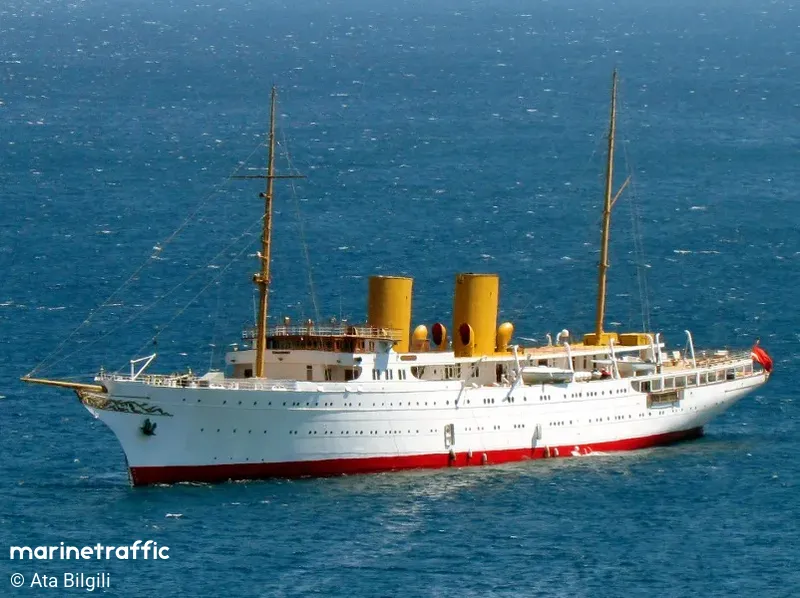
Belem operates in the North Sea with a routine typical of working heritage vessels. She moved ninety-four point one nautical miles from Haugesund to Stord on August first, followed by short runs between Stord and Bergen. Her passages totalled roughly sixty nautical miles across four days, matching dry-docking logistics or crew changes. Savarona, the largest vessel in the cohort at one hundred and twenty-four metres, holds position in the Marmara Sea. Her coordinates place her far from the major shipping lanes of the Dardanelles, suggesting a long-term mooring arrangement.
The northern segment confirms that even the most active vessels in this group restrict themselves to sheltered waters and short durations away from base. Belem’s movements between Norwegian ports reflect the seasonal availability of specialist yards and the need to winterize wooden-hulled vessels before autumn storms. Savarona’s location in the Marmara Sea indicates a deliberate choice to avoid the heavy commercial traffic of the Bosporus while remaining accessible to Istanbul-based conservators. The data leaves little room for ambiguity. Half the tracked Historic fleet has not moved at all. The other half sails only in sheltered channels or circles around familiar anchorages. Preservation overrides propulsion.
Reporting and data: CelebYachts, republished by On the record.
Sources
The numbers on this page point here. Each one links to the record it came from.
- 1