
 CelebYachts reportThe Fleet
The stationary fleet of Middle Eastern royalty
AIS data reveals that nineteen of twenty-one tracked state and royal hulls held station this season, using the western Mediterranean only as a controlled…
By On the record · Aug 7, 2026 · Data from CelebYachts1
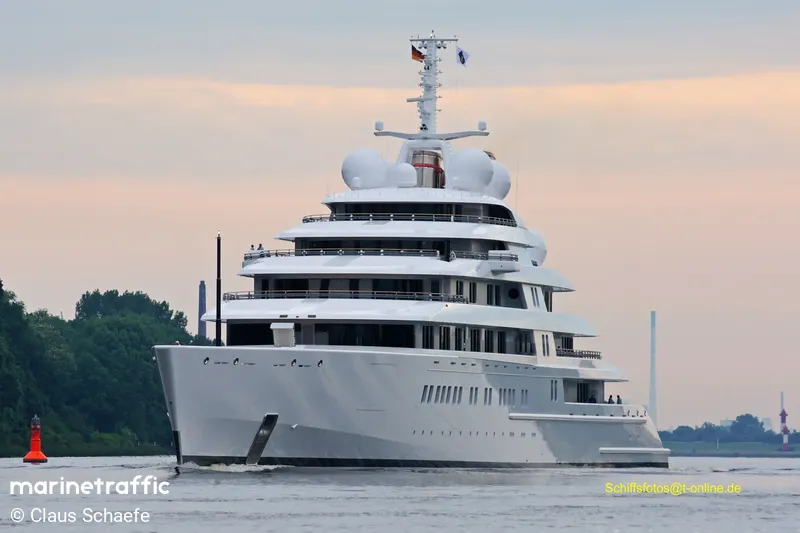
A vessel’s position is the boat’s, not the owner’s. Ownership is as reported, not certified.
The Middle Eastern royal and heads-of-state cohort does not migrate. Position archives show eighteen vessels holding anchor or mooring throughout the summer months, while only three logged passage. The pattern reflects sovereign logistics, not leisure cruising.
The position archive for the Middle Eastern royalty and heads-of-state cohort records a fleet that holds station rather than cruises. Of the twenty-one tracked hulls in the category, eighteen remained within their designated sea areas throughout the monitoring window. Only three vessels logged significant passage, and two of those belong to the same owner. The western Mediterranean functioned as a transit corridor for a small subset of the fleet, while the largest state-owned assets maintained their positions near their respective capitals. This distribution follows operational requirements rather than hull dimensions or purchasing power.
The anchored state assets
The stillness of the largest vessels is the dominant feature of the dataset. Azzam measures 180.6 metres and sits in the Persian Gulf. Dubai measures 160.0 metres and occupies the same waterway. Fulk Al Salamah measures 164.0 metres and holds position in the Oman Gulf. These three hulls account for nearly half the total tonnage of the cohort. Their owners include the UAE President, the Ruler of Dubai, and the Sultan of Oman. AIS broadcasts show them maintaining fixed coordinates for extended periods. The absence of movement from vessels of this scale indicates that they serve as floating command centres or secure residences where relocation requires months of preparation. The engineering constraint of moving a 180-metre super-yacht through shallow coastal channels dictates that any departure would be logged weeks in advance. The data shows no such departures.
El Mahrousa / El Horriya, measuring 145.72 metres, reports null status in the Area field. The vessel carries Egyptian Navy or Presidency flags and operates outside the standard civilian AIS reporting framework or remains in restricted waters. Its static presence in the registry contrasts with the active broadcasting of the remaining twenty hulls. The null Area classification suggests either deliberate signal suppression or assignment to a naval domain that does not map onto the civilian sea-Area boundaries used by the tracking database.
The transit corridor
The transit activity concentrates entirely in the western Mediterranean. Al Saïd, measuring 155.0 metres and owned by the Sultan of Oman, executed a westward progression through the central Med. She departed Porto Cervo for Bonifacio on 28 July, covering 47 nautical miles. Two days later she crossed from Ajaccio to Monaco, logging 122 nautical miles. On 2 August she continued from Nice to Tarragona, completing a 333-nautical-mile leg. This sequence aligns with standard summer routing for vessels avoiding the congested Strait of Gibraltar during peak season, though the pace suggests scheduled stops rather than continuous sailing.

A+, measuring 147.25 metres and owned by Sheikh Mansour bin Zayed Al Nahyan, made a single 19-nautical-mile hop around Olbia on 30 July. Yas, measuring 141.0 metres and owned by Sheikh Hamdan bin Zayed Al Nahyan, departed the Olbia Area on 4 August. These three movements represent the entirety of the cohort’s navigation data for the period. The shared ownership between A+ and Yas explains their proximity in the Tyrrhenian Sea. Both vessels report Abu Dhabi ruling family members as owners, confirming that the Olbia-Area activity was a joint deployment rather than isolated transit. The clustering of two large UAE vessels in the Tyrrhenian Sea accounts for four of the six hulls currently recorded in the western Mediterranean basin.
The remaining sixteen hulls distributed themselves across twelve distinct sea areas, with no further passage recorded. Three vessels clustered in the Balearic Sea: Katara, measuring 124.35 metres, and Al Lusail, measuring 124.0 metres, both report the Emir of Qatar as owner. Al Saïd also appears in the Balearic count after her transit, indicating she arrived in the region following the Tarragona leg. Three vessels held station in the Red Sea: Al Salamah, measuring 139.0 metres, reports the Saudi state as owner. Serene, measuring 133.9 metres, reports Mohammed bin Salman as owner. Maryah, measuring 125.0 metres, reports Sheikh Tahnoon bin Zayed Al Nahyan. The clustering in the Red Sea suggests a coordinated presence along the southern maritime approach to the Arabian Peninsula.
Two vessels occupied the Ligurian Sea: Al Mirqab, measuring 133.2 metres and owned by the former Qatari prime Minister, and Al Raya, measuring 110.0 metres and reporting the Bahrain royal family. Single vessels appeared in the Aegean Sea (Blue, 160.0 metres, owned by Sheikh Mansour), the Adriatic Sea (Prince Abdulaziz, 147.01 metres, owned by the Saudi royal family), the East Mediterranean (Opera, 146.35 metres, owned by the UAE Foreign Minister), the Piraeus Area (Radiant, 110.0 metres, owned by Abdulla Al Futtaim), the Arabian Gulf (Loaloat Al Behar, 103.82 metres, owned by the Sultanate of Oman), and the Dubai Area (Dubawi, 88.3 metres, owned by the Crown Prince of Dubai). The geographic spread mirrors diplomatic itineraries. Vessels owned by Foreign ministers or former prime ministers appear in the Aegean and East Mediterranean, consistent with regional conference schedules or bilateral visits. Vessels owned by sitting rulers remain anchored in home waters.
The distribution reveals a structural divide between state-owned naval auxiliaries converted for ceremonial use and privately operated royal pleasure craft. The remaining vessels fall into a predictable ownership hierarchy: UAE ruling family members control seven hulls, Omani state entities control four, Saudi state or royal family members control four, and Qatari state or former officials control three. The absence of movement from the majority of the cohort is itself the finding. Maritime broadsheets often treat large yacht positioning as evidence of wealth mobility, assuming that high net worth individuals continuously relocate their assets across seasons. The AIS archive contradicts this assumption for sovereign and state-linked owners. Security protocols, diplomatic duty, and the logistical weight of vessels exceeding 130 metres create a gravitational pull toward home waters. The western Mediterranean serves only as a controlled bypass for those who must travel. The rest remain at anchor, broadcasting static coordinates while the summer progresses.
The data contains gaps that limit precise analysis. We do not know the exact anchorage coordinates for the static hulls, only the general sea Area provided by AIS broadcast zones. We do not know the maintenance schedule for the vessels that held station, nor do we know if the Red Sea cluster represents a single coordinated event or independent arrivals. The sale prices for these hulls have never been confirmed; the figures reported in trade publications differ by tens of millions of dollars. The corporate structures behind some owners, particularly Abdulla Al Futtaim and the various ruling family branches, obscure the exact funding sources for the acquisitions. These omissions do not alter the primary observation: the fleet is largely immobile.
Reporting and data: CelebYachts, republished by On the record.
Sources
The numbers on this page point here. Each one links to the record it came from.
- 1