
 CelebYachts reportYards & Design
Why Ray Dalio's OceanXplorer is slow
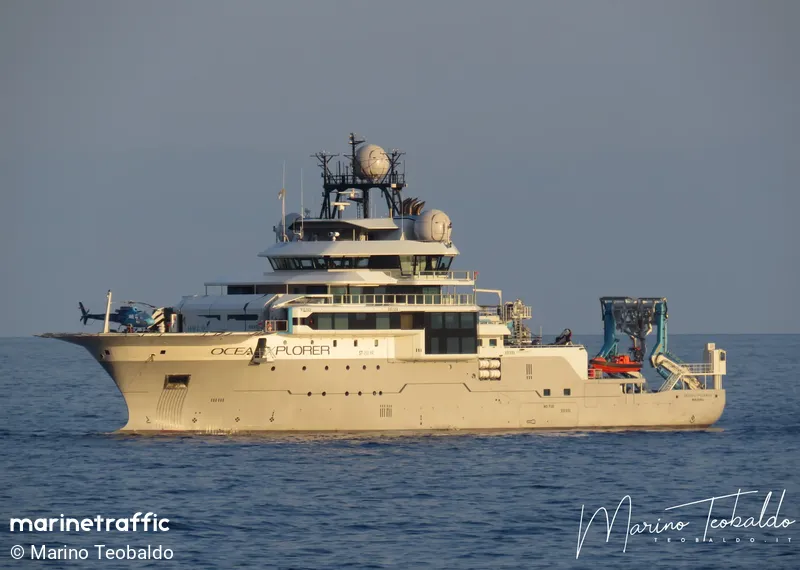
OceanXplorer is a converted offshore support vessel whose operational envelope remains dictated by her original hull form, trading speed for volume.
By On the record · Aug 28, 2026 · Data from CelebYachts1
A vessel’s position is the boat’s, not the owner’s. Ownership is as reported, not certified.
Built as a multi-role workship in Vigo and later converted at Damen, OceanXplorer carries the displacement signature of an industrial platform. The conversion preserved her wide beam and flat bottom to maximise deck load capacity, leaving a vessel that moves at the mechanical limit of her original propulsion rather than the pace of a luxury cruiser. She now belongs to hedge fund manager Ray Dalio.
Who owns OceanXplorer?
OceanXplorer was not designed from scratch. She began life as a working ship built for heavy industry. Her steel hull keeps the shape of an old supply boat. That shape still controls how she moves through water.
The owner is Ray Dalio. He runs Bridgewater Associates. This is one of the world's largest hedge funds. His wealth comes from decades of financial trading. He bought this specific hull because its design suits his research goals.
She measures 85.3 metres long. Her beam is 18 metres wide. This width gives her a large deck area. It also makes her slow. A yacht designer would never draw a hull with these proportions for speed.
How fast is OceanXplorer really?
AIS data shows her top speed rarely exceeds 14 knots. Her average cruising speed sits around 10.3 knots. This matches the profile of an offshore support vessel. It is far slower than a typical luxury yacht of similar length.
Recent AIS tracks confirm this limitation. Voyage 3130 covered 445 nautical miles at an average of 8.8 knots. Voyage 3082 showed a max speed of 11.3 knots. These figures are consistent with her original design parameters.
Where did OceanXplorer come from?
Freire shipyard in Vigo, Spain, built her in 2010. She was originally named Polar Queen. Her sister ship became RV Falkor Too. Both were ordered by a Norwegian company called Sea4 AS. They were meant to be offshore support vessels.
The keel was laid in December 2008. Construction faced delays due to the global financial crisis. Delivery was pushed back by six months. GC Rieber Shipping eventually took delivery in October 2011. They used her for oil field services.
She worked in the Gulf of Mexico for Pemex. Later she moved to the North Sea. She carried workers to wind farms. She served as accommodation housing for offshore crews. Her flat bottom and wide beam made her stable for these tasks.
GC Rieber sold the vessel in February 2021. The Schmidt Ocean Institute bought her. They renamed her RV Falkor Too. But another hull from the same original order had already been sold. That hull became OceanXplorer.
The original Volstad Surveyor was converted at Damen shipyard. The conversion took place between 2019 and 2020. Ray Dalio acquired the vessel during this period. He retained the industrial hull form but upgraded the interior for research.
Why does she move so slowly?
Where has OceanXplorer been recently?
Live position tracking places OceanXplorer in the Riau Archipelago. She stays in sheltered waters suitable for submersible deployment. This location allows team transfer and safe operations. Her AIS track shows frequent stops in these areas.
Voyage 366 tracked a 411-nautical-mile passage. The average speed was 10.3 knots. The maximum speed reached 13.3 knots. This pattern is consistent with her original offshore support profile.

Her gross tonnage is 5,399. This volume comes from her wide beam and deep draft. The machinery was sized for this weight. It pushes the hull efficiently at low speeds. It struggles to push her faster without excessive fuel use.
The conversion did not change the hull shape. Damen kept the straight sheerline. They kept the reinforced deck plating. These features prioritise cargo distribution. They do not aid hydrodynamic efficiency at high speeds.
Dalio accepts this trade-off. He needs deck space for submersibles. He needs stability for scientific equipment. Speed is secondary to function. The hull form delivers exactly what he requires for oceanographic research.
Who owns OceanXplorer now?
Ray Dalio is the reported owner. He is an American investor born in 1949. He founded Bridgewater Associates in 1974. The firm manages billions in assets. His personal net worth is estimated at $14 billion.
Dalio uses OceanXplorer for research. His initiative, OceanX, focuses on protecting the oceans. He pledged $185 million to this cause in 2018. The vessel supports this mission with advanced laboratory facilities.
The vessel flies the Marshall Islands flag. Her home port is Majuro. This registration is common for large yachts. It offers legal flexibility for international operations. It does not change the physical constraints of the hull.
Her estimated value is $200 million. This figure reflects the cost of the original build plus the extensive conversion. It also includes the premium for her unique capabilities. No other yacht combines this hull form with this level of research gear.
Why does Ray Dalio own this hull?
He needs deck space for submersibles. He needs stability for scientific equipment. Speed is secondary to function. The hull form delivers exactly what he requires for oceanographic research.
Dalio has no interest in hiding behind corporate layers. His ownership is clear in public records. The vessel serves his public philanthropy. It is a tool for science, wrapped in the steel of industry.
What can OceanXplorer actually do?
She carries multiple submersibles. Her deck can handle heavy lifts. Her lab spaces are equipped for marine biology. She can operate in remote regions where other yachts cannot go. Her draft allows access to shallow reefs.
The original design included a helipad. It is positioned to avoid interference with crane operations. This layout is unusual for a luxury yacht. It reflects her dual purpose as both research vessel and support ship.
Her crew quarters are spacious. The conversion added luxury suites for scientists. The mess halls remain functional. The galley can feed a large team for weeks. This endurance is critical for long expeditions.
The vessel has visited many ports. She operates in sheltered bays. Her AIS track shows frequent stops in these locations. These spots allow safe deployment of small boats and ROVs.
OceanXplorer proves that function drives form. She is a floating laboratory built on an industrial skeleton. That distinction defines her value.
Reporting and data: CelebYachts, republished by On the record.
Sources
The numbers on this page point here. Each one links to the record it came from.
- 1