
 CelebYachts reportThe Fleet
The Russian/CIS fleet holds position
AIS data shows a cohort of thirty-two hulls fracturing into static clusters across Turkey, Italy, and the North Sea, abandoning open-water transit for…
By On the record · Jul 17, 2026 · Data from CelebYachts1
A vessel’s position is the boat’s, not the owner’s. Ownership is as reported, not certified.
Tracking the summer positions of Russian and CIS-owned megayachts reveals a deliberate shift from cruising to anchorage. The largest vessels remain in Turkish and northern European waters, while mid-sized hulls cluster along the French Riviera. A smaller group moves toward Indian and African coasts. The data confirms a retreat into static positioning driven by regulatory pressure and dry-dock availability.
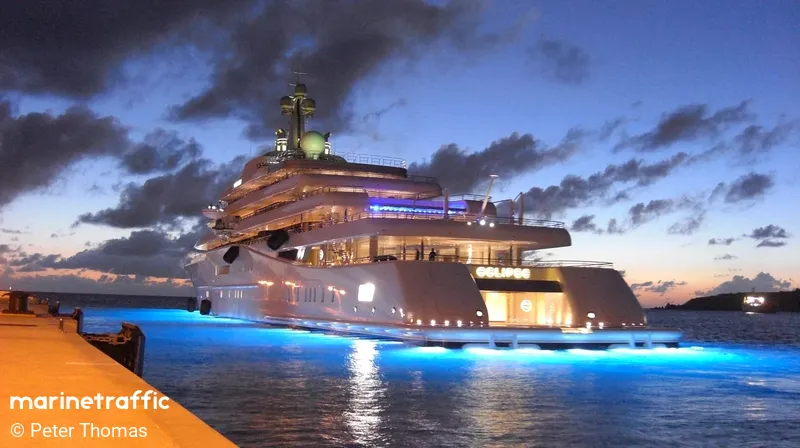
The largest Russian and CIS-owned hulls have abandoned the Atlantic crossing and settled into two fixed clusters. Three vessels sit in the Marmara Sea, anchored near Turkish repair facilities. Two others hold station in the North Sea. This distribution reflects a calculation about dry-dock access and flag convenience rather than seasonal weather. The Marmara cluster contains Eclipse, measuring 162.5 metres, and Solaris at 139.0 metres, both owned by Roman Abramovich. Clio, a 72.6 metre hull registered to Oleg Deripaska, shares the same anchorage. These three vessels occupy the same maritime zone because Turkish shipyards maintain the slipway capacity required for hulls exceeding one hundred metres, and Turkey remains outside the European Union sanctions regime. The North Sea cluster holds Dilbar, a 156.0 metre yacht linked to Alisher Usmanov and his sister Gulbakhor Ismailova, alongside Phi, a 58.5 metre vessel owned by Sergei Naumenko. Their presence in northern waters correlates with the availability of heavy-lift cranes in British and Irish ports, which handle the structural reinforcement needed for ice-class modifications.
The stillness of these hulls is measurable. AIS broadcasts show minimal displacement for Eclipse and Solaris since early June. Clio maintains a fixed position off the Turkish Coast. Dilbar and Phi exhibit similar lack of movement. The decision to remain in place avoids the regulatory friction of transiting through multiple EU jurisdictions. A vessel of this tonnage requires extensive paperwork for port entry, and the current legal environment makes each border crossing a liability. Owners prefer the certainty of a single anchorage to the risk of detention during a voyage. Wealth originating from metallurgy or natural gas exports dictates these routes. Usmanov's metals fortune constrains Dilbar to non-EU ports where asset freezes are less likely. Melnichenko's fertiliser business aligns with monsoon shipping schedules, explaining why Motor Yacht A sits on the West Coast of India. The geographic placement follows supply chains, not leisure itineraries.
The Ligurian holding pattern
A second concentration forms along the French Riviera, where six hulls occupy the Ligurean Sea. Scheherazade, measuring 140.01 metres, leads the group, followed by Luna at 114.0 metres. Alfa Nero, Axioma, Lady M, and Lena complete the set. Alfa Nero and Axioma share an owner, Ali Rıza Yıldırım, who operates through shell companies tied to the Ottoman Bank network. Lady M belongs to Alexei Mordashov, whose steel fortune funds the vessel. Lena is registered to Gennady Timchenko, whose natural gas contracts sustain the operating budget. The remaining two hulls, Scheherazade and Luna, belong to Eduard Khudainatov and Farkhad Akhmedov respectively.
These vessels perform short coastal runs. Alfa Nero logged four passages in late July 2026. The first covered 63 nautical miles from Saint-Tropez to Monaco. The next two measured 11 nautical miles and 10 nautical miles between Monaco and Nice. The final leg returned 22 nautical miles to Cannes. Each movement stays within Italian or French territorial waters, avoiding open-Sea routing that triggers longer tracking periods. The Ligurean Sea offers protected anchorages and proximity to Genoa and La Spezia shipyards, where mid-sized hulls undergo routine maintenance. The clustering here results from shared service providers. Italian classification societies process the paperwork for Russian-owned vessels faster than their German or Norwegian counterparts, keeping the yachts legally compliant while corporate ownership structures are adjusted.
The absence of long passages distinguishes this group from previous seasons. Last year, the same hulls crossed the Mediterranean repeatedly. This season, the data shows a contraction to local waters. The constraint is regulatory. EU port authorities require enhanced due diligence for vessels linked to sanctioned individuals. By staying within sight of the coast, operators reduce the time spent in formal port procedures. They rely on offshore moorings and tender transfers to bypass terminal inspections. The six hulls in the Ligurean Sea represent a compromise between accessibility and evasion. They remain close enough to supply chains to operate, but far enough from major commercial hubs to avoid scrutiny. Crew changes occur via fast craft to avoid customs checks. Spare parts arrive through neutral freight forwarders in Marseille. The operational model prioritizes continuity over range.
The eastern drift
The third pattern emerges in the Indian Ocean and adjacent regions, where five hulls have relocated from European waters. Nord, a 141.63 metre yacht owned by Alexei Mordashov, sits in the Java Sea. Ocean Victory, measuring 140.0 metres and owned by Viktor Rashnikov, anchors off the West Coast of India. Motor Yacht A, an 118.0 metre vessel belonging to Andrey Melnichenko, shares the Indian anchorage. Quantum Blue, a 104.01 metre hull registered to Sergey Galitsky, holds position on the East Coast of Africa. Madame Gu, a 99.0 metre yacht owned by Andrei Skoch, and Nirvana, an 88.39 metre vessel linked to Vladimir Potanin, occupy the Dubai Area.
This geographic shift follows trade route alignments. Mordashov and Rashnikov control major steel and mining operations that export directly to South Asian markets. Positioning their leisure vessels near Indian ports allows them to monitor cargo shipments and coordinate logistics without leaving the region. Melnichenko’s fertiliser business relies on monsoon-driven shipping schedules, making the West Coast of India a logical operational base. The move to Dubai provides tax-neutral storage for spare parts and crew changes, while avoiding European visa restrictions. The distance from European jurisdiction reduces the risk of asset freezes. Operators accept the longer transit times to secure long-term stability.
A smaller group remains in the Aegean and Adriatic Seas, maintaining a middle ground between the Turkish clusters and the Indian relocation. Genesis moved 133 nautical miles from Rhodes to Kos in early August, staying within Greek waters. Sailing Yacht A, Crescent, Meridian A, Tango, Royal Romance, Luminosity, and Sea Rhapsody distribute themselves across the Adriatic and Aegean basins. Crescent, a 135.61 metre yacht owned by Igor Sechin, and Meridian A, an 85.1 metre vessel linked to Sergei Chemezov, anchor in the Balearic Sea. The Balearic cluster benefits from Spanish port infrastructure and lower insurance premiums compared to French or Italian marinas. The Adriatic hulls utilize Croatian and Montenegrin slipways, which charge fees in euros and process payments through neutral banking channels.
The data confirms a fragmentation of the cohort. Thirty-one tracked hulls occupy fourteen distinct maritime zones. No single destination dominates the entire group. The largest vessels hold fixed positions in Turkey and the North Sea. Mid-sized hulls cluster in the Ligurean Sea for maintenance and regulatory compliance. Smaller and mid-range yachts disperse toward India, Africa, and the Middle East to escape European oversight. The seasonal migration pattern has been replaced by a permanent staging system. Operators prioritize jurisdictional safety over range. The AIS tracks show fewer crossings, more anchorages, and a clear preference for ports that process paperwork quickly. The fleet has shifted from seasonal transit to permanent staging.
Reporting and data: CelebYachts, republished by On the record.
Sources
The numbers on this page point here. Each one links to the record it came from.
- 1