
 CelebYachts reportProfiles
The Sultan’s floating ministries
Three hulls, forty years. The sequence of Qaboos bin Said’s yachts reveals a shift from domestic utility to diplomatic projection, driven by the logistical demands of statecraft rather than personal leisure.
By On the record · Oct 8, 2026 · Data from CelebYachts1
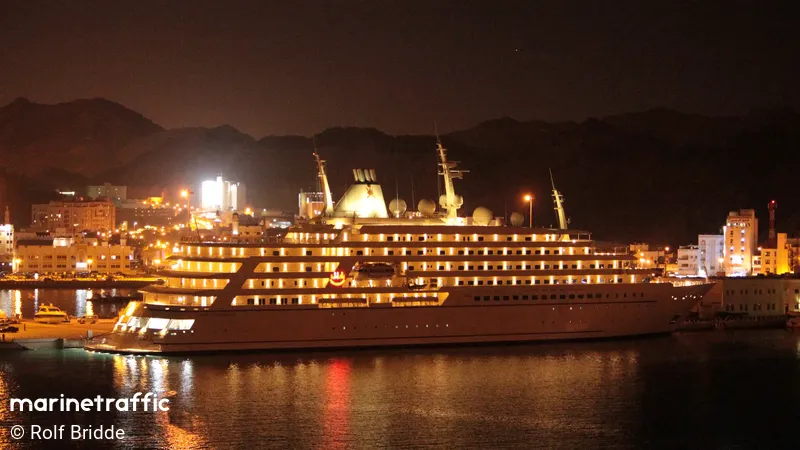
A vessel’s position is the boat’s, not the owner’s. Ownership is as reported, not certified.
The Sultan of Oman has operated three distinct vessels since 1988, escalating from a fifty-two-metre tender to a hundred-and-sixty-four-metre flagship. The progression marks a deliberate expansion of sovereign capability, replacing a locally managed workboat with internationally built platforms designed to host state visits and facilitate regional mediation.
The fleet of the late Sultan Qaboos bin Said Al Said evolved in direct proportion to the diplomatic weight of his office. Three hulls span four decades, moving from a domestically constructed tender to two superyacht-class platforms that functioned as floating embassies. The sequence does not track private leisure; it tracks the scaling of state infrastructure. Each vessel was commissioned to accommodate a specific operational requirement, and each replacement reflected a shift in how the sultanate projected power across the Persian Gulf.
The domestic baseline
The first vessel in the register, Zinat al Bihaar, entered service in 1988 at 52.6 metres. She was designed by Colin Mudie, an Edinburgh-born naval architect who had studied engineering at Southampton University and worked under Laurent Giles and Uffa Fox before establishing his own practice. Mudie’s portfolio included motorsailers, luxury yachts, and tall ships, and his approach prioritised seaworthiness over decorative excess. The hull was constructed by the Oman Royal Yacht Squadron, a domestic yard that oversaw both design and build. Flagged OMAN, she represented a utilitarian starting point for a ruler who had ascended to the throne in 1970 after overthrowing his father with British support.
A fifty-two-metre vessel requires minimal crew and can operate from modest ports. It suits short-range transit and coastal inspection, which aligned with the early phase of Qaboos’s modernisation campaign. The sultanate was still laying down basic infrastructure: paved roads, desalination plants, and telecommunications networks. A domestically built yacht kept construction costs within local oversight and avoided the political complications of foreign shipyard contracts. The Oman Royal Yacht Squadron retained administrative control, ensuring that the vessel remained an extension of the royal household rather than a commercial asset. The exact interior configuration remains unpublished, but the dimensions indicate a focus on functional accommodation rather than expansive entertainment spaces.
The Lürssen commission
The second hull, Al Saïd, represents a structural leap in scale and purpose. Ordered in 2006 and launched in September 2007 by Lürssen, she measured 155 metres upon delivery in 2008. At launch, she held the distinction of being the world’s second longest yacht. Code named Project Sunflower during construction, she was built to accommodate the growing diplomatic footprint of the sultanate. The jump from 52.6 metres to 155 metres is not incremental; it crosses the threshold where a yacht ceases to be a transport vessel and becomes a self-contained facility. The length dictates a multi-deck layout capable of hosting foreign heads of state, secure communication suites, and aviation operations without requiring port infrastructure.
Lürssen, a German yard with a long history of constructing large displacement vessels, provided the engineering discipline required for a hull of this tonnage. The decision to move to a European yard reflects the sultanate’s integration into international maritime standards and its need for yards capable of handling complex classification requirements. Al Saïd flew the OMAN flag throughout her service, administered by the Oman Royal Yacht Squadron. An estimated value of $500 million underscores the financial commitment, though the figure is reported rather than confirmed. The vessel’s deployment coincided with Oman’s emergence as a neutral mediator in regional conflicts, including later facilitation of secret US–Iran talks and hostage releases. A hull of that size provides the physical space necessary for high-level negotiations away from public scrutiny.
The Mariotti upgrade
Fulk Al Salamah replaced Al Saïd as the primary sovereign vessel when she entered service in 2016. Measuring 164 metres, she extended the length record set by her predecessor by nine metres. She was built by T. Mariotti S.p.A. in Genoa, an Italian yard founded in 1928 as a repair workshop before expanding into cruise ships, offshore vessels, and superyachts. Mariotti’s operational history includes joint ventures for hull construction and a focus on environmentally regulated luxury segments. The choice of builder indicates a preference for yards experienced in large-scale displacement projects rather than boutique yacht construction alone.
The timing of Fulk Al Salamah’s delivery aligns with a period of declining health for Qaboos, who was diagnosed with colon cancer in 2014 and received treatment abroad. The acquisition of a larger, more modern platform may have been driven by operational necessity rather than aesthetic preference. A 164-metre hull offers improved stability for long-range passages and expanded guest capacity, which became critical as the sultanate continued to host international delegations. The estimated value matches that of Al Saïd at $500 million, suggesting a consistent budget allocation for sovereign maritime assets. Both vessels share the OMAN flag and remain under the administration of the Oman Royal Yacht Squadron, maintaining continuity in command structure despite the change in builder and scale.
The sovereign constraint
The operational reality of these hulls diverges sharply from the typical superyacht profile. Our tracking data records no voyages for any of the three vessels, and their movement patterns are absent from public AIS broadcasts. This silence is consistent with state-owned assets that operate under restricted communications protocols or avoid commercial tracking networks. The absence of leisure cruising data reinforces the conclusion that these platforms were deployed for official business rather than private recreation. They functioned as mobile offices, capable of anchoring in remote waters while maintaining secure lines of communication with Muscat and foreign capitals.
Qaboos bin Said Al Said ruled until his death in January 2020 at the age of 79. He left no children, and the succession was managed through a sealed letter opened by the royal court. The yachting fleet did not transfer to a single heir’s personal use; it remained institutional property of the sultanate, administered by the same Squadron that oversaw the earliest tender. The progression from a 52.6-metre domestic workboat to two 150-plus-metre international builds maps directly onto the sultanate’s transition from isolation to a central node in Gulf diplomacy. Each hull was scaled to host the negotiations that defined the region’s stability, and each replacement marked a recalibration of sovereign capability rather than a pursuit of luxury.
Reporting and data: CelebYachts, republished by On the record.
Sources
The numbers on this page point here. Each one links to the record it came from.
- 1