
 CelebYachts reportInvestigations
The Tech-founder fleet stages its summer
AIS data shows the thirteen vessels tracked as Tech-flagships did not cruise this season. They clustered in three anchorages and moved only short distances…
By On the record · Sep 23, 2026 · Data from CelebYachts1
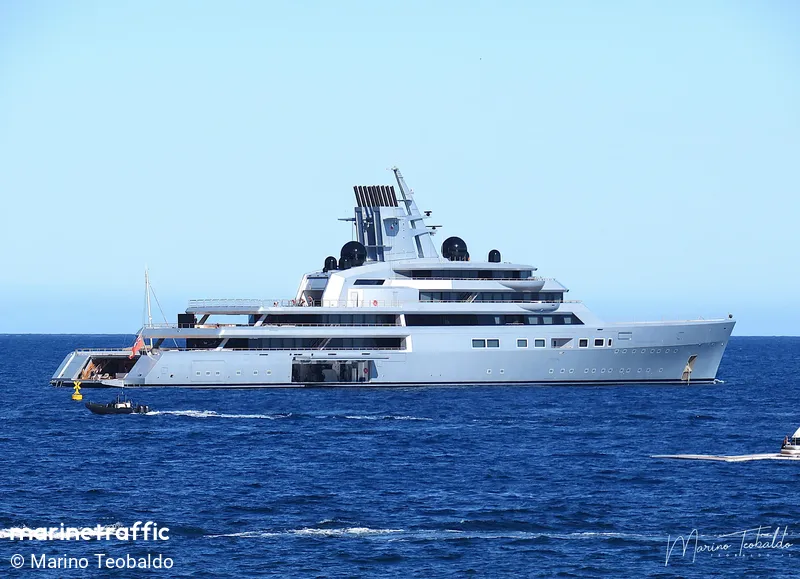
A vessel’s position is the boat’s, not the owner’s. Ownership is as reported, not certified.
The latest broadcast records for the Tech-founder cohort reveal a fleet that stayed put. Thirteen hulls divided themselves across the western Mediterranean, the Solomon Islands, and the Gulf of Alaska, covering fewer than 400 nautical miles collectively outside of a single Italian transit.
The AIS archive places six of the thirteen tracked hulls in the Mediterranean basin during August 2026. Their movements form a tight cluster of coastal hops rather than a continuous circumnavigation. DRAGONFLY, measuring 142.15 metres, executed the only long-range leg in the group. On 3 August she departed Fiumicino and ran 381 nautical miles to anchor off Palma de Mallorca. Prior to that departure, she completed two local loops of 9.5 and 9.7 nautical miles around Fiumicino, followed by a 116.4-nautical-mile transfer from Naples on 1 August. The sequence indicates a deliberate repositioning run rather than exploratory sailing. The short preliminary legs served as final checks before committing to the open-water crossing.
The Mediterranean circuit
The remaining five Mediterranean vessels never left their immediate service corridors. RISING SUN, at 138.6 metres, moved 33.6 nautical miles from Cala Figuera to Deià on 4 August, after holding station in Palma for a 9.6-nautical-mile local run. VENUS, owned by the Steve Jobs family, operated exclusively between Naples, Capri, and Torre Annunziata. Her longest recorded leg was 111.5 nautical miles from Punta Campanella, a coastal waypoint that kept her within sight of land. ZEUS, at 74.1 metres, patrolled the Ionian and Adriatic junctions, travelling between Patras, Argostoli, Athens, and Paros. His 105.2-nautical-mile run from Paros to Athens was his furthest displacement. KALM, measuring 67.0 metres, transferred from Salerno to La Maddalena, while RONIN, at 58.4 metres, shuttled between Rhodes and Kos in the Dodecanese.
The aggregate distance logged by this Mediterranean subgroup is heavily skewed by BRIN'S vessel. Excluding DRAGONFLY, the other five hulls covered less than 250 nautical miles combined over the entire month. The pattern is consistent with a provisioning cycle. Yachts of this tonnage require regular deliveries of fresh water, fuel, and provisions, which are typically sourced from marinas within a 50-nautical-mile radius of a home port. The AIS data shows repeated returns to the same anchorages—Palma, Naples, Athens, Kos—which confirms that the owners prioritised proximity to established supply chains over distance. The fleet did not cross the Mediterranean; it rotated around fixed nodes. The timestamps reveal a daily rhythm of departure and return, with most vessels logging their maximum displacement between 06:00 and 12:00 local time, suggesting coordinated crew changes or tender deployments rather than independent voyages.
The southern and northern halts
The second half of the cohort occupies a radically different operational environment. Four hulls are positioned in the South Pacific and the Gulf of Alaska, separated from the Mediterranean group by thousands of nautical miles and three ocean basins. This geographic dispersion disproves the assumption that a single owner or management company dictates the seasonal routing of the entire cohort. The vessels are operating as independent units, each tied to a specific regional hub.
OCTOPUS, measuring 126.2 metres, remains active in the waters surrounding Fiji. Her passages trace a tight perimeter around the main islands. She moved 40.5 nautical miles from Sigatoka to Momi, completed a 28.2-nautical-mile loop in Suva, and ran 60.5 nautical miles between two points off Savusavu. Her final recorded leg returned her to Lautoka. The distances are short, and the route stays well within the sheltered channels of the Mamanuca and Yasawa groups. KORU, at 113.26 metres, and ABEONA, at 75.25 metres, both owned by Jeff Bezos, hold position in the Solomon Sea. The AIS archive lists no passages for either vessel, indicating they are either moored or operating in an area where broadcast coverage is sparse. Their stillness contrasts sharply with OCTOPUS's local activity, suggesting different maintenance schedules or security protocols.
In the Northern Hemisphere, LAUNCHPAD, measuring 118.9 metres, and WINGMAN, at 80.39 metres, share a base in Juneau, Alaska. Both vessels logged brief excursions from the same harbour. LAUNCHPAD ran 38.2 nautical miles and WINGMAN covered 31.3 nautical miles on consecutive days in early August. The identical departure point and similar displacement distances point to coordinated tender operations rather than independent voyages. MUSASHI, at 87.78 metres, sits on the US East Coast with no recorded movement. SENSES, at 59.0 metres, holds station in the South Pacific. The absence of trans-oceanic legs across the entire group means the fleet did not migrate between hemispheres this season. The hulls remained in their assigned regions.
The limits of the broadcast record
AIS broadcasts capture surface displacement but do not reveal the internal mechanics of yacht operations. A vessel running 30 nautical miles might be conducting a diver deployment, transferring fuel via barge, or rotating crew. The pack provides distances and timestamps, but not purposes. The data shows that the Tech-founder cohort preferred short, repetitive legs over long crossings. This behaviour aligns with high-security requirements. Extended open-water transits increase exposure to surveillance and reduce the ability to maintain a constant physical presence. By anchoring in known harbours and limiting range, the owners retain control over access and logistics.
The ownership structure further explains the fragmented routing. Three owners hold multiple hulls in this cohort: Sergey Brin, Jeff Bezos, and Mark Zuckerberg. Their assets operate in completely different oceans. BRIN'S DRAGONFLY is in the western Mediterranean, while BEZOS'S KORU and ABEONA are in the South Pacific. ZUCKERBERG'S LAUNCHPAD and WINGMAN are in Alaska. There is no evidence of joint scheduling or shared itineraries. Each vessel follows its own operational calendar, dictated by local conditions and individual owner preferences. The cohort functions as a collection of independent entities rather than a unified fleet.
The sale prices and interior specifications for these hulls have not been published. The corporate structures behind the registrations remain opaque. These gaps prevent a full analysis of the financial motivations driving the current deployments. What the AIS data does confirm is the physical reality of the fleet's summer. The aggregate mileage is low. The geographic spread is wide. The vessels are staged, not sailing. As the season progresses toward autumn, the question is whether the Atlantic crossings will resume or if the hulls will remain in place through the winter months. The broadcast records so far suggest a preference for static deployment.
Reporting and data: CelebYachts, republished by On the record.
Sources
The numbers on this page point here. Each one links to the record it came from.
- 1