
 CelebYachts reportYards & Design
Why H3 is slower than her original design
H3 shows how a ten-metre extension changes a yacht's speed without changing its engines.
By On the record · Jul 14, 2026 · Data from CelebYachts1
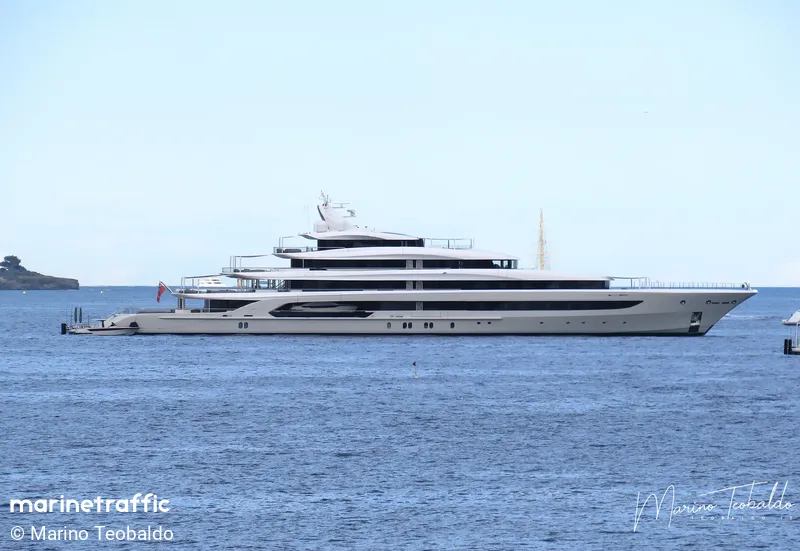
A vessel’s position is the boat’s, not the owner’s. Ownership is as reported, not certified.
Waleed bin Ibrahim Al Ibrahim owns H3, a 105-metre yacht that was stretched by Oceanco. The hull grew longer but the machinery stayed the same. This forces the heavier boat through the water at lower speeds.
H3 sits in the Adriatic Sea right now. She holds the Cayman Islands flag and George Town as her home port. The AIS data shows her moving slowly near the coast. Her top speed has dropped since she left the builder.
The owner is Waleed bin Ibrahim Al Ibrahim. He is a Saudi businessman who controls MBC Group. He bought the yacht in 2018 for €35 million. He paid to stretch the hull by ten metres. He kept the original engines.
This choice changed how the yacht moves. The new length adds weight. The old engines push with the same force. The result is a slower boat. The steel tells us why physics wins over budget.
What did Oceanco change about the hull?
The yard started with a ninety-five-metre underwater profile. They cut the hull and added ten metres. The total length is now one hundred five metres. The beam stays at fifteen metres. The gross tonnage rose to three thousand one hundred seventy-six.
Oceanco rebuilt the superstructure completely. Reymond Langton designed the new interior. The project code was 1050H. The yard launched the finished yacht on January twenty-fifth, two thousand twenty-three. They named her H3 after the owner's wife, Hana.
The hull form remained a displacement type. This shape pushes water aside rather than planing on top. A longer displacement hull needs more power to keep pace. The builders did not add that power.
The original design had a different ratio of length to beam. The new ratio stretches the hull further. This increases the waterline length. It also increases the wetted surface area. More surface means more drag in the water.
The yard assembled the original hull in Durban. They shipped it to the Netherlands for finishing. The same process applied to the refit. The steel came from South Africa again. The finishing work happened in Alblasserdam.
The ten-metre insertion preserves the original propulsion plant but suppresses top speed.
How do the engines handle the extra weight?
The yacht carries two MTU engines. Each engine produces ten thousand horsepower. They are twenty-cylinder units. These engines powered the original ninety-five-metre hull. They still power the one hundred five-metre hull.
The original design promised speeds up to twenty-four knots. That figure applied to the lighter hull. The new hull weighs significantly more. The same engines cannot reach that speed now.
AIS data confirms the slower performance. Recent tracks show average speeds around twelve knots. Maximum bursts reach fourteen knots. The machinery limit is clear in the broadcast data.
The engines run at high load to maintain speed. They consume more fuel per mile. The efficiency drops because the hull fights harder against the water. The driver feels this in the throttle response.
The conversion saved money on the main plant. Buying new engines costs millions. Keeping the old ones avoids that expense. The trade-off is visible in every nautical mile logged.
Who owned H3 before the refit?
Hamad bin Jassim bin Jaber Al Thani first owned the yacht. He called her Al Mirqab when she launched in two thousand. Indian businessman Vijay Mallya bought her in two thousand six. He renamed her Indian Empress.
Mallya faced legal trouble in two thousand seventeen. He was suspected of financial crimes. The yacht sat in Valletta, Malta. Court orders held her there. Crew salaries went unpaid.
The Maltese court auctioned the yacht in June two thousand eighteen. Credityacht Ltd won the bid for forty-three point five million euros. They failed to pay on time. The union accepted a short extension. Other creditors refused.
A second auction was scheduled for September. Credityacht was banned from bidding. Sea Beauty Yachting Limited made a private offer of thirty-five million euros. The court approved this deal instead. Credityacht had to pay the difference as a penalty.
The buyer represented an unnamed client. That client sold the yacht to Waleed bin Ibrahim Al Ibrahim in two thousand eighteen. He renamed her NEOM to promote a new city. He then sent her back to Oceanco.
Why did Waleed buy a troubled yacht?
Waleed bin Ibrahim Al Ibrahim controls MBC Group. The Saudi government bought sixty percent of the company in two thousand eighteen. Waleed kept his forty percent stake. He remained chairman of the board.
His wealth comes from family business deals. His brothers invested in real estate in the United States. They represented Boeing and Rolls-Royce in Saudi Arabia. Their fortune grew through these contracts.
Buying a distressed asset offered value. The price was fixed by the court sale. The refit cost extra but was controlled. The result was a custom yacht tailored to his taste.
The name change reflected personal priorities. NEOM was a corporate promotion. H3 honoured his wife. The identity shifted from brand building to private life.
He chose to keep the original engines. This decision defined the yacht's character. It prioritized budget over raw speed. The steel reflects that choice today.
What does the AIS track reveal?
The vessel moved from Cartagena to Gibraltar recently. She covered two hundred twenty-seven nautical miles. Her average speed was thirteen point seven knots. The maximum speed hit seventeen point one knots.
She sailed from Patras to Hydra in Greece. The distance was one hundred thirty-five nautical miles. The average speed dropped to ten point one knots. The max speed reached fifteen point eight knots.
These numbers match the engineering limits. The hull drags more than before. The engines struggle to push faster. The data proves the conversion impact.
The yacht is active and well-maintained. She travels across the Mediterranean regularly. The slow speed does not stop her from sailing. It just defines her range.
Oceanco delivered another superyacht in two thousand twenty-two. Jeff Bezos commissioned a larger vessel. H3 remains a unique case of stretched geometry. The record shows exactly what happens when you add length without adding power.
Reporting and data: CelebYachts, republished by On the record.
Sources
The numbers on this page point here. Each one links to the record it came from.
- 1