
 CelebYachts reportInvestigations
The thirty-two-metre constraint
A restricted hull sits off the American coast, maintained by an opaque chain of payments that the available records do not trace.
By On the record · Aug 14, 2026 · Data from CelebYachts1
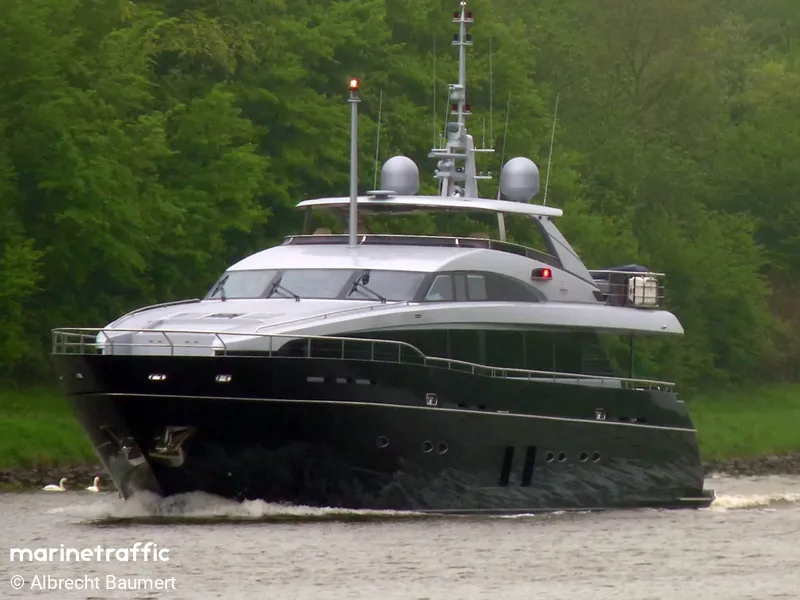
A vessel’s position is the boat’s, not the owner’s. Ownership is as reported, not certified.
Divina Barbara has not moved since October 2018. Her registration points to a Sanctioned owner, but the legal instrument that froze her assets is missing from the public file. The story here is not the seizure, which we cannot document, but the engineering reality of keeping a thirty-two-metre Princess afloat in international waters without a home port.
The regulatory file for this hull does not contain the primary listing; the authority, date, and instrument that triggered the restriction remain unrecorded in the available sources. Neither does it state who has been paying to maintain her or what physically happened to the vessel when she stopped broadcasting. Those gaps are permanent until new documents surface. What remains on the table is a thirty-two-metre motor yacht registered under a United Kingdom flag, built at a Plymouth shipyard, and sitting stationary in open water for more than five years.
The Plymouth footprint
Divina Barbara measures thirty-two metres in length with a beam of eight metres. The register lists Princess Yachts as the builder, though the entry carries an unverified tag and rests on a single source. The dimensions place her squarely within the operational envelope of the company's South Yard site. That facility was released by the Royal Navy in 2012 after centuries of naval use, and it currently handles vessels up to forty metres in length. A hull of this size requires different handling protocols than the ninety-five-metre super yachts that dominate press releases. The slipway, the dry-dock capacity, and the mooring infrastructure are all calibrated to a specific displacement range.
Princess Yachts operates across five sites in Plymouth covering over one point one million square feet. The New Port Street location has housed the head office since 1965. Lee Mill was collaboratively developed with naval architect Bernard Olesinski in the late nineteen seventies. Langage was constructed specifically for the company in 1989 and has expanded significantly since. Coypool was purchased in 1996. The South Yard occupies former HMNB Devonport land and retains historical structures including the East Ropery, built between seventeen sixty-three and seventeen seventy-one, and No One Dock, which began construction in sixteen ninety-two. These facilities process hundreds of vessels annually, but a thirty-two-metre project follows a distinct supply chain. The hull mould, the engine installation sequence, and the interior fit-out schedule are all dictated by the yard's throughput capacity rather than bespoke engineering constraints.
Gross tonnage is absent from the register, which means internal volume calculations rely entirely on length and beam. An eight-metre beam provides a specific stability curve and deck layout that differs markedly from narrower hulls of comparable length. The estimated value sits at eighteen million dollars, a figure that reflects depreciation rather than original build cost. Vessels of this age and category typically lose value rapidly once they leave active service, particularly when ownership becomes entangled in regulatory restrictions. The absence of a recorded home port removes local harbour master oversight, leaving maintenance schedules dependent on private agreements rather than municipal marina contracts.
The AIS silence
Automatic Identification System data shows Divina Barbara last transmitting on seventeen October 2018. The final coordinates place her at thirty degrees twenty-eight minutes north, thirty-five degrees fifty-three minutes west, roughly two hundred nautical miles east of the United States East Coast. The status field is null. She has not broadcast a position since that date. AIS transponders on luxury motor yachts are usually tied to the main electrical bus; when power is cut, the unit stops sending NMEA sentences within minutes. A complete silence lasting more than five years indicates either a deliberate shutdown of the transmitter, a catastrophic failure of the power distribution system, or a prolonged lay-up in a location where maritime authorities have not required active tracking.
Keeping a thirty-two-metre aluminium or steel hull stationary in saltwater for half a decade imposes specific physical demands. Corrosion protection systems require periodic inspection. Zinc anodes degrade and must be replaced. Fuel stabilisers break down and contaminate storage tanks. Battery banks suffer sulfation if left uncharged. Marine growth accelerates on underwater surfaces, increasing drag and requiring dry-docking for cleaning. The cost of maintaining these systems scales linearly with time, regardless of whether the vessel is moving. Private owners typically fund these expenses through offshore management companies, but the register contains no record of a chartering agent, a technical superintendent, or a maintenance contractor. The financial trail ends at the owner name.
The MMSI identifier 235096361 corresponds to a United Kingdom registration. British flagged vessels carry specific classification requirements under Lloyd's Register standards, even when operating outside territorial waters. Safety of Life at Sea conventions demand functional life-saving appliances, fire suppression systems, and communication equipment. None of these systems can remain certified while the vessel sits idle. Classification societies typically suspend certificates after extended periods without surveyor attendance. The practical result is a hull that exists in a legal grey zone: technically seaworthy by design, but operationally non-compliant due to lack of recent inspections. This status does not prevent anchorage, but it does prevent commercial chartering or insurance coverage.
The reporting threshold
Ownership on this site is reported, not certified. The register lists Eduard Khudainatov as the owner, placing the vessel in the second tier of Sanctioned and seized yachts. No net worth, citizenship, occupation, or birth date appears in the research files. The biography budget for this piece is zero paragraphs because the available data does not explain where the capital originated or what corporate structure holds the title. We can only report the name attached to the hull and the category assigned by our internal tracking system.
Regulatory listings operate on a binary principle: a vessel is either frozen by executive order or it is not. When the primary listing is missing, as it is here, we cannot quote the stated grounds, the issuing authority, or the effective date. Reporting agencies sometimes delay publication of sanctions pending diplomatic negotiations or asset recovery proceedings. In those cases, the hull continues to exist in limbo, maintained by third-party payers who absorb the cost of preservation while awaiting a court ruling. The absence of documentation does not mean the restriction is inactive; it means the paper trail has not reached the public domain.
The combination of a UK flag, an unverified builder tag, a null home port, and a five-year AIS silence creates a profile that matches long-term lay-up rather than active cruising. The engineering constraints of a thirty-two-metre Princess dictate specific maintenance intervals that private operators must fund continuously. The regulatory gap leaves those payments untraceable. The hull remains where it anchored in October 2018, sustained by capital that leaves no record, waiting for a document that may never appear.
Reporting and data: CelebYachts, republished by On the record.
Sources
The numbers on this page point here. Each one links to the record it came from.
- 1CelebYachtsCelebYachts: The thirty-two-metre constraint